


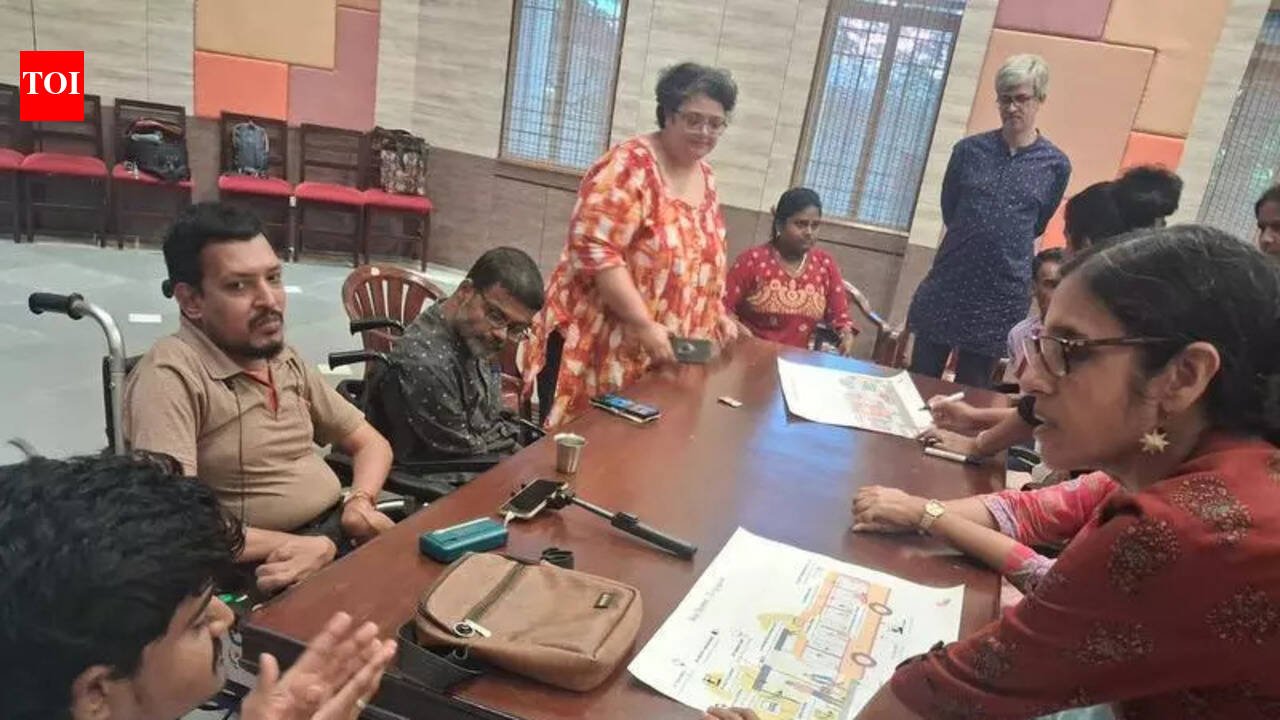
Chennai: Inaccessible footpaths, untrained public transport staff, unplanned constructions, and poor last-mile connectivity are among the top concerns on mobility faced by persons with disabilities (PwD) in the city.At a focus group discussion, organised by the citizen, consumer and civic action group (CAG) on Saturday, several persons with different types of disabilities shared their experiences and urged the govt to enable barrier-free mobility.“It is difficult to access something as basic as footpaths, with bulky bollards blocking our paths. Travelling in public transport is a hassle, especially in suburban and local trains. Once we get down, it is difficult for wheelchair users like me to get cabs to reach our destinations. Many times, we are charged high rates,” said K Anushya, a resident of Poonamallee.Rude attitude of public transport staff was a common concern flagged. “Even today, we have cases where conductors are ill-informed and charge us for wheelchairs we carry, which is against the law. In low-floor buses, conductors are not trained to help us board or alight from the buses, resulting in us falling and injuring ourselves,” said Rajeev, a PwD activist.The change must happen at the inception stage of an idea, construction, or a policy, said Sathish, a PwD activist. “In railway stations, the gap between the train and the platforms is dangerously wide enough for persons to pass through. Such errors must be rectified at the time of construction itself. As for roads, simple steps such as removal of low-hanging cable wires and construction of ramps will go a long way,” he added.The discussion was also aimed at collecting inputs from PwDs to prepare a report on mobility, said Nina Subramani, researcher, CAG. “We are currently studying how accessible public transport and public spaces are for commuters with disabilities. What stood out most was the dismal lack of continuous, accessible, and encroached footpaths, along with inadequate training for bus drivers and conductors. When people with disabilities can travel comfortably and independently, the city becomes safer and more accessible for everyone,” she told TOI.
