


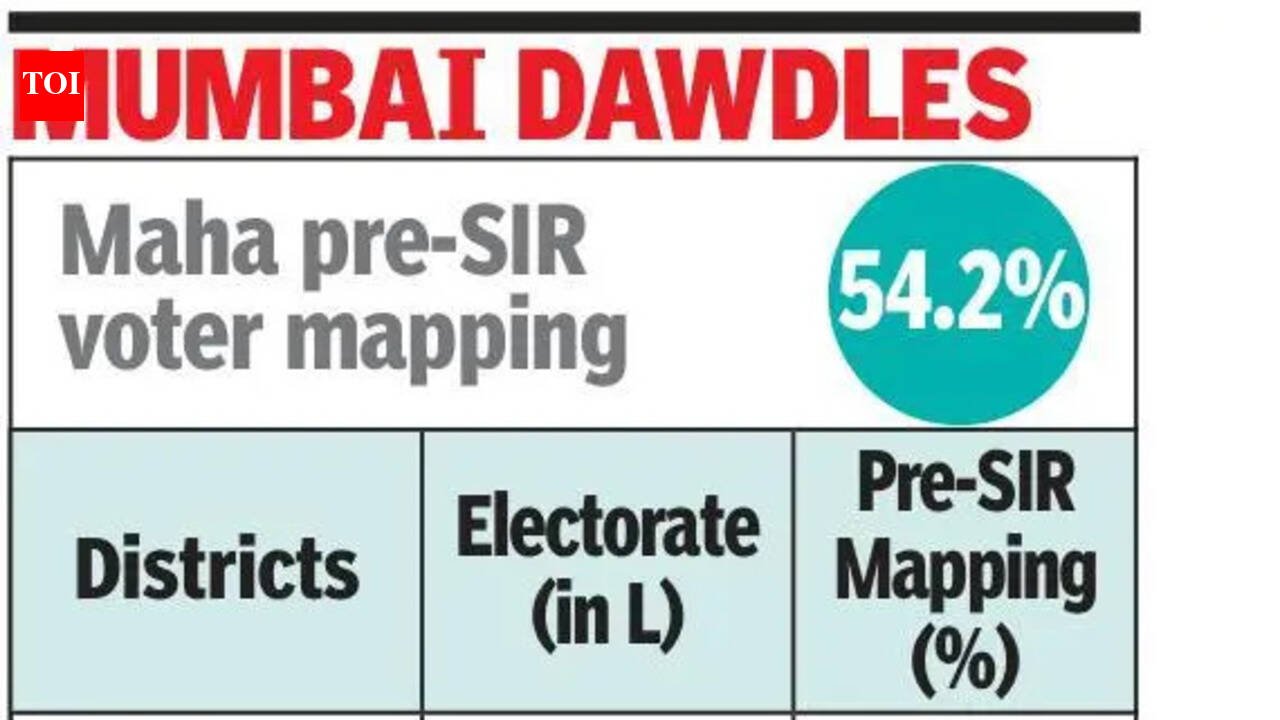
Nagpur: Maharashtra’s largest urban districts have emerged as the weakest links in the ongoing pre-special intensive revision (SIR) exercise, with key cities like Pune, Mumbai, Thane and Nagpur reporting some of the lowest coverage in state despite hosting a major chunk of state’s electorate. Official data shows while the statewide average stands at 54.15%, these urban centres are significantly behind, with Pune at 27.47%, Mumbai Suburban 28.35%, Thane 30.92%, Nagpur 34.49% and Mumbai City 39.36%.The trend is striking, given that these districts account for a substantial share of Maharashtra’s electorate. Pune has more than 91.5 lakh electors, followed by Mumbai suburban 78.3 lakh, Thane 75.1 lakh, Nagpur 46.4 lakh and Mumbai city with 25.72 lakh. Yet, the number of voters mapped so far remains proportionally low, pulling down the pace of the exercise.A senior official said frequent movement of people, within cities or to other locations, makes it difficult for booth level officers (BLOs) to trace voters. “In many cases, houses are found locked or occupants have moved out,” the official said.The situation calls for bolstering availability of BLOs. Of 4,610 BLOs assigned to Nagpur district, more than 1,000 were not on duty initially, affecting the early pace of the revision, an official said. While the number of absentee BLOs has reduced to 250, the initial gap slowed progress on ground. Apart from logistical and procedural issues, low public engagement in cities has also impacted progress. Field staff report that urban residents are often reluctant to cooperate or ask BLOs to return later.In contrast, Gadchiroli, once a Maoist-hit district and predominantly rural, has emerged among the top performers, recording 85.5% mapping — one of the highest in the state — continuing its trend of strong electoral participation seen in past voter turnouts.Other Vidarbha districts have also outpaced urban centres, with Buldhana at 80.9%, Amravati at 71.9%, Gondia at 71.2% and Chandrapur at 68.1%, reflecting more stable populations and better ground-level verification compared with cities.Officials indicated that improving BLO deployment, simplifying documentation requirements and increasing public awareness will be critical to accelerating coverage in urban Maharashtra.
