


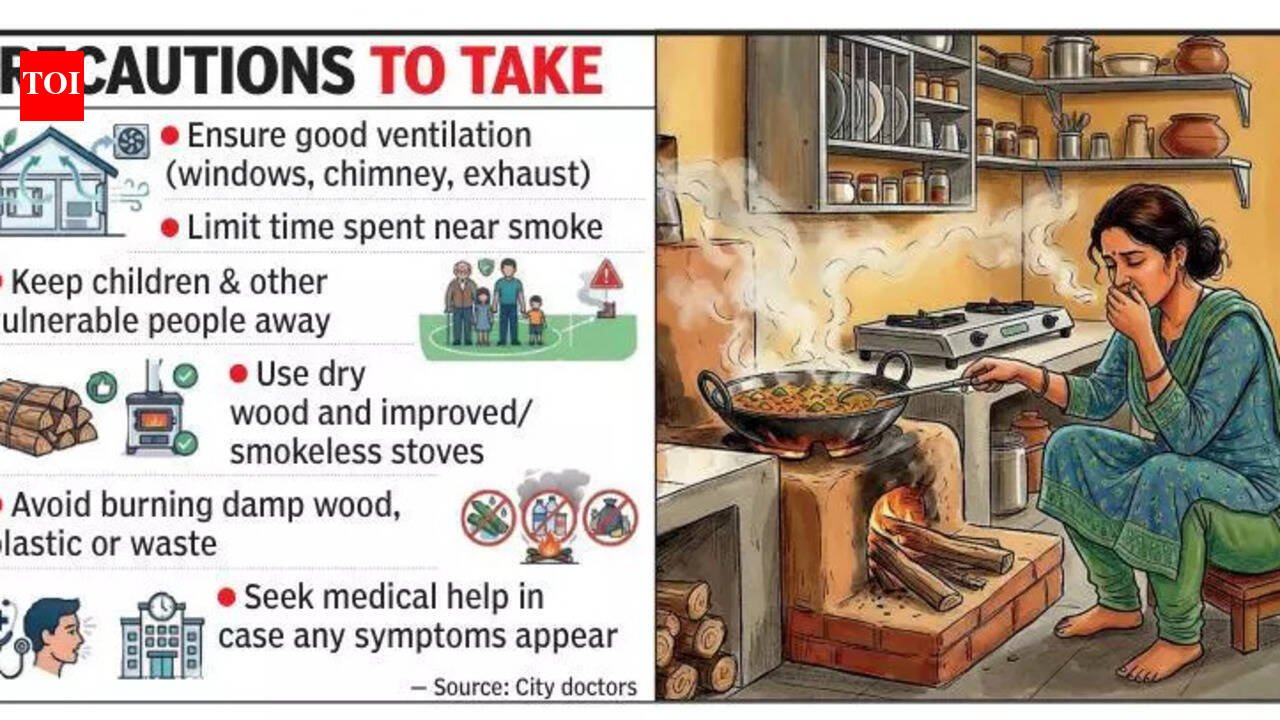
Bengaluru: Thinking of switching to cooking with firewood amidst the ongoing LPG crisis? It is a bad idea, warn clinicians, as exposure to fumes from firewood can have several short-term and long-term adverse impacts on health.Doctors say the renewed interest in firewood and other biomass fuels, driven by LPG supply disruptions and rising costs, risks reversing years of progress made in reducing household air pollution through a transition to cleaner fuels.“Whenever non-renewable material like charcoal or biomass such as firewood is burned, it releases harmful gases and poses a health hazard to the person who is cooking,” said Dr Satyanarayana Mysore, chairman, HOD & consultant, pulmonology, sleep medicine & lung transplant physician, Manipal Hospitals, Old Airport Road.He added that the risks go beyond emissions. “From soot deposition to worsening airway health parameters in people who are in the cooking area, biomass fuel leads to chronic obstructive airflow diseases, worsen asthma, and create instability in terms of allergic rhinitis or even upper airway resistance syndromes.”Echoing this, Dr Sachin D, consultant, clinical and interventional pulmonology, critical care and sleep disorders, Kauvery Hospitals, Electronics City, pointed to both immediate and long-term health effects. “Cooking with firewood emits a lot of smoke that contains particulate matter (PM2.5), carbon monoxide, and several other toxic gases. On inhalation, these can have both short-term and long-term impacts on overall health. Short-term effects may include a burning sensation in the eyes, throat, and sinuses, along with a cough, headache, and a feeling of nausea.”“In the long term, this exposure can significantly impact the lungs and lead to a gradual decline in lung function. It may begin to affect the air exchange process in the lungs and can result in conditions such as emphysema,” he said.Doctors also cautioned that the impact extends beyond individuals to entire households. “The home environment is also affected, and the impact is not just on individual health, but also a kind of collateral damage for the entire household, especially if the kitchen is poorly ventilated. Worst of all, if there are children whose lungs are still developing, they are particularly vulnerable,” said Dr Ravindra Mehta, interventional pulmonologist and founder & director, Vaayu Chest & Sleep Specialists.Bharathi AV, senior dietitian and HOD of nutrition & dietetics at Hosmat Hospital, Magrath Road, elaborated: “The perception that food cooked on firewood is healthier is common, but medically speaking, the food itself is not significantly ‘healthier’ simply because it is cooked on firewood. The perceived benefits are largely related to taste or traditional cooking methods rather than any proven nutritional superiority. In reality, the health risk lies in the smoke exposure during cooking, not in the food itself. While occasional use may not be harmful, regular exposure outweighs any perceived benefits of smoky or traditional preparation.”If firewood use is unavoidable, doctors recommend minimising exposure through better ventilation and safer cooking practices. Cooking in well-ventilated spaces, using chimneys or exhaust systems, and opting for improved or smokeless stoves can help reduce risks. However, clinicians caution that these measures offer only limited protection. “Very few effective precautions are feasible when cooking with open fuel sources such as firewood, coal, or kerosene,” Dr Ravindra noted.
