


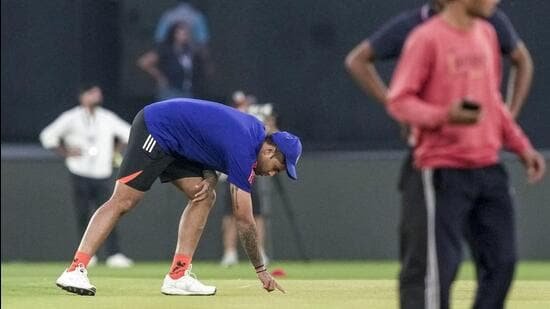
Ahmedabad: Underneath the hessian and tarpaulin lay a greenish-looking pitch, with a round of mowing yet to be done. India’s first Super 8 match against South Africa on Sunday will be played on the strip comprising a mixture of red and black soil. Adjoining the black soil pitch used for the India-Netherlands match which made batting hard work, the hybrid pitch could be relatively friendlier for the batters. A lot will also depend on weather conditions; a sharp difference in temperatures could bring the dew factor into play.
Pitches were central to conversations during the league phase, as stickier pitches made hitting boundaries difficult. For Indian batters accustomed to feasting on bowlers in the previous two bilateral series against South Africa and New Zealand, they have had to make adjustments.
Indian bowling coach Morne Morkel made it clear that batting according to conditions has been a conscious effort, especially after the collapse against the USA in the opening match where they were reduced to 77/6 before staging a recovery. In the following matches, even after a scrap in the middle overs, the two power hitters Shivam Dube and Hardik Pandya have been able to cover up and post competitive totals.
Abhishek bowls, has light batting net
In Friday’s practice session, Hardik and Surya spent considerable time trying to dig out yorkers from off-spinners coming round the wicket for sixes. Similarly, Abhishek Sharma combined with Axar Patel to challenge the right-handed batters with left-arm slow orthodox spin. The batters tried to condition themselves to facing spin from Aiden Markram, Keshav Maharaj and George Linde.
In focus due to his three successive failures, Abhishek didn’t bother to have a long batting net session. Lest it leads to complicating matters in his mind. Tilak Varma, who struggled against slow bowlers throughout the league phase, tried to bat more freely against the spinners.
Morkel suggested some of the tired wickets in play could be a result of a long domestic season, but they were happy to adjust. “It is so important that you have guys who can sum up the conditions quite well. The importance of that is to communicate what a par score is and the type of balls we want to bowl on the surface. I think so far this tournament we’ve done that really well with batting and bowling,” he said. “Barring the first game, I think it wasn’t a 200-plus surface, maybe a 170 surface, and we went out a little bit too hard at the start.”
While Ishan Kishan has covered up for Abhishek Sharma’s failure to fire at the top, Indian batters have felt the squeeze the most in the middle overs. Their scoring rate (7.55) has been poor and dot ball % (34.2) alarmingly high.
“You’re going to face different conditions, different challenges. Sometimes you’re going to have a crosswind, sometimes a good surface, sometimes tricky. That’s why at training we tell the guys that it’s not all about hitting 65 sixes,” Morkel said.
“I think it’s important to not just have tunnel vision and be one-dimensional—that We’re going to try and score 300 or 250 every game. Yes, the mindset is there to take the bowling on, But still have the smartness about how you’re going to construct and how you’re going to put a score on the board.”


