


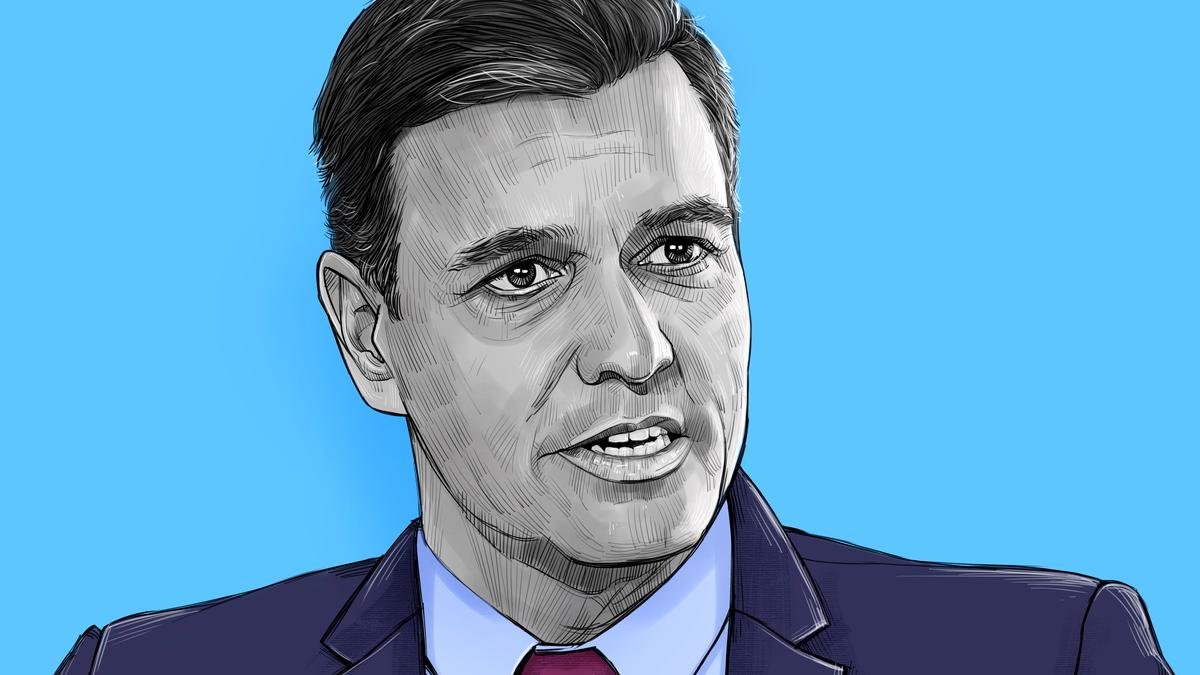
On March 4, Spain’s Prime Minister Pedro Sanchez delivered a televised address to the nation on “recent international events”. Days earlier, when his government had announced it will not allow the U.S. to use their military bases in Spain for strikes on Iran, President Donald Trump had reacted angrily, saying, “We’re going to cut off all trade with Spain. We don’t want anything to do with Spain.”
As the conservative Opposition leaders accused Mr. Sanchez, leader of the Spanish Socialist Workers’ Party (PSOE), of jeopardising Spain’s relations with the U.S. for petty political gains, he doubled down. In a 10-minute speech that resonated across Europe, Mr. Sanchez characterised the war on Iran as a violation of international law, becoming the only European head of government to publicly reject the war on principle.
Mr. Sanchez, 54, elaborated on his anti-war stance in the form of three ‘no’s. “First, no to the breakdown of international law that protects us all, especially the most vulnerable, civilian population; second, no to assuming that the world can only solve its problems through conflict, through bombs; and finally, no to repeating the mistakes of the past” — a call back to the 2003 Iraq war which had been extremely unpopular in Spain. His government’s position, he said, can be summed up in four words: ‘No a la guerra’, or ‘no to war’. ‘No a la guerra’ quickly became a ‘war cry’ for thousands of anti-war protesters, adorning placards and banners as they organised demonstrations and marches across Spain.
It was clear from the beginning that the U.S./Israel-initiated war on Iran had no upside for Europe. It promised only energy shocks and economic setbacks. But Europe’s political establishment, committed to a strategy of placating and flattering Mr. Trump, would not take him on. And then, Mr. Sanchez did.
Many have questioned the motives behind Mr. Sanchez’s adversarial position, which he has justified on ethical grounds. They have suggested it is rather driven by self-serving pragmatism. After all, he is on his third term as Prime Minister. He runs a fragile coalition government with the support of smaller left-wing parties and regional allies, including Catalan separatists. He has been losing regional elections. He has not got a budget passed in years. And elections are due in 2027. With barely a year left in his premiership, what better way to shore up his support base, please his allies, and put the pro-war Opposition on the mat than to take on the cartoonishly villainous persona of Trump? It would also distract the public from the corruption allegations against his wife — allegations he claims were cooked up by right-wing operatives to harass him.
There may be merit in this argument. As the first politician in Spain’s history to oust a sitting Prime Minister through a no-confidence motion, there is no doubt Mr. Sanchez is a savvy political operator. Yet, if it was such an easy political win to increase your popularity by confronting Mr. Trump, why have not his European counterparts done it? Contrast Sanchez’s words — “We will not be complicit in something that is bad for the world and that is also contrary to our values and interests, simply out of fear of reprisals from someone” — with those spoken by the head of Europe’s most powerful economy, German Chancellor Friedrich Merz, who said, “Categorising the events [in Iran] under international law will have relatively little effect. Therefore, this is not the time to lecture our partners and allies.”
Standing up to Trump and Israel
Pragmatism is a part of the explanation, not all of it. Mr. Sanchez had defied Mr. Trump before as well, when he rejected his diktat that European NATO members should raise their military spending to 5% of national GDP. He secured an exemption for Spain, stating it would spend only 2.1%. The reason: spending more would not be possible without raising taxes on the middle classes and cutting welfare budgets. He is also the only European head of government to describe Israeli atrocities in Gaza as “genocide”. He has barred Spanish ports and air space from being used for ferrying weapons to the Israeli war machine. He rejected Mr. Trump’s Gaza reconstruction plans on the grounds that it lacked Palestinian input. Unlike a few other European states that mildly pushed back against Mr. Trump’s claims on Greenland but endorsed his actions against Venezuela, Mr. Sanchez’s foreign policy positions — be it Greenland, Venezuela, Gaza, Lebanon or Cuba — have been consistent with the principle that international law must be the basis for conflict resolution. Even his refusal to let Spain serve as a launch pad for strikes on Iran had a legal basis, with the Defence Minister stating that “our understanding of the deal [regarding use of these bases] is that operations have to comply with international legal frameworks”.
Mr. Sanchez’s most startling departure from the rest of Europe, and also the West as whole, is his policy on immigration. While every other social democrat leader in Europe feels compelled to assuage anti-immigrant sentiment by raising barriers to illegal immigration, Mr. Sanchez has been aggressively pro-immigrant. In January, his government rolled out a programme to “regularise” half a million undocumented immigrants by giving them work and residency permits. He explained his rationale in an op-ed in the New York Times, titled, “I’m the Prime Minister of Spain. This is why the West Needs Migrants”. In an obvious reference to Mr. Trump, he wrote: “Some leaders have chosen to hunt them down and deport them through operations that are both unlawful and cruel. My government has chosen a different way: a fast and simple path to regularise their immigration status.” He explained the economic benefits of being an “open” rather than closed society, pointing out that mitigating labour shortages through migrants have enabled Spain to become the fastest growing large economy of Europe, increase workers’ purchasing power, and lower poverty and inequality levels.
Good politics
Mr. Sanchez’s positions – his anti-war stance, pro-immigrant policies, raising the minimum salary – could be understood through a moral or ideological lens. But they are more usefully read as “good politics’, defined not in the narrow sense of prolonging your hold on power but broadly understood as delivering on the promises that made people vote you to power. What sets him apart from other European social democrats, especially someone like U.K. Prime Minister Keir Starmer, is that he believes in stubbornly embracing social democratic policies instead of junking or diluting them once in power.
Born in 1972 in Madrid to a civil servant couple, Mr. Sanchez joined the PSOE in 1993, picking up a doctorate in economics along the way as he swiftly climbed the party ranks, becoming the secretary-general in 2014. He led the party to two back-to-back defeats before finally becoming Prime Minister in 2018, a post he has held since.
In rejecting Mr. Trump’s war-related demands, Mr. Sanchez likely calculated there was little risk of economic blowback against Spain since it traded with the U.S. as part of the EU bloc. Regardless of his political motivations, Mr. Sanchez has not only shown up the hypocrisy of other Western leaders but also demonstrated that it is both possible and politically rewarding to stand up to the bully and walk the talk on ‘European’ values.
Published – March 29, 2026 02:03 am IST
