
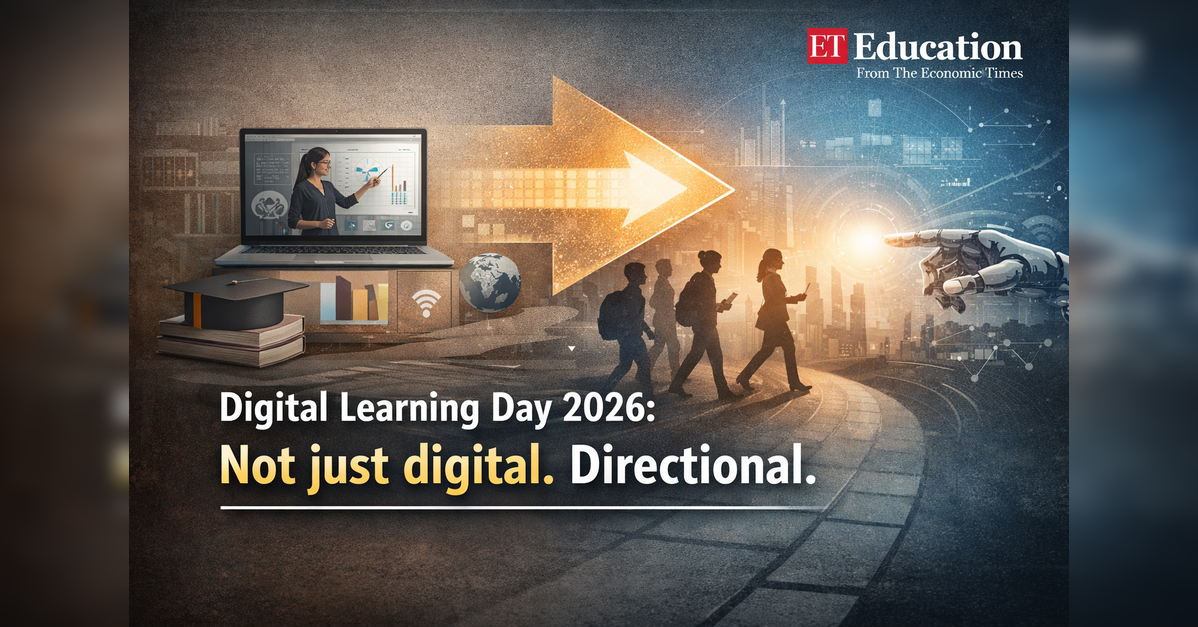
On Digital Learning Day, the conversation is no longer about whether technology belongs in education. It is about how deeply, how ethically, and how intelligently it is being woven into the learning experience.
Classrooms are no longer confined to four walls. They stretch across devices, data dashboards, discussion boards and digital labs. But Digital Learning Day is not about celebrating screens. It is about recognising a deeper transformation. Education in India is moving from uniform delivery to personalised journeys, from passive instruction to active engagement, and from access for a few to opportunity for many. Artificial intelligence is shaping individual learning pathways. Data is informing pedagogy. Simulations are replacing static diagrams. High-quality education is no longer determined solely by geography.
This moment demands not just adoption, but reflection. Not just infrastructure, but intention.
“The illiterate of the 21st century will not be those who cannot read and write, but those who cannot learn, unlearn, and relearn.”
– Futurist Alvin Toffler
That sentiment feels more urgent than ever.
To mark Digital Learning Day, ETEducation reached out to leading voices across India’s education landscape to understand how digital learning is shaping the future. What emerges is not a story about devices. It is a story about access, inclusion, employability, confidence and courage.
Rethinking pedagogy in a digital age
At the forefront of management education, Prof Himanshu Rai, Director, IIM Indore, captures the structural shift underway:
“Digital learning is fundamentally reshaping education by extending access, deepening engagement, and enabling more personalized, data-informed instruction. When strategically designed, digital tools support differentiated learning, strengthen critical thinking, and promote collaboration across disciplines and geographies. Rather than serving as an end in themselves, technologies function best as enablers of sound pedagogy, helping educators adapt to diverse learner needs, support continuous feedback, and prepare students with the digital, analytical, and ethical competencies required in an increasingly complex global society.”
Building on the idea of purposeful integration, access and equity emerge as defining pillars of this transformation. Shishir Jaipuria, Chairman, Jaipuria Group of Educational Institutions, underscores the democratizing force of AI-powered platforms:
“Digital learning is transforming the way education is accessed and experienced. AI integration in digital learning is particularly emerging as a force-multiplier in creating personalised learning pathways and empowering teachers with tools to delegate non-teaching tasks to technology and focus more on pedagogy delivery. Most importantly, digital learning is proving to be a powerful means for equity in education by taking unprecedented opportunities of learning to rural and under-served regions. When guided with purpose, technology can be a great boon.”
Blending tradition with transformation
Digital progress does not mean abandoning identity. Dr Vinita S Sahay, Director, IIM Bodh Gaya, highlights how innovation can coexist with ethos:
“At IIM Bodh Gaya, digital learning blends Indian ethos with global management thinking through case-based pedagogy, analytics-driven insights, and industry-connected classrooms. Reflecting industry’s shift toward data, technology, and sustainability, this approach empowers diverse learners to become inclusive, agile, and responsible leaders in India’s digital-first economy.”
At the foundational level, the implications are even more significant. Prof Manoj Singh Gaur, Director, IIT Jammu, draws attention to scale, inclusion and responsibility:
“Digital learning, augmented by AI, is redefining learning and skilling with personalised tools, assessment practices, and access. The emerging platforms will strengthen foundational literacy and numeracy (FLN) and will address learning gaps at scale. Key challenges include teacher readiness, infrastructure, and data privacy. With a focus on responsible, inclusive, and outcome-driven AI/ML use will enable customised solutions for present and future challenges.”
Equity, access and employability
For higher education institutions striving to bridge divides, digital learning is an equaliser. Dr CA Achyut Dani, Director General & Provost, JG University, reflects:
“Digital learning is a powerful equalizer, advancing accessible, inclusive, and affordable education. By connecting urban India with rural Bharat, it dissolves barriers of geography and privilege. Universities must integrate digital innovation with pedagogy to scale excellence, equity, and employability – shaping confident citizens for India’s knowledge-driven future.”
The reach of digital platforms also reshapes scale and logistics. Dr Vikram Singh, Former Director General of Police, UP and Chancellor, Noida International University, observes:
“Digital education is a blessing and revolution both!
This has made education convenient, affordable and accessible. Coupled with distance education it has made remarkable progress in spreading quality education for one and all.This comes at an affordable cost, with manageable logistics and more importantly,at the convenience of the teacher and the taught. The tutorials can be replicated, complex issues can be explained with greater clarity by 3D animations, bullet points and graphics.
Indeed a win-win situation for all stakeholders to make India Viksit Bharat in 2047!”
Looking ahead, employability and skills take centre stage. Pravesh Dudani, Founder and Chancellor, Medhavi Skills University, reframes the future in economic terms:
“Digital learning is democratising access across Bharat, shifting India from degrees to demand-driven skills through simulations, internships, and industry projects. The future is competency and employability at scale. Education will be measured by skills mastered and livelihoods created, not time spent. This is Skillonomics- turning India’s demographic potential into productive power.”
Human confidence in a digital world
At the school level, the human dimension remains powerful. Dr Sunita Gandhi, Chief Academic Advisor, City Montessori School, reminds us that confidence is the real transformation:
“A child who once hesitated to raise her hand finds her voice through a digital discussion space. This is the real promise of digital learning, not screens, but confidence. When technology meets thoughtful teaching, and real-world experiences, learning becomes more inclusive, personal, and deeply empowering.”
That confidence must translate into preparedness. Piyush Singh Chauhan, Vice Chairman, SR Group of Institutions, notes:
“Digital learning is no longer an alternative, it is the backbone of future ready education. When technology is blended with strong pedagogy, it democratizes access, personalises learning, and nurtures critical thinking. The goal is not just digital classrooms, but digitally empowered minds prepared for a rapidly evolving world.”
For global competitiveness and lifelong relevance, Maj Gen BD Wadhwa Retd, AVSM and Pro Chancellor Emeritus, IILM University, sees boundless opportunity:
“Digital learning is redefining education by making classrooms borderless, adaptive, and skill-driven. Through AI tools, virtual simulations, and personalized platforms, learners gain real-time feedback, industry exposure, and lifelong learning habits – preparing them not just for jobs, but for continuous innovation in a rapidly changing world.”
The end of one-size-fits-all
And perhaps the boldest challenge comes from Nitish Jain, President, SP Jain School of Global Management, who questions the very structure of higher education:
“Every student wants a different job. Most get the same degree. That made sense when teaching was manual. It doesn’t now.
Digital learning lets us map education to individual careers, not mass-produce graduates. The fintech analyst needs different training than the sustainability consultant. Why teach them identically? At SP Jain Global, we’re using AI to build each student’s path around their actual career goal; not around our curriculum convenience.
Digital Learning Day should mark the end of one-size-fits-all education. The technology exists. The question is whether institutions are willing to stop treating students like batches and start treating them like individuals with different destinations.”
A reckoning, not a ritual
Digital Learning Day is not a celebration of devices. It is a reckoning.
The tools are here. The platforms are scalable. The intelligence is artificial, but the responsibility is profoundly human.
The real question is no longer whether digital learning can transform education.
It is whether institutions are ready to transform themselves.
The future is not waiting. It is already logged in.
