


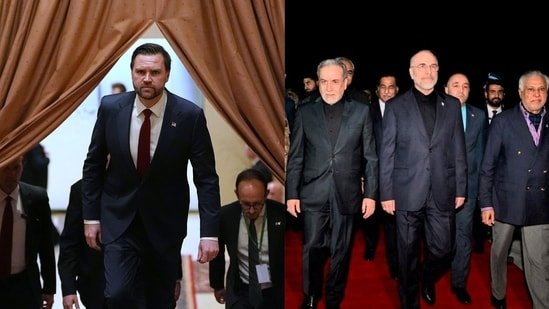
Peace talks between the US and Iran stalled in the early hours of Sunday without any conclusion, with uncertainty surrounding what happens next as the fragile two-week truce ends by April 22.

US Vice President J D Vance said talks fell flat after Iran chose “not to accept” the terms put forth by the US. The primary issue between both sides is Iran’s nuclear programme. US President Donald Trump has since issued new threats against Iran.
Iran had also laid out some key demands ahead of the talks, including financial compensation for damage caused by US-Israeli strikes, a halt to all regional hostilities against proxy groups, and sovereignty over the Strait of Hormuz. Iran has denied it is enriching uranium for a nuclear bomb; it’s for power-generation purpose, it has maintained.
But what now?
Pak says will try again
Pakistan’s foreign minister Ishaq Dar has said his country will try to facilitate a new round of dialogue between Iran and US in the coming days, the Associated Press reported.
“It is imperative that the parties continue to uphold their commitment to ceasefire,” Dar said.
However, there has been no indication regarding this from both sides.
While Vance said the lack of agreement was “bad news for Iran much more than it’s bad for the United States of America”, Iranian parliament speaker Mohammad Bagher Ghalibaf has signalled that Iran lacks trust in the US.
Vance was leading the delegation from the US, while Ghalibaf was Iran’s chief negotiator in Islamabad.
On Strait of Hormuz ‘blockade’
Meanwhile, Trump said the US Navy would “immediately” begin a blockade to stop ships from entering or leaving the Strait of Hormuz. The reopening of and free navigation in the strait has been a sticking point between both countries.
Looking to take back strategic control over the waterway, Trump said he has instructed the US Navy to “seek and interdict every vessel in International Waters that has paid a toll to Iran.”
“No one who pays an illegal toll will have safe passage on the high seas,” he said, seeking to take away Tehran’s economic leverage in the conflict. Trump also said that America was ready to “finish up” Iran at the “appropriate moment”.
Iran open to dialogue, but…
Iran’s state-run news agency IRNA reported that Tehran was open to continuing the dialogue. However, there has been no word officially on whether the talks will resume again.
Following the talks, Ghalibaf siganlled that Iran would not relent on its position.
“We have never sought war. But if they try to win what they failed to win on the battlefield through talks, that’s absolutely unacceptable,” he said.
However, Vance has described the issues which Iran has refused to budge on as “red lines” for Trump. “We need to see an affirmative commitment that they will not seek a nuclear weapon, and they will not seek the tools that would enable them to quickly achieve a nuclear weapon,” Vance said.
Neither side has indicated what will happen after the 14-day ceasefire expires.
