
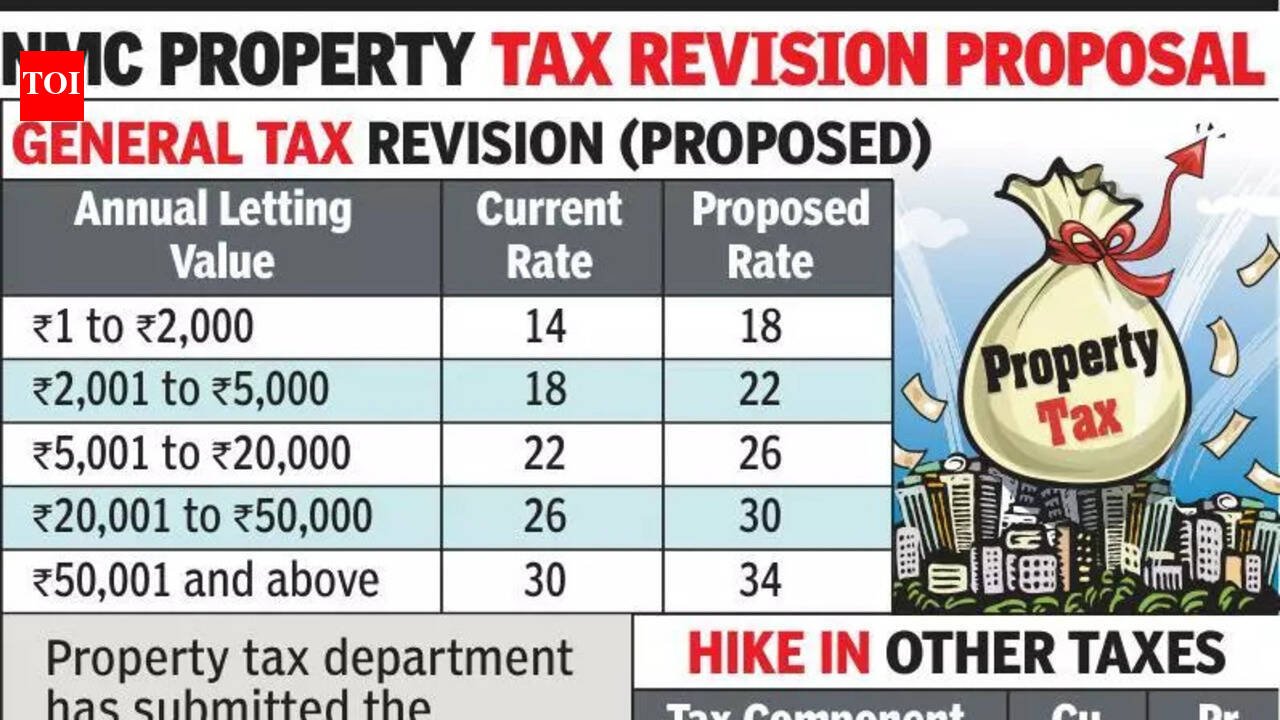
Nagpur: After nearly a decade of status quo, the Nagpur Municipal Corporation’s property tax department proposed a 4% increase in general tax across all five slabs, along with a hike in five other levies from 1% to 2%. The proposal, pitched as a fiscal corrective, is now awaiting approval from municipal commissioner Abhijeet Chaudhari.The NMC levies property tax on the basis of annual letting value which is calculated by multiplying the net built-up area (in sqm) with prevailing base rental rate of the locality. After arriving at this base figure, various weightage factors are applied depending on the property’s characteristics such as structural category (premium, good, or ordinary construction with respective multipliers such as 1.25, 1 or 0.8), usage factor (residential, commercial, etc), and age factor of the building. If cleared, the revision will be routed through the standing committee and placed before the general body for final approval, with implementation likely from the next financial year. The move is being justified as necessary to shore up revenues, as property tax remains the civic body’s primary internal income source, funding essential services including roads, water supply, sanitation, and fire protection.What makes the proposal politically intriguing is the timing — and past inaction. Between March 2022 and Jan 2026, the NMC functioned without an elected general body, giving the administrator full powers under the Maharashtra Municipal Corporation Act to take key fiscal decisions. Despite this window of administrative control, the tax revision proposal did not move forward. Senior officials confirm that similar proposals were submitted during this period but did not receive the green signal.Now, with BJP retaining power for a fourth consecutive NMC term, the chances of a tax hike appear uncertain. While there is no immediate election pressure, political observers say it is unlikely that a ruling party with a renewed mandate would risk public dissatisfaction by approving a property tax increase early in its term.NMC last revised property tax rates in 2015. Since then, operational costs, infrastructure demands, and salary expenditures rose steadily. Officials privately admit that Nagpur’s property tax rates are lower compared to several other municipal corporations, limiting revenue mobilisation potential.Yet, governance is often as much about optics as arithmetic. A tax revision, though fiscally prudent, may be politically inconvenient. As the civic budget is likely to be presented later this month, all eyes will be on whether the long-pending proposal finally finds traction — or once again remains confined to files, reflecting a familiar hesitation to balance the books at the cost of voter sentiment.
