


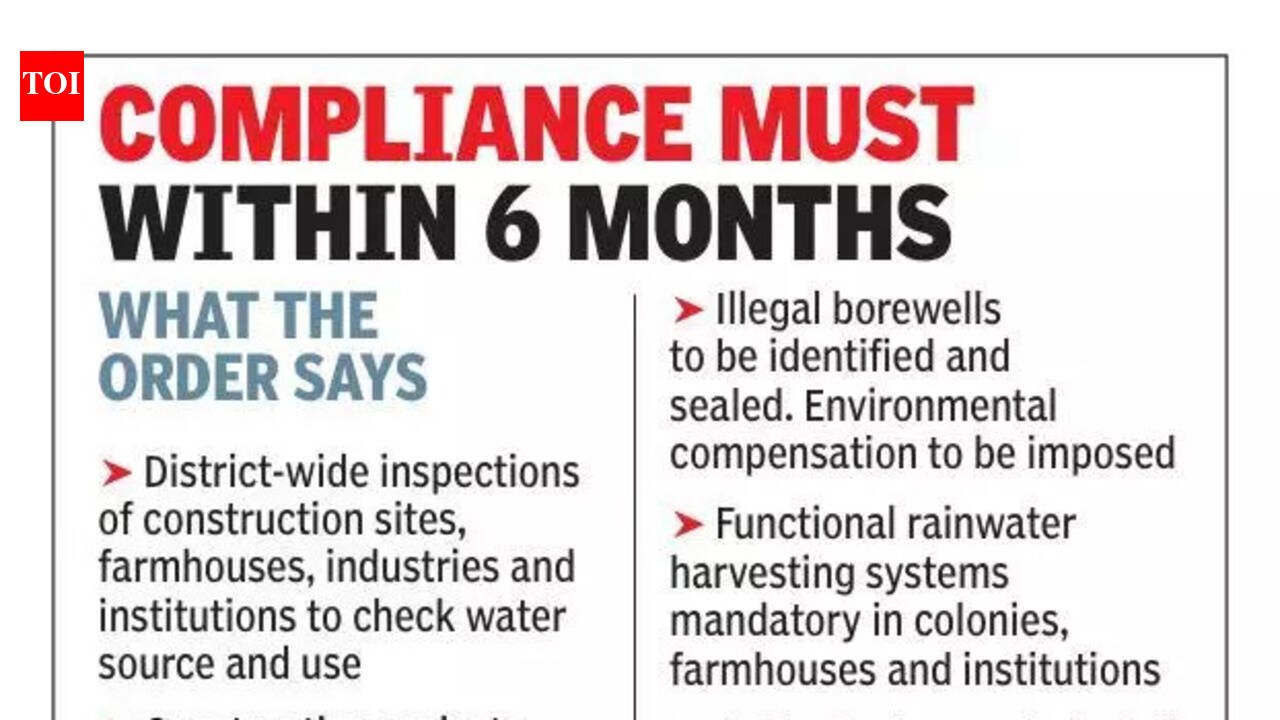
Gurgaon: National Green Tribunal (NGT) slammed Haryana govt for not acting against rampant illegal extraction of groundwater in the city and ordered an inspection of construction sites, farmhouses, industrial units, educational institutions and pharma units to check if they are illegally drawing groundwater. The data by National Compilation on Dynamic Groundwater Resources shows the city extracted groundwater over twice its permissible limit in 2023 and 2024. NGT also said all colonies and institutions must maintain functional rainwater harvesting systems, illegal borewells must be sealed and legal users must be monitored through piezometers. It gave the state govt six months to complete the entire process. The tribunal took suo motu cognisance of a TOI report — Gurgaon a Groundwater Dark Zone, But Extraction Over 2 Times the Limit — published on Aug 5, 2025. NGT’s principal bench observed that official replies filed by multiple departments were heavy on plans and claims, but light on enforcement. The tribunal has given govt authorities a slew of instructions, including inspection drives, supplying water treated by sewage treatment plants (STP), carrying out sealing drives and imposing environmental compensation, to tackle the problem at the earliest. The tribunal stated in its Feb 10 order, “None of the above replies reflects the effective action by authorities at the ground level to check the unauthorised withdrawal of groundwater by different entities and project proponents”. The order was passed by the bench comprising Prakash Shrivastava (chairperson) and Dr A Senthil Vel (expert member). Referring to the TOI report, the bench observed that it “clearly mentioned unauthorised and illegal extraction of groundwater by entities like builders, industries, educational institutions, pharmacy firms, residential societies.” It said authorities were now required to take “effective action at the ground level” against each category. NGT directed a district-wide inspection drive, beginning with construction sites, farmhouses, industries, educational institutions, pharmaceutical firms and public institutions. “The respondent authorities will inspect each of the construction sites in Gurgaon and ascertain the quantity and source of water used,” the order said, adding that all project proponents must be shifted to STP-treated water. It also made govt responsible for supplying treated STP water to construction projects free of cost. The tribunal also noted that large-scale extraction happens at farmhouses for gardening and horticulture purposes. “These farm houses (must) utilise STP-treated water for such purposes,” the bench said. It stressed that residential colonies, farmhouses and institutional areas must have “effectively operating rainwater harvesting systems” in place. For non-potable uses, the bench made its position clear, stating “use of STP-treated water instead of extracting the groundwater be ensured and encouraged” for activities such as car washing, vehicle servicing and dust mitigation, where water does not come into human contact. NGT directed Haryana Water Resources Authority to inspect all construction sites and farmhouses to identify illegally operating borewells. “Wherever illegal borewells are operating, apart from sealing, environmental compensation shall also be imposed by the PCB,” the order said, directing that details be shared with the Haryana State Pollution Control Board for penal action. Even legal users of groundwater will now face tighter monitoring. The tribunal ordered that piezometers be installed wherever groundwater extraction is permitted, so that usage can be measured and charged accordingly. The entire exercise must be completed within six months, with each respondent directed to file a separate action taken report before the tribunal. The bench kept the door open to re-list the matter if compliance is found wanting. In 2024, the city extracted 212% of its permissible annual groundwater limit — more than double the amount that can be used, according to National Compilation on Dynamic Groundwater Resources of India. This was 195% in 2025.
