


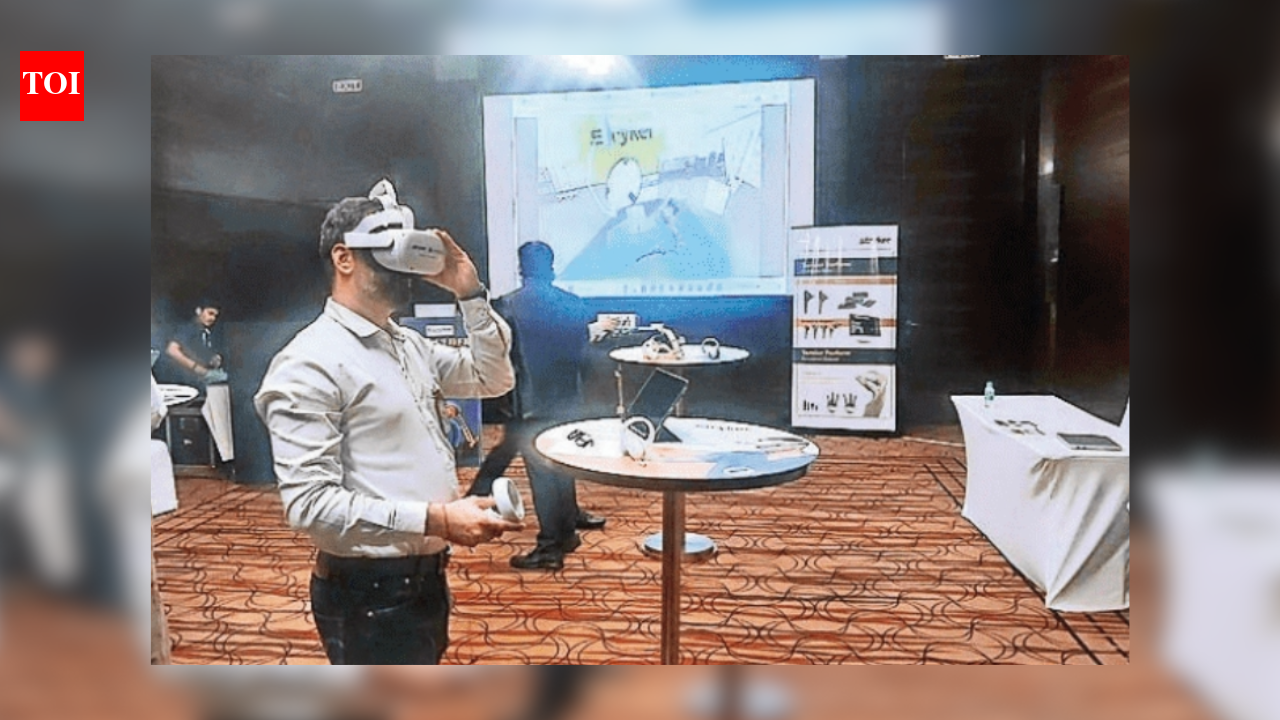
PUNE: It is the beginning of a new era for orthopaedic surgeons who are looking at VR headsets and AI to plan their shoulder surgeries. Shoulder surgeries, which are on the rise, according to doctors, are tricky because of high mobility of the joint.Over 300 shoulder surgeons, including more than 50 from abroad, converged in Pune on Friday for a two-day conference to check out the latest VR-based surgical simulation platform. The platform allows doctors to enter a shared virtual operating room, practise shoulder surgery on 3D patient models and learn techniques from global experts.Dr Ashish Babhulkar said the VR Meta Quest headset,originally designed for gaming, is being used in a lateral application for surgical training. Developers in Canada adapted complex surgeries onto the device so surgeons can train on a virtual 3D model without harming patients.“Multiple users can log in, practise the procedure, return to it repeatedly, and refine their skills. Patient safety remains paramount, and the platform also reduces surgical time. The same virtual system can be used for knee, hip and other surgeries. The VR platform also enables real-time mentoring. Using another headset, a surgeon can join remotely, demonstrate instrument handling, correct techniques, and guide procedures interactively,” he said.“Surgeons can perform anentire virtual surgery at home without an operation theatre or patient. Additional surgical scenarios can be incorporated into the system, though they require optimisation and coordination with the developers, aprocess that takes a few days,” Dr Babhulkar said.“Already the surgeons have started using an AI-powered pre-operative planning system which utilises CT scans of patients uploaded by thedoctor to analyse bone deformities, calculates implant size and alignment, and generate multiple surgical design simulations so that doctors can look at the pros and cons of each design before choosing the best for their patient, eliminating the guesswork in OTs,” Dr Babhulkar said.Dr Vedant Shah from Rajkot in Gujarat said the conference was first conceptualised in 2003 by Dr Babhulkar as a basic instructional workshop.“Over the years, it has evolved into a comprehensive academic platform that now attracts faculty from all six continents. What began with foundational teaching now covers both basic and highly complex surgical cases. Such conferences allow us to meet legendary doctors, and interact directly with them. The platform also encourages a discussion of complicated cases and direct interaction with international faculty. These exchanges provide participants with a broader perspective on their own methods and decision-making processes,” Dr Shah said.Dr John Joseph from Kottayam in Kerala said technologies like VR bridge the gap between merely watching a surgery and actually performing one. For many participants, like Dr Sanjay Shyam Deo, professor of orthopaedics, Symbiosis University Hospital, Pune, it was their first hands-on exposure. With 30 years of experience, Dr Deo said such systems are particularly useful for understanding the technical aspects of a procedure.
