


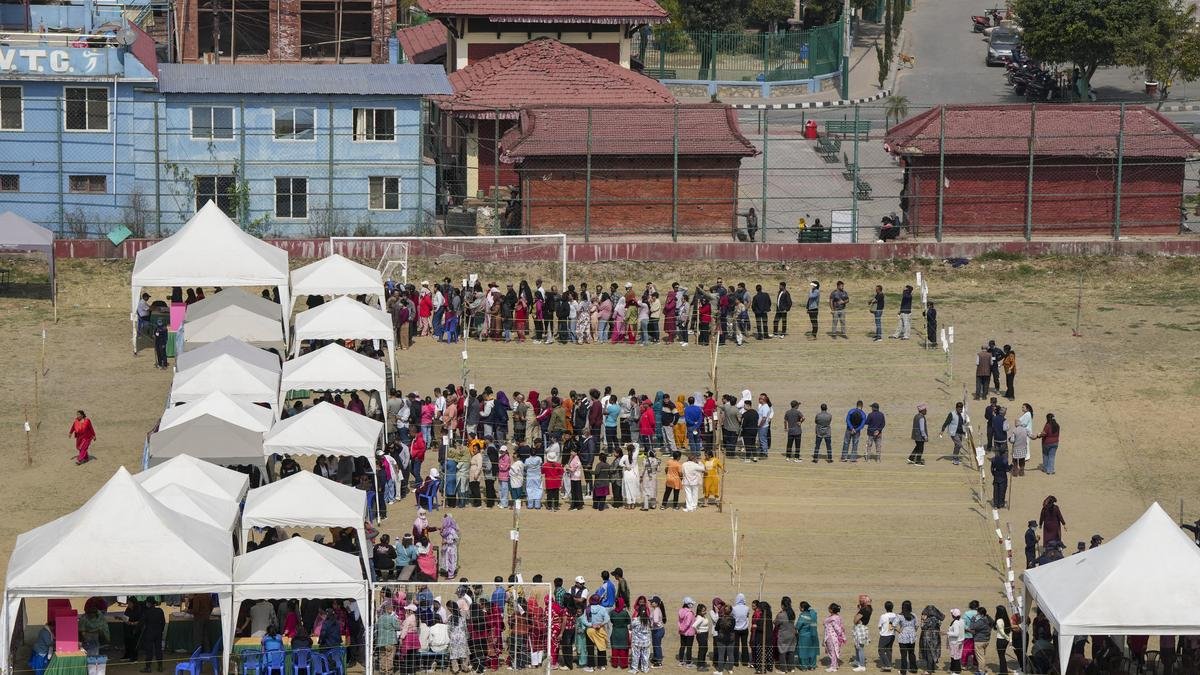
“The beauty of democracy is people’s participation. I would like to urge all voters to reach their polling booths and cast their ballots,” wrote Nepal Prime Minister Sushila Karki on Thursday (March 5, 2026) morning on X, as polling began across the country in what she called “a defining moment” for Nepal.
Earlier, Ms. Karki cast her vote in Dhapasi, Kathmandu, and thanked election officers and security personnel for conducting the first election since last September’s ‘Gen Z protests’, which claimed 77 lives. On September 8, 2025, the first day of the protests, police firing killed 19 young protesters.
The election is expected to restore constitutional order and bring the democratic process back on track. Though it will take time for the results to come in, a majority for any single party is unlikely. Many fear Nepal could return to the familiar cycle of coalition governments, which may stall efforts to meet the protesters’ demands for an end to corruption, clean governance, and accountability.
As Nepalis wait for the results, political calculations have begun.
Post-poll scenario
The Rastriya Swatantra Party (RSP) is seen as the frontrunner but is unlikely to reach the 138-seat threshold in the 275-member House of Representatives needed to form a majority government. The nearest contender could be the Nepali Congress (NC), Nepal’s grand old party in power since 1990. If the RSP’s momentum falters, the balance could shift.
The Communist Party of Nepal (Unified Marxist-Leninist), led by K.P. Sharma Oli, is expected to lose ground. Mr. Oli, 74, was Prime Minister during the protests.
Former mayor and rapper Balendra Shah at a polling booth before casting his vote in Kathmandu on March 5, 2026.
| Photo Credit:
ANI
The Nepali Communist Party, a coalition of fringe Left groups formed by Maoist leader Pushpa Kamal Dahal after the protests, is projected to have a modest showing.
Since psephology is not practised in Nepal and pre-poll surveys are prohibited by the Election Commission, predicting outcomes is difficult. Government formation in the coming days, however, is going to be tricky.
If the RSP emerges as the single largest party, senior leader Balendra Shah, a former Kathmandu mayor and a hugely popular but polarising figure, is slated to become Prime Minister. But whose support will he rely on?
The NC, likely to finish second, may not be keen to form a coalition with the RSP. Such a partnership — where the largest and second-largest parties govern together — has already been tried, with underwhelming outcomes. In July 2024, the NC, which was the largest party in the dissolved House, had joined hands with Mr. Oli’s UML, then the second-largest party. That government fell in September.
Will the RSP turn to Mr. Oli’s UML and will he agree? Mr. Shah’s leadership will mark a personal and unceremonious defeat. The tensions still remain as the RSP leader had called Mr. Oli a “murderer” after the protests.
Alternatively, could the RSP seek support from Mr. Dahal? The 71-year-old former Maoist leader was often the kingmaker in Nepali politics. Despite his party finishing third in the 2022 elections with just 32 seats, he managed to lead the government until July 2024 by switching sides between the UML and NC. Mr. Dahal would boast that he had the “magic number” and the ability to make or break governments, keeping both larger parties on edge. With his party’s poll prospects now weak, whether his support alone could help the RSP form a government remains unclear, meaning smaller parties may also need to be roped in.
If the RSP fails to form a government, the NC may have to step in. Would the NC then partner with the UML? An NC-UML coalition would essentially recreate the government that fell in September, albeit with NC’s newly elected president Gagan Thapa at the helm. Regardless of Mr. Oli’s personal outcome, UML is expected to remain under his influence, limiting Mr. Thapa’s ability to deliver reforms.
Mr. Thapa himself may not be enthusiastic about having Mr. Oli as his alliance partner, aware that such a coalition could hurt more than help. Would he instead turn to Mr. Dahal, known more as a source of instability than a stabilising force in Nepali politics?
Ground reports indicate that Mr. Oli, who previously won with one of the largest margins, faces stiff competition from Mr. Shah. If neither the RSP nor NC succeed in forming a coalition, will the UML step forward to lead? Could Mr. Oli and Mr. Dahal join forces again?
If they do, with support from smaller parties, the duo — representing Nepal’s ageing political elite and a history of patronage-driven governance — could return to power.
The question remains: what real change, the rallying cry of the youth movement, will Nepal see then? Will “the defining moment” elude the Nepalis again?
Published – March 05, 2026 05:05 pm IST
