


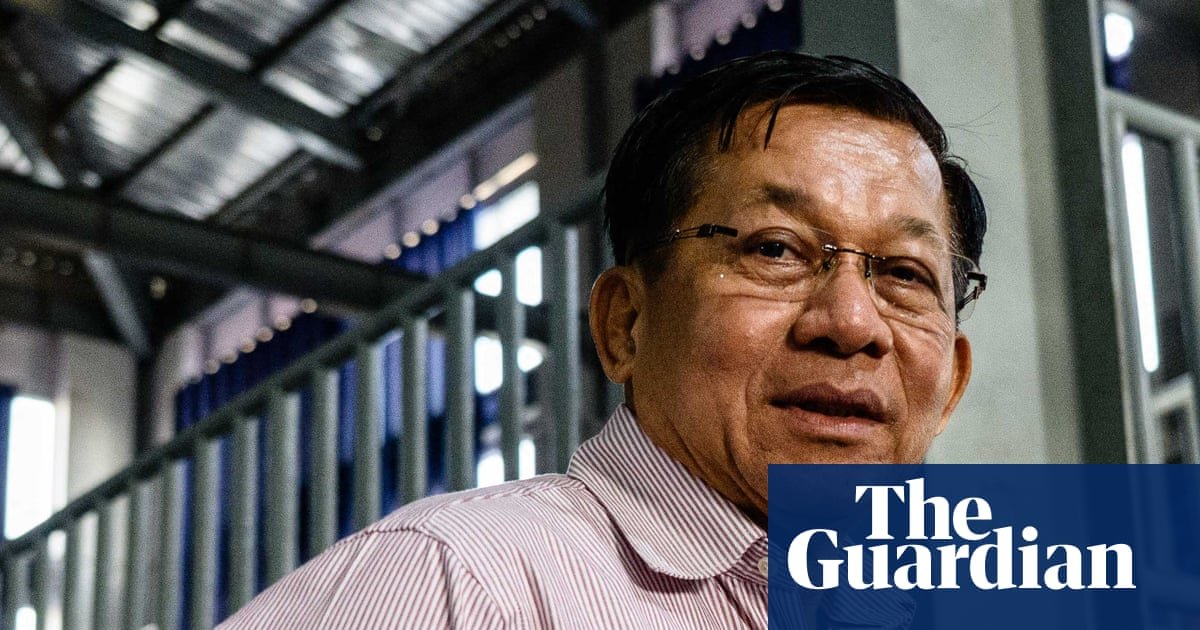
Min Aung Hlaing, the military general who plunged Myanmar into conflict and economic chaos when he took power in the 2021 coup has been appointed president, months after widely condemned sham elections.
Min Aung Hlaing, who is wanted by the prosecutor of the international criminal court for crimes against humanity against the Rohingya Muslim minority, was voted president by lawmakers on Friday. Myanmar’s parliament is dominated by the pro-military party, which won a landslide in one-sided elections earlier this year.
Min Aung Hlaing has long sought the role, say analysts, but for years his ambitions were thwarted by the electoral success of the hugely popular Aung San Suu Kyi.
The former de facto leader no longer poses a threat, however. The 80-year-old has been detained since the 2021 coup, when her government was ousted from power. Her party was banned from contesting recent elections, which were held across three phases from December to January.
The election, which the military’s proxy Union Solidarity and Development party (USDP) won by a landslide, was widely condemned as a sham that sought to give a veneer of legitimacy to military rule. It is not expected that the changes in leadership will ease the political crisis or the deadly conflict that continues to rage across the country.
Min Aung Hlaing was already Myanmar’s acting president, and it is likely he will install loyalists in key positions, said International Crisis Group in recent analysis.
“He will not trust anybody [enough] to take orders from [them] – he would want to deliver the orders,” said Yanghee Lee, a former special rapporteur for Myanmar, who added that Min Aung Hlaing is seen as a paranoid, suspicious person.
The general, 69, was born into a family from Dawei, in south east of Myanmar. He studied law at university in Yangon, but longed to join the military and on his third attempt was admitted to the Defence Services Academy, the country’s elite institution for training officers.
Myanmar’s military has been likened to a state within a state, siloed from the rest of society with its own banks, companies, news outlets and hospitals. It considers itself the protector of Myanmar as a Buddhist Bamar nation– Bamar referring to the majority ethnic group.
He was appointed commander-in-chief in 2011, but assumed the role at a time when Myanmar was embarking on a fragile transition to democracy.
The military remained extremely powerful during this period, even after Aung San Suu Kyi won a sweeping victory in 2015. Under the military’s model of “disciplined democracy”, it was granted a quarter of parliamentary seats, and the power to appoint key cabinet positions.
The uneasy power-sharing arrangement broke down after the 2020 election, which Aung San Suu Kyi’s NLD again won by a landslide. Min Aung Hlaing accused her party of widespread voter fraud, without evidence, and seized power on 1 February 2021. The coup triggered mass protests that spiralled into a civil war.
Min Aung Hlaing has been accused of presiding over repeated atrocities and human rights abuses. In 2009, while overseeing operations in border areas of the north-east, his troops were accused of driving tens of thousands of ethnic minority people from their homes. Such brutality would be repeated on an even greater scale in violence against the Rohingya Muslim minority in Rakhine state in 2017, which is now the centre of a genocide case at The Hague.
Since the coup, UN investigators have accused Min Aung Haling’s regime of indiscriminate airstrikes killing civilians, “mass killings of detainees, dismemberment and desecration of bodies, rape and the deliberate burning of entire villages”, describing such crimes as “a manifestation of an organisational policy”.
Myanmar has denied the accusations of genocide, and the military says its post-coup operations are targeted at terrorists it accuses of destabilising the country.
In recent months, Min Aung Hlaing had stepped up his international trips, attempting to clamber back from his status as an international pariah.
His diplomatic style has been mocked by his critics – particularly a visit to Moscow last year, when, while heaping praise on Vladimir Putin, he said the friendship between Myanmar and Russia had been prophesied by the Buddha thousands of years ago when the Russian president was a “rat king” in a previous life. It is not clear if Putin understood the obscure reference.
Richard Horsey, a senior Myanmar adviser to Crisis Group, said the junta leader presented himself as a politician rather than a “soldier’s soldier”, and even in the midst of a post-coup fight was often photographed inspecting infrastructure and factories, rather than visiting the frontlines. “It’s well known that he’s long coveted the presidency,” Horsey added.
Min Aung Hlaing is also a deeply superstitious figure and keen to present himself as devoutly religious, added Horsey. He has frequently commissioned and renovated pagodas and religious sites, including a huge Buddha statue in the capital Nay Pyi Taw.
“I don’t think he sees that as [being in] contradiction with his role as a brutal leader,” said Horsey.
At home, Min Aung Hlaing is unable to travel to large areas of Myanmar that have been seized by opposition groups or are in the midst of fighting.
However, with backing from his ally China, the junta chief probably hopes the recent election will allow him to reverse his isolated status abroad and reassure pro-military voices who have criticised his failure to suppress opposition since the coup.
