


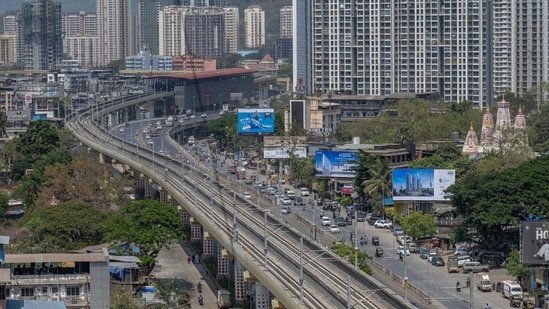
Mumbai marked a key milestone in its urban transit journey as Devendra Fadnavis on April 7 inaugurated Phase 1 of Metro Line 9, connecting Dahisar East to Kashigaon and extending the network to Mira Bhayandar in Thane district and Line 2B which will run from Mandale to Chembur.
The enhanced connectivity is expected to give a fillip to the financial capital’s real estate markets, making these locations more attractive to both end-users and investors. Areas once considered peripheral are now emerging as new hubs for residential and commercial development, according to real estate experts.

With regular services on both the lines set to start from April 8, the financial capital of the country will have six operational Metro lines.
In a first for the city, a metro corridor has extended beyond municipal limits into Mira Road. The launch of Metro Line 9 Phase 1 (Dahisar East to Mira Road), along with Phase 1 of Metro Line 2B between Mandale and Diamond Garden in Chembur, is set to reduce commute time.
Real estate experts believe that enhanced connectivity will have a direct impact on housing demand, particularly in peripheral micro-markets. Areas such as Mira Road, Dahisar and Chembur are likely to witness increased interest from homebuyers seeking relatively affordable options with improved access to key business districts.
Reduced travel time is expected to make these locations more attractive to both end users and investors. With infrastructure development acting as a key catalyst, developers may also accelerate project launches along these corridors to tap into rising demand, real estate experts said.
Metro Line 9, running from Dahisar East to Kashigaon in Mira-Bhayandar, marks the first metro corridor in the Thane district. Meanwhile, Metro Line 2B connects Mandale to Diamond Garden (Phase 1), extending metro access to key Harbour Line areas, including Chembur and nearby localities.
Mumbai Metro lines and impact on the real estate market
According to real estate experts, the commencement of operations of two new Metro lines will have a substantial impact on real estate.
“The impact of the Mandale–Diamond Garden stretch of Mumbai Metro Line 2B (Phase 1), spanning over 5.3–5.5 km with 5 stations, on real estate is substantial because it brings first-time metro connectivity to parts of eastern Mumbai like the Chembur–Mankhurd belt,” they said.
Also Read: Mumbai Metro Line 3: MMRC makes approval mandatory for redevelopment or construction within 50 m
As per ANAROCK data trends, the areas that have been positively impacted by the entire Mumbai Metro 2B (Andheri-Mandala) over the years include Andheri, Goregaon, Jogeshwari, Vile Parle, Santacruz, BKC, Kurla, Sion, Chembur, Govandi, and Mankhurd, among others, said Rajkumar Singh, Senior Executive Director – Residential Sales (West), ANAROCK Group, a real estate consultancy.
As per ANAROCK Research, prices in a few of these micro-markets rose by 26 per cent to 32 per cent in Q1 2026 compared to 2022. Chembur has seen the highest 32 per cent rise in the said period. The areas positively impacted by the Metro 9 project include Dahisar, Mira Road and Bhayandar. As per ANAROCK Research, average residential prices in these areas have increased by 25% to 37% between 2022 and Q1 2026.
According to ANAROCK research, in Chembur, prices rose from ₹24,700 in 2022 to ₹32,500 in Q1 2026, marking an increase of 32 per cent. Andheri saw values climb from ₹28,200 to ₹36,700 during the same period, reflecting a 30 per cent rise, while Goregaon witnessed a similar 30 per cent growth, with prices moving from ₹26,800 to ₹34,900.
In premium locations such as Bandra, residential capital values increased from ₹44,950 in 2022 to ₹56,500 in Q1 2026, registering a 26 per cent appreciation. Meanwhile, Thane recorded the highest growth among the listed markets, with prices rising from ₹14,150 to ₹20,300, translating into a 43 per cent increase, ANAROCK research showed.
According to the research, in Bhayandar, prices increased from ₹12,500 in 2022 to ₹16,950 in Q1 2026, reflecting a 36 per cent rise. Mira Road recorded a similar upward trend, with values moving from ₹14,000 to ₹19,200, marking a 37 per cent increase.
Dahisar saw comparatively moderate growth, with residential values rising from ₹19,500 in 2022 to ₹24,350 in Q1 2026, translating into a 25 per cent increase, the research showed.
This is what real estate developers have to say
“The Metro expansion and infrastructure push are redefining how Mumbai and its suburbs live and move. Enhanced last-mile connectivity and reduced travel times are making the Mira-Bhayandar micro-markets far more attractive for homebuyers and investors. Areas once considered peripheral are now emerging as new hubs for residential and commercial activity,” said real estate developer Purvesh Sarnaik (Director) of Vihang Ahead.
“As commute times shrink and accessibility improves, we are witnessing a clear uptick in interest from both end-users and investors looking to capitalise on this infrastructure-led growth. This will not only boost commercial and residential demand but also accelerate the overall development of these regions into self-sustained urban hubs,” Sarnaik said.
With this, Mumbai now ranks second in the country after Delhi in terms of metro network with more than 100 km of operational metro lines. The financial capital now has six operational metro corridors including Metro Line 1 (Ghatkopar-Andheri-Versova), Line 2A (Andheri West-Dahisar East), Line 7 (Dahisar East and Andheri East) and Line 3, known as Aqua Line (Colaba-Bandra Kurla Complex-SEEPZ).
