


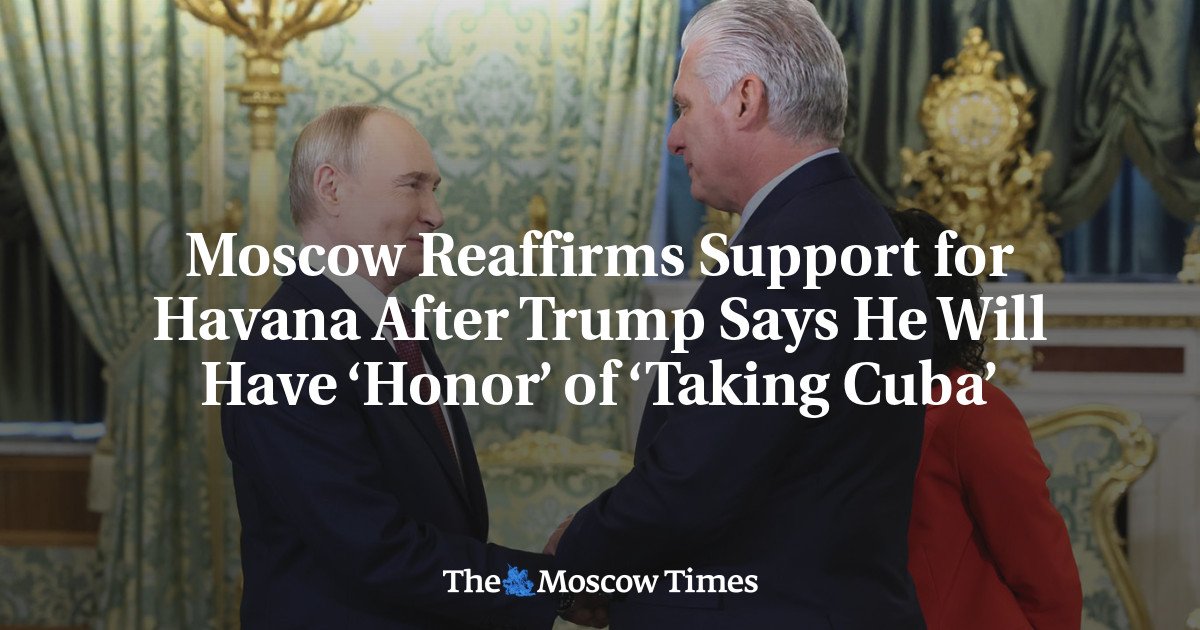
The Kremlin said Tuesday that Moscow remains committed to helping authorities in Havana after U.S. President Donald Trump claimed he could do “anything I want” with Cuba after a U.S.-imposed oil blockade plunged the island nation into darkness.
“Of course, we are ready to provide all possible assistance, and all these issues are being worked out with our Cuban counterparts,” Kremlin spokesman Dmitry Peskov told reporters during a daily briefing.
He said Moscow and Havana are maintaining “expert and working levels” of contact during the energy crisis.
President Vladimir Putin’s press secretary spoke after Trump on Monday said he believes he would have the “honor of taking Cuba,” which plunged into darkness under a total power blackout linked to the oil embargo.
“Whether I free it, take it, I think I could do anything I want with it… They’re a very weakened nation right now,” Trump told reporters at the White House.
The blackout on Monday resulted from a “complete shutdown of the national grid,” Cuban energy officials said, adding that work had begun to restore power.
Peskov, whose country is seeking to revive economic ties with the United States under Trump, avoided directly criticizing the U.S. president over Cuba’s economic crisis.
“Cuba is an independent sovereign state that faces major economic difficulties due to the suffocating embargo imposed on the country. Significant humanitarian problems are developing there,” the Kremlin spokesman said.
Last week, Cuba confirmed it has opened talks with the U.S. government, which is demanding major political and economic reform in the country.
Russia’s Embassy in Havana previously promised to send oil and other petroleum products to Cuba as humanitarian aid. There is still no indication of Russian oil having reached Cuba, with no imports recorded on the island since Jan. 9.
Cuba, which imports around 60% of its energy supply, previously relied on oil sold by Venezuela. Those shipments ended after then-President Nicolás Maduro was captured in a U.S. military raid.
Even before, the Caribbean island of around 9.6 million people had faced rolling blackouts amid its most serious economic crisis since the 1991 collapse of the Soviet Union, its former principal benefactor.
Cuba has been allied with Russia since its 1960s socialist revolution, relying on the Soviet Union for economic and political support for decades. The Kremlin has maintained close relations with the Caribbean island after the U.S.S.R. collapsed.
