


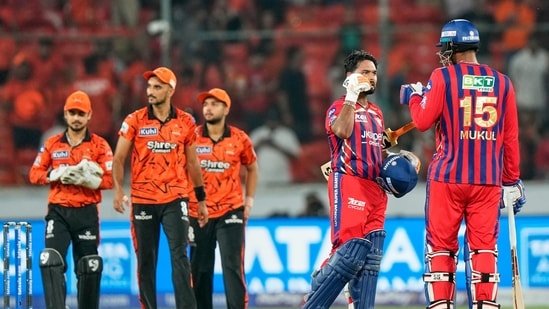
Sunrisers Hyderabad’s defeat to Lucknow Super Giants was not just about the top-order collapse. It was about how completely LSG took control of the match’s shape. They did not merely pick up wickets early; they shut down SRH’s scoring engine, forced a middle-overs rebuild, and then chased with far more clarity and lower risk than the home side managed across 20 overs.
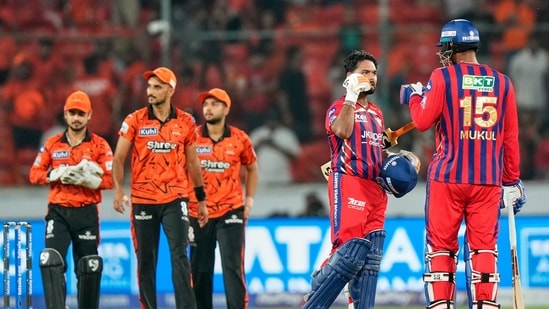
That is what made this such a significant result. SRH are a side built to overwhelm attacks, especially in the first six overs. Instead, LSG turned them into a team fighting for survival almost immediately and never really let go of that control.
LSG’s powerplay bowling broke SRH’s identity
The biggest reason LSG won was the way they attacked SRH in the first six overs. SRH finished the powerplay on just 22/3, scoring at only 3.67 per over. For a batting unit that has been framed around explosive starts and boundary-heavy aggression, that was the single biggest phase swing of the night.
The damage was not just in wickets, but in inactivity. SRH played 25 dot balls in the powerplay, a dot-ball percentage of 67.6. That meant they were barely rotating strike, let alone building pressure on the bowlers. In a format where powerplay scoring often dictates the rest of the innings, LSG forced SRH into a kind of innings they are not designed to play.
The score progression made the squeeze even clearer. SRH slipped to 1/1, then 8/2, then 11/3. At that point, the innings was no longer about maximising 20 overs. It became a rescue mission.
Mohammed Shami was central to that squeeze, conceding only 7 runs in 19 balls while taking two wickets in the powerplay. Prince Yadav added another crucial breakthrough while giving away only one run in his first over. LSG did not just strike; they made scoring feel unavailable.
LSG’s length control denied SRH easy release shots
The quality of LSG’s new-ball execution is even clearer when the lengths are broken down. Against SRH in the powerplay, good-length balls brought just 8 runs from 19 balls and produced 14 dots. Full balls produced only 13 runs from 15 balls and also fetched three wickets.
That is a hugely important detail. LSG were not offering predictable short balls to be pulled or easy half-volleys to be driven cleanly. They kept SRH stuck between attacking options, forcing mistimed strokes and indecision.
The line data strengthens that reading. Balls outside off yielded only 2 runs from 9 deliveries and one wicket. On middle, SRH managed just 2 runs from 8 balls, with seven dots. Even on off-stump, where batters often access scoring areas more naturally, LSG still kept SRH to 11 runs from 13 balls while taking two wickets.
This was not random collapse material. It was highly controlled bowling that targeted SRH’s preferred launch zones and disrupted the tempo of the innings.
Klaasen and Nitish repaired the damage, but SRH never completed the recovery
To SRH’s credit, Heinrich Klaasen and Nitish Kumar Reddy did give them a route back into the game. From 26/4, SRH added 116 runs in 64 balls before the fifth wicket fell. That partnership phase ran at 10.88 per over, which is more in line with the kind of batting SRH want to produce.
Klaasen made 62 off 42, while Nitish made 56 off 34. Without them, this would have been a far more lopsided result. But the problem for SRH was that the recovery came from too deep a hole.
Even more damaging was the finish. After reaching 142/4, SRH ended on 156/9. That means they lost five wickets for just 14 runs at the back end. So the middle-order rescue never got the death-overs payoff needed to transform the innings into something truly threatening.
That final collapse left LSG chasing a total that was competitive only if SRH produced an equally dominant bowling start. They did not.
LSG chased with the safer scoring model
The chase underlined the difference in batting method between the two teams. SRH hit 11 fours and 8 sixes, but also played 49 dot balls. LSG, in contrast, hit 20 fours and only 2 sixes, while reducing their dot-ball count to 37.
That tells the story of a chase built on control rather than bursts. LSG did not need to force six-hitting phases because they kept accessing lower-risk scoring options far more regularly. Their boundary profile was more stable, and their innings had fewer stalls.
Rishabh Pant’s 68 off 50 fitted that context. It was not an all-out assault, but it did not need to be. Aiden Markram’s 45 off 27 gave LSG early shape, and after that, they never really lost command of the required pace. Their wickets also fell at manageable intervals rather than in a destructive cluster.
In the end, that was the difference between the sides. SRH played from crisis after the first over. LSG controlled both the pressure and the tempo. That is why they won, and why the margin felt more convincing than the score alone suggests.
