


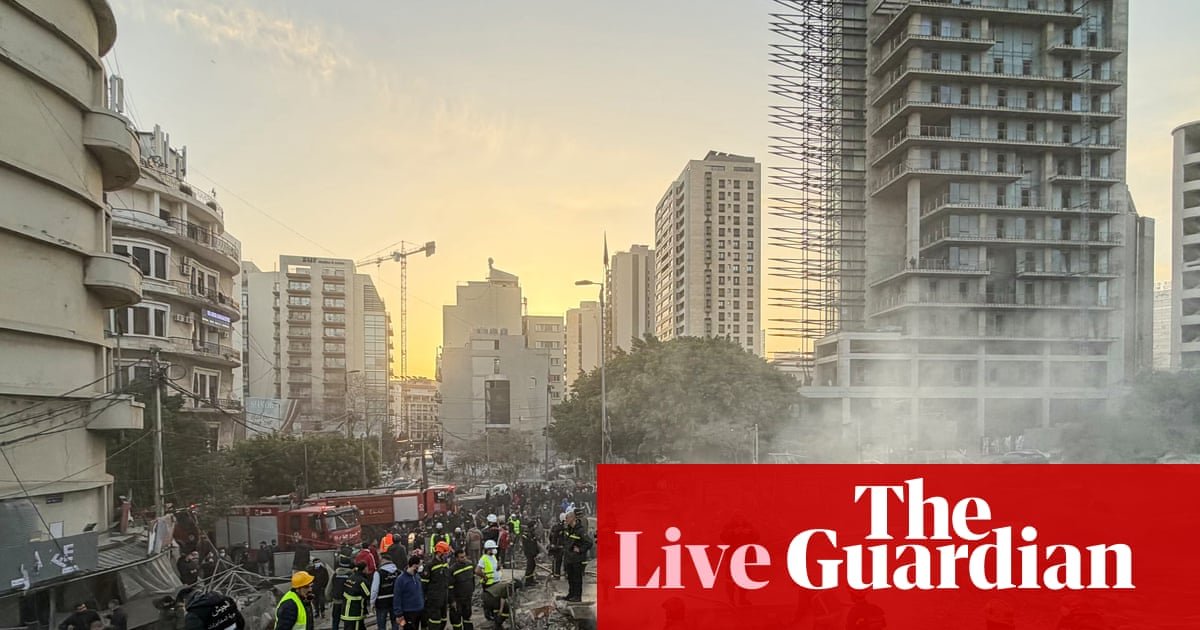
Israel strike on Iranian gas field coordinated with US – report
Israel’s strike against Iran’s South Pars gas field was coordinated with and approved by the Trump administration, the American news website Axios reported, citing two senior Israeli officials.
The report says a US defence official also confirmed the claim.
The offshore gas field in the Persian Gulf, which Iran shares with Qatar, is the largest such facility in the world. Qatar’s foreign ministry spokesman, Majed Al Ansari, described the targeting of the field — an extension of Qatar’s North Field — as a “dangerous and irresponsible step”.
Key events
Jillian Ambrose
Iran has threatened to attack energy infrastructure across the Gulf region in retaliation for Israeli strikes on its largest gasfield, marking the first targeted attacks on its fossil fuel production since the war began.
Iran’s Revolutionary Guards have threatened counterstrikes on several energy facilities across Saudi Arabia, the UAE and Qatar “in the coming hours” after state media reports that missiles had targeted its gas facilities at the giant South Pars field, the largest gas reserves in the world.
The strikes on Iran’s South Pars gasfield, which it shares with Qatar, were widely reported in Israeli media to have been carried out by Israel with the consent of the US.
The attack against the heart of Iran’s gas infrastructure marks a key escalation in US and Israeli military operations. The two countries have until now largely spared Iran’s oil and gas sector and helped to keep a lid on the global oil price surge.
The oil price climbed towards $110 a barrel on Wednesday afternoon as the mounting threat to the Gulf’s oil and gas infrastructure fuelled concerns over more disruption to global supplies, amid the continuing blockade of the strait of Hormuz.
Tulsi Gabbard also cited unspecified reports that China, India and other countries have been able to move tankers through the strait of Hormuz but it was not clear how much has been crossed through the channel controlled by Iran.
“There has been some reporting of China, India and other countries being able to move their tankers through the Strait. However, it is unclear the volume or the measure of that,” Gabbard said at a Senate hearing on worldwide threats.
Asked about reports that US intelligence suggests the Iranian regime will likely remain in place “weakened but more hardline”, intelligence chief Tulsi Gabbard says she will not comment on leaked “so-called intelligence”.
She tells the Senate’s intelligence committee that the regime maintains power in Iran “even though they are vastly degraded”.
Asked if the killing of the supreme leader made him a “martyr”, Gabbard added that the Iranians are using his death as a “call to arms”.
The Israeli military told AFP on Wednesday that “debris” had hit Ben Gurion Airport following Iranian missile fire, without specifying when the incident had occurred.
Israeli media reported that private planes parked at the international airport near Tel Aviv had sustained damage.
The army lifted the censorship order regarding the incident on Wednesday but did not authorise the disclosure of the date.
UAE condemns targeting of South Pars gas field, after Iran blames US and Israel
The UAE condemned the targeting on Wednesday of Iranian facilities in a gas field shared with Qatar, calling the attack attributed by Iran to the US and Israel a “dangerous escalation” in a rare rebuke.
“The United Arab Emirates affirmed that targeting energy facilities linked to the South Pars gas field in the Islamic Republic of Iran, which is an extension of the North Field in the sisterly State of Qatar, constitutes a dangerous escalation,” the foreign ministry said in a statement.
“Targeting energy infrastructure poses a direct threat to global energy security… It also entails serious environmental repercussions and exposes civilians, maritime security, and vital civilian and industrial facilities to direct risks,” it added.
William Christou
Israel and Hezbollah are engaged in intense ground clashes in at least three strategic areas in south Lebanon as Israel continues to push on with its ground invasion of its neighbour, according to a Lebanese security source and residents of the affected towns.
Much of the fighting was concentrated around the strategic hilltop city of Khiam, with the Israel Defense Forces carrying out an air and artillery campaign against Hezbollah fighters dug into the city. Fighting escalated there after days of clashes, with a Hezbollah spokesperson acknowledging there were “heightened clashes” on the eastern and northern outskirts of the city.
As fighting continued in Khiam, Israeli troops attempted to push into border towns in the central and western sectors of south Lebanon. A resident of the Aita al-Chaab border village said fighting was intense between Israeli soldiers and Hezbollah fighters there.
A Lebanese security source said that the village was one of a number of border towns that was the site of heavy fighting as Israel tried to infiltrate southern Lebanon through a number of points along the shared border. There, they had been met with resistance by members of Hezbollah.
The fighting came as Israel amassed troops along the border, bringing four brigades and columns of tanks ahead of an expanded ground invasion of south Lebanon. The Israeli military said that already it had started a “limited ground operation,” as the political echelon discussed expanding the campaign.
The war was triggered when Hezbollah launched rockets at Israel on 2 March. Israel quickly launched a military operation on Lebanon with the goal of completely eliminating Hezbollah. Hezbollah styled the war as one of survival for Lebanon, saying it was defending the country from the near-daily Israeli airstrikes on the country since the November 2024 ceasefire between the two parties. Outside Hezbollah’s constituency, the move to drag Lebanon into a war was deeply unpopular.
The latest hostilities are a contest between Israel’s airpower and Hezbollah’s guerrilla fighters. Experts said the ground fighting in Lebanon was now centred on strategic axes, in particular Khiam, which could determine Hezbollah’s ability to fight off Israel’s invasion.
Iran made no effort to rebuild uranium enrichment after its capabilities were destroyed in a June 2025 US-Israeli attack, the US intelligence chief testified Wednesday, contradicting president Donald Trump’s justifications for his ongoing war.
“As a result of Operation Midnight Hammer, Iran’s nuclear enrichment program was obliterated. There has been no efforts since then to try to rebuild their enrichment capability,” Tulsi Gabbard, the director of national intelligence, said in prepared testimony to the Senate.
Gabbard: Iran government ‘intact’ despite heavy blows from US-Israeli bombing
Tulsi Gabbard, the US director of national intelligence, said Iran’s government has suffered heavy blows in the US-Israeli military campaign but that it remains “intact”.
The US intelligence community “assesses the regime in Iran to be intact but largely degraded due to attacks on its leadership and military capabilities,” she told a US Senate hearing.
She said that if Iran’s leadership survived the war it would begin a years-long effort to rebuild its missile and drone programmes.
Israel strike on Iranian gas field coordinated with US – report
Israel’s strike against Iran’s South Pars gas field was coordinated with and approved by the Trump administration, the American news website Axios reported, citing two senior Israeli officials.
The report says a US defence official also confirmed the claim.
The offshore gas field in the Persian Gulf, which Iran shares with Qatar, is the largest such facility in the world. Qatar’s foreign ministry spokesman, Majed Al Ansari, described the targeting of the field — an extension of Qatar’s North Field — as a “dangerous and irresponsible step”.
Iran’s president confirms intelligence minister Esmail Khatib killed
Iran’s president, Masoud Pezeshkian, confirmed the country’s intelligence minister, Esmail Khatib, had been killed.
Israeli defence minister, Israel Katz, said earlier today that Khatib was killed in a strike overnight.
“The cowardly assassination of my dear colleagues Esmail Khatib, Ali Larijani, and Aziz Nasirzadeh, along with some of their family members and accompanying team, has left us heartbroken,” Pezeshkian said in a post on X, mentioning the secretary of Iran’s supreme national security council and defence minister who were also killed in previous Israeli attacks.
Reuters news agency quoted a senior Iraqi official as saying Iranian gas flows to Iraq were suspended after an attack on Iran’s South Pars gas field.
Iran supplies between a third and 40% of Iraq’s gas and power needs, according to the news agency.
Qatar condemns Israel for attack on Iran’s South Pars natural gas field
Majed Al-Ansari, adviser to the Qatari prime minister and spokesperson for the foreign ministry, has blamed Israel for the reported strikes on facilities linked to Iran’s South Pars natural gas field, which Doha shares with Tehran.
He described it as “a dangerous and irresponsible step” that threatens global energy security.
In a statement posted on X, he said:
The Israeli targeting of facilities linked to Iran’s South Pars field, an extension of Qatar’s North Field, is a dangerous & irresponsible step amid the current military escalation in the region.
Targeting energy infrastructure constitutes a threat to global energy security, as well as to the peoples of the region & its environment.
We reiterate, as we have repeatedly emphasised, the necessity of avoiding the targeting of vital facilities. We call on all parties to exercise restraint, adhere to international law, & work toward de-escalation in a manner that preserves the security & stability of the region.
Thousands of Iranians are attending a funeral ceremony held for Iran’s supreme national security council secretary Ali Larijani and Basij commander Gholam Reza Soleimani in Tehran.
Large crowds are at the ceremony, which also honoured 84 Iranian navy personnel who lost their lives in the US-Israeli attacks.
Here are some images:
Russia on Wednesday condemned the killing of Iranian security chief Ali Larijani, after ally Tehran vowed retaliation for his death in an Israeli airstrike.
Larijani had met Russian president Vladimir Putin in the Kremlin in January, at a time when US navy ships were heading towards Iran ahead of the US-Israeli air campaign launched at the end of February.
“We firmly condemn actions aimed at harming the health and, even more, the killing of the leadership of sovereign and independent Iran. We condemn such actions,” Kremlin spokesman Dmitry Peskov told reporters in a daily briefing.
Moscow is a close ally of Iran and has condemned the US and Israeli attacks, which Tehran has responded to with a barrage of missile and drone strikes on US allies across the Gulf.
Iran’s revolutionary guards issued evacuation warnings on Wednesday for several oil facilities across Saudi Arabia, UAE and Qatar, Iranian state media reported.
It comes as Qatar said that Israel’s targeting of an Iran gas facility was “dangerous and irresponsible”.
Summary of developments so far
-
Israel has claimed Iran’s intelligence minister, Esmail Khatib, was killed in a strike overnight. There has been no comment from Iran on Khatib’s reported assassination but it would be the latest in a string of Israeli strikes that have killed senior Iranian leaders.
-
The Israeli defence minister, Israel Katz, said the Israeli prime minister, Benjamin Netanyahu, had authorised the military “to assassinate any senior Iranian official … without the need for additional approval”. He added that “significant surprises” are expected today as the “intensity of the strikes in Iran is increasing”.
-
It comes a day after Iran confirmed the deaths of its security chief, Ali Larijani, and the Islamic Revolutionary Guard Corps’ (IRGC) Basij paramilitary force commander Gholamreza Soleimani. Iranian media reported that a funeral procession for both men will take place today in Tehran.
-
At least 12 people were killed in Israeli strikes in central Beirut, according to the Lebanese health ministry. News agencies reported four airstrikes over an eight-hour period this morning in a densely populated area within walking distance of the city centre and headquarters of the Lebanese government. The Israeli military said it had completed an overnight wave of strikes targeting Hezbollah infrastructure.
-
The Israeli military said it will begin attacking bridges across the Litani river in southern Lebanon as it once again ordered people to flee north. An Israel Defense Forces (IDF) spokesperson said the military was carrying out the bombing to prevent Hezbollah from moving reinforcements and combat equipment to areas where Israeli forces are operating.
-
Iran launched an attack on an airbase in the UAE where Australian soldiers are stationed, the Australian prime minister, Anthony Albanese, said. An Iranian projectile hit a road just outside the Al Minhad base, which hosts more than 100 Australian military personnel. Albanese confirmed that no Australian personnel were injured.
-
Iran’s foreign minister Abbas Araghchi said the global repercussions of the Middle East war “will hit all”, suggesting more western officials should push back against the conflict.
-
In an interview with Al Jazeera, Araghchi also said that Iran’s stance against the development of nuclear weapons would not significantly change.
US-Israeli strikes hit Iranian gas facility in Bushehr province – reports
Iranian state media reported that US and Israeli strikes have hit Iran’s offshore South Pars natural gas field in the southern Bushehr province.
South Pars, the world’s largest natural gas field, is shared between Iran and Qatar in the Persian Gulf.
It was not immediately clear if Israel or the US had carried out the attack and neither have commented on the reported strikes. If confirmed it would mark a significant escalation of US and Israeli attacks against Iranian energy infrastructure.
The UAE has intercepted 327 ballistic missiles, 15 cruise missiles and nearly 1,700 drones from Iran since the war began, the country’s defence ministry said.
The attacks have killed eight people, including two members of the armed forces and six foreign nationals, the ministry added. A further 158 people of various nationalities have been injured.
The ministry said it had intercepted 13 ballistic missile and 27 drone attacks just today.
‘We want change but not like this’: Iranians describe daily life under air attack
A picture essay by the Guardian’s Stefanie Glinski and photographer Mohammad Mohsenifar illustrates the daily struggles of Iranians in Tehran who are trying to stay safe from the bombing as the war stretches into a third week.
Click on the link below to read their stories:
