


Opening summary
Hello and welcome to our live coverage of the Iran war and the wider Middle East crisis.
Donald Trump has announced that a peace deal with Iran “has been largely negotiated”, after calls with a Pakistani mediator, Gulf allies and Israel, potentially paving the way for an end to the war launched by the US and Israel in February.
Trump wrote that the “final aspects and details” of a “Memorandum of Understanding” are still being discussed and “will be announced shortly”, but said the strait of Hormuz will be opened as part of the deal.
However, Iran’s Fars news agency, which is close to the powerful Islamic Revolutionary Guard Corps, reported that the strait would remain under Iranian control, and that Trump’s assertion that an agreement was nearly final was “inconsistent with reality”.
Three senior Iranian officials told the New York Times the agreement would stop the fighting in Iran and in Lebanon, and could release $25bn in Iranian assets frozen overseas, with a nuclear agreement to be negotiated within 30 to 60 days.
We will bring you the latest developments, as they happen.
Key events
Iran’s foreign ministry spokesperson has posted a cryptic message on X that might be read as referring to Donald Trump.
Esmaeil Baqaei’s post says above an image of an apparent ancient carved artwork over a map of Iran:
In the Roman mind, Rome was the undisputed center of the world. Yet the Iranians shattered that illusion; when Marcus Julius Philippus (Philip the Arab) marched east against Persia, the campaign did not result in Roman victory — it ended in a peace established on Sasanian terms: the emperor had to come to terms!
Trump’s announcement of a deal with Iran being close said it would involve reopening the strait of Hormuz, without giving further details – but getting the waterway reopened has been a central concern for Washington amid the war.
Why is the strait so important? It’s one of the world’s most vital arteries for global trade, and Iran’s chokehold on it has crippled international shipping and sent energy prices soaring, bringing fears of driving a global economic downturn.
About 20% of all global oil supplies and seaborne gas tankers pass through the strait.
It lies between Oman and Iran and links the Gulf to the north with the Gulf of Oman to the south and the Arabian Sea beyond – a location that makes it a crucial chokepoint for oil deliveries from Opec countries to customers in Asia. Options to bypass the strait are limited.
You can read more in this explainer:
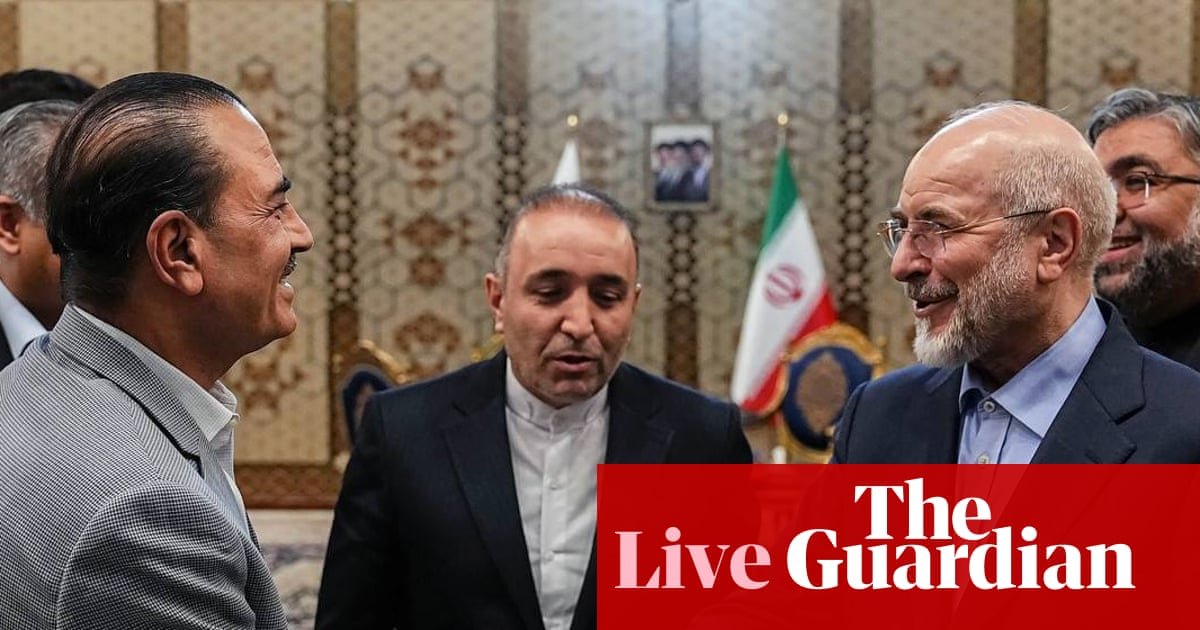
The Pakistani army has said the negotiations with Iran resulted in “encouraging” progress towards a final understanding.
The deal being negotiated was “fairly comprehensive to terminate the war”, two Pakistani sources involved in the negotiations to end the war told Reuters.
Iran had said on Saturday that it was working towards a memorandum of understanding with the US laying out an approach to ending the war after its top officials met with Pakistani army chief Asim Munir.
Reuters quoted sources as saying the proposed framework would unfold in three stages: formally ending the war, resolving the crisis in the strait of Hormuz and launching a 30-day window for negotiations on a broader agreement, which can be extended.
One of the Pakistani sources also there was no guarantee the US would accept the memorandum. If it did, it would lead to further talks after the Eid holiday ended on Friday.
On Saturday Donald Trump told Axios he expected to decide on Sunday whether to resume attacks on Iran. “Either we reach a good deal or I’ll blow them to a thousand hells,” the news site quoted him as saying.
Trump’s social media post made no mention of Iran’s nuclear program and highly enriched uranium, which Tehran has sought to negotiate over later, but came amid growing optimism among officials over a potential deal to end the war.
Earlier on Saturday, a regional official with direct knowledge of the Pakistan-led mediation efforts said the US and Iran were closing in on an agreement.
The official, speaking on condition of anonymity to discuss the closed-door deliberations, also told the Associated Press that “last-minute disputes” could blow up the efforts.
This is not the first time in recent weeks that a deal has been described as close.
The official said the deal would include an official declaration of the end of the war, with two-month negotiations on Iran’s nuclear program. The strait of Hormuz would be reopened and the US would end its blockade of Iran’s ports .
Iran, meanwhile, had signalled “narrowing differences” in negotiations after Pakistani army chief Asim Munir held more talks in Tehran.
US secretary of state Marco Rubio earlier pointed to “some good signs” while also saying: “I don’t want to be overly optimistic … so let’s see what happens over the next few days.”
Donald Trump made the announcement via a Truth Social post, saying he had spoken to a host of leaders in the Middle East by phone, including a separate call with Israeli prime minister Benjamin Netanyahu, which he said “went very well”.
He added: “Final aspects and details of the deal are currently being discussed, and will be announced shortly. In addition to many other elements of the agreement, the Strait of Hormuz will be opened.”
As we reported in the summary, the Fars news agency, which is close to the regime in Tehran, has said Trump’s assertion that an agreement was nearly final was “inconsistent with reality”.
Opening summary
Hello and welcome to our live coverage of the Iran war and the wider Middle East crisis.
Donald Trump has announced that a peace deal with Iran “has been largely negotiated”, after calls with a Pakistani mediator, Gulf allies and Israel, potentially paving the way for an end to the war launched by the US and Israel in February.
Trump wrote that the “final aspects and details” of a “Memorandum of Understanding” are still being discussed and “will be announced shortly”, but said the strait of Hormuz will be opened as part of the deal.
However, Iran’s Fars news agency, which is close to the powerful Islamic Revolutionary Guard Corps, reported that the strait would remain under Iranian control, and that Trump’s assertion that an agreement was nearly final was “inconsistent with reality”.
Three senior Iranian officials told the New York Times the agreement would stop the fighting in Iran and in Lebanon, and could release $25bn in Iranian assets frozen overseas, with a nuclear agreement to be negotiated within 30 to 60 days.
We will bring you the latest developments, as they happen.
