


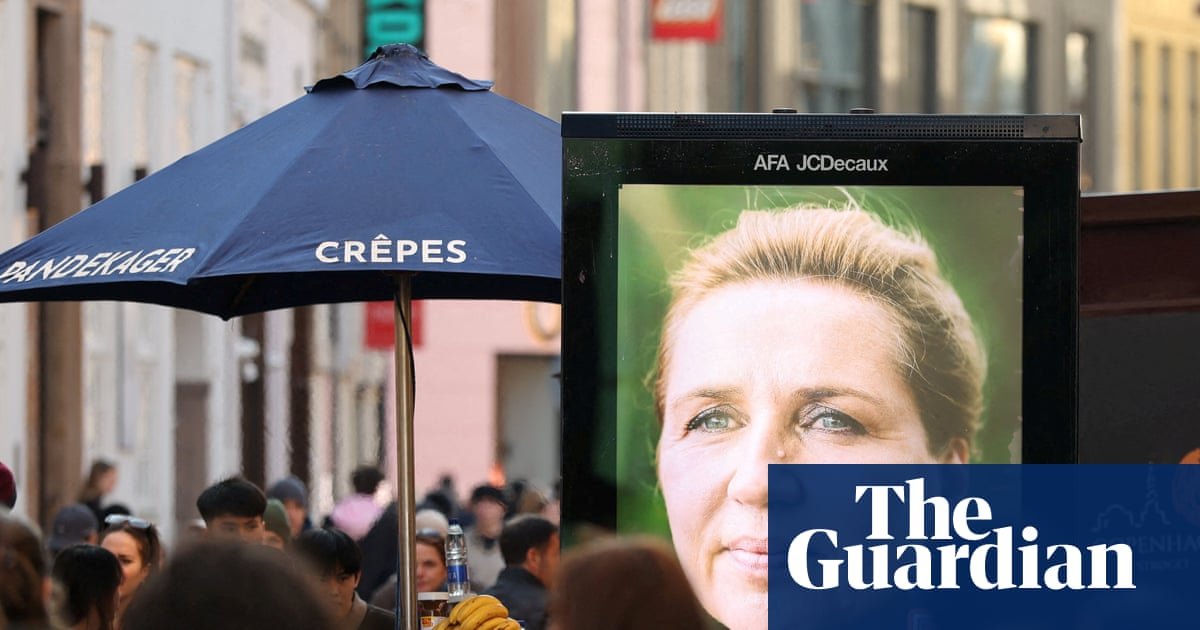
Mette Frederiksen’s Social Democrats and Denmark’s other left-leaning parties appear to have failed to win enough votes to gain a clear mandate to form a government in an election fought amid geopolitical tensions with the US over Greenland.
According to two exit polls released shortly after voting stopped on Tuesday evening, the prime minister’s party looked to have won the most votes but still performed worse than expected, with an estimated 19%-21% of the vote.
If confirmed, the Social Democrats and the other left-leaning parties that form the “red bloc” would be well short of a majority in the 179-seat parliament. But the right-leaning parties of the so-called “blue bloc” also fell short, putting foreign minister, Lars Løkke Rasmussen, leader of the non-aligned centre-right Moderates, in the spotlight as a likely kingmaker.
Official results are expected later on Tuesday or early on Wednesday.
Denmark now faces weeks of coalition talks, after which another centrist coalition or a centre-right coalition appears likely to emerge.
Frederiksen’s prospects for a third term as prime minister were not looking good after the disastrous municipal elections in November, when her party took a severe hit nationally and lost control of Copenhagen for the first time in more than 100 years.
The 48-year-old called an early election last month hoping to benefit from a “Greenland bounce” in the polls in response to her robust handling of Trump’s threats in January to invade the largely autonomous territory that is part of the Danish kingdom. Discussions between the US, Nuuk and Copenhagen are still taking place, but tensions have receded. Its impact appears to have had a lasting effect on Danish voters, nevertheless.
“I know that sometimes I express myself a bit bluntly,” the prime minister said during a recent campaign event. “But given the times we live in, it is perhaps very good that there are some things that cannot be misunderstood: that Russia should not be allowed to win or that Greenland is not for sale.”
On Tuesday, the Greenlandic prime minister, Jens-Frederik Nielsen, described the vote as the most important for the Danish parliament in the Arctic island’s history.
“We are in a time where we have a superpower trying to acquire us, take us, control us,” Nielsen told AFP. “They have a desire to do it, so we are still in a very tense situation.”
On Tuesday, Frederiksen met Greenlandic people living in Aalborg, where she said she could never have imagined that as prime minister she would become involved in “defending you against anyone from outside”.
She added: “For all of us who have been involved in this, whether as Greenlanders who have felt threatened, or as Danes who have felt a strong sense of solidarity – or, in my own case, as the one who had to stand at the forefront – we will never forget the time we have been through together.”
Greenland, she said, had been subjected to “completely unreasonable and unacceptable pressure” by the US, adding: “But you stood firm, and you did so with a grace, determination and strength that the rest of the world greatly admires.”
Although it grabbed the international headlines, Greenland did not dominate the election, which was largely fought on domestic issues – including a Social Democrat pledge for a “wealth tax” to fund smaller class sizes in primary schools, the cost of living crisis, the tightening of Denmark’s already hardline immigration laws, animal rights and clean drinking water.
The wealth tax, a 0.5% tax on assets held by an individual worth more than 25m kroner (nearly £3m), was welcomed by many on the left. But it went down badly with Denmark’s super-rich.
Henrik Andersen, the chief executive of wind turbine giant Vestas, declared “enough is enough” and suggested he may leave the country if it was introduced. The shipping magnate Robert Mærsk Uggla, who is the chair of the board of directors of Maersk and the chief executive of AP Møller Holding, said it would be “harmful to Denmark.”
In coming weeks the role of Rasmussen is likely to be critical. On the eve of the election, Rasmussen said he did not want to be prime minister, a job he has already held twice, but that he would like the role of “royal investigator”, a role which entails helping to form a government and is usually held by the person who goes on to become prime minister.
A veteran of the political scene, Rasmussen nonetheless cultivates an image as a man of the people, recently telling Euroman magazine that he sometimes uses hand soap instead of toothpaste and likes to smoke his pipe in bed “if I have a sore throat or am sick”.
