


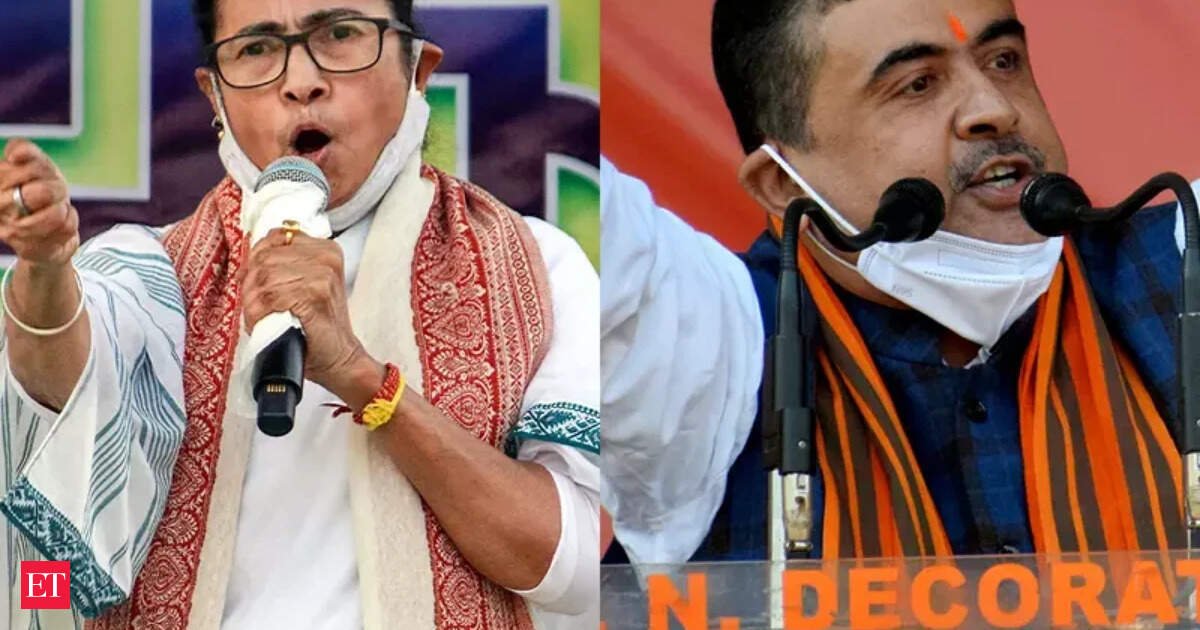
While the Trinamool Congress is looking to retain its stronghold in south Kolkata with organisational strength and emotion, the BJP wants to breach the keep by banking on social arithmetic and symbolism.
Also Read: Mamata Banerjee alleges ‘conspiracy’, counters BJP ‘charge sheet’
The fight is reminiscent of the electoral clash between Banerjee and Adhikari in the 2021 Assembly polls, when the chief minister had taken on her protege-turned-rival, who had then just joined the BJP, in the latter’s home turf, Nandigram.
Banerjee had lost the fight, although the BJP had been drubbed by the TMC five years ago. She later won the Bhabanipur Assembly bypolls.
The turf has changed, and it remains to be seen if the result does too.
Mamata Banerjee’s party is banking on the “‘ghorer meye’ (girl next door)” pitch, organisational muscle and continuity. On the other hand, the BJP is looking to wrest the chief minister’s “safest” seat with caste calculations, Ram Navami imagery and booth-level social engineering.The TMC has revived the emotional cadence of “Bangla Nijer Meyekei Chay (Bengal wants its own daughter)” from its 2021 assembly polls playbook in a more localised form.
At a strategy meeting chaired by state TMC president Subrata Bakshi, councillors were instructed to push the slogan: ‘Banglar unnayan ghore ghore, ghorer meye Bhabanipure’. The message is simple: Bhabanipur is not merely electing a CM; it is standing by its own daughter.
Councillors have been told to go door-to-door, avoid confrontation and distribute leaflets highlighting Banerjee’s development work.
The TMC has also set up ‘photo corners’ across the constituency, where people can pose with life-size cutouts of Banerjee.
The first such booth has come up at Muktadal More in Ward 73, where Banerjee lives, carrying the appeal: “Stand beside Mamata Banerjee, take a picture together, speak for Bengal”.
For the TMC, however, it is more than a gimmick. It is an attempt to portray Banerjee not as a chief minister, but a familiar neighbourhood figure.’
Also Read: Bengal elections: Adhikari factor key in Tamluk-Kanthi battleground as BJP-TMC face off
“We are not fighting this election with aggression. We are fighting it with emotion, with connect and with the work Banerjee has done in Bhabanipur,” a senior TMC leader said.
Despite the TMC’s confidence, the BJP believes the ground has shifted. Bhabanipur has long been a “mini-India” of sorts, comprising Bengali bhadralok neighbourhoods, Marwari and Gujarati traders, Sikh and Jain families and a sizeable Muslim electorate.
Roughly 42 per cent of voters are Bengali Hindus, 34 per cent non-Bengali Hindus and around 24 per cent Muslims.
It is this social arithmetic that appears to have encouraged Adhikari to challenge Banerjee on her home turf.
For months, the BJP has quietly mapped Bhabanipur booth by booth and community by community.
Party leaders claim Kayasthas make up 26.2 per cent of the electorate, Muslims 24.5 per cent, eastern Indian migrant communities 14.9 per cent, Marwaris 10.4 per cent and Brahmins 7.6 per cent.
The survey identified where Bengali Hindus dominate, where Hindi-speaking traders are concentrated and which booths are likely to be influenced by Muslim voters.
“The battle in Bhabanipur cannot be fought with one slogan. It has to be fought booth by booth, community by community,” a BJP functionary said.
That explains Adhikari attending the recent Ram Navami procession that traversed through Bhabanipur, culminating at Hazra crossing, near Banerjee’s residence.
“The state now wants Ram Rajya. People are tired of appeasement politics. They want good governance,” Adhikari said.
Political observers say the BJP is trying to consolidate Hindu votes, cutting across Bengali and non-Bengali communities, and simultaneously putting Banerjee on the defensive over minority politics.
“The BJP knows that social arithmetic alone may not be enough. So, it is attempting at emotional and ideological polarisation through Ram Navami and Ram Rajya pitch in the seat where the majority are Hindus, while a considerable portion of them are non-Bengali Hindu voters,” political analyst Biswanath Chakraborty said.
The special intensive revision of electoral rolls has added another layer to the contest.
Nearly 47,000 names in Bhabanipur have reportedly been deleted from the voters’ list. It is roughly 11,000 fewer than the over 58,000-vote margin secured by Banerjee in the 2021 bypoll. Another 14,000 remain under adjudication.
More than 56 per cent of those under scrutiny are Muslims, although the community forms only around 24 per cent of the electorate.
The BJP believes that if minority votes shrink even marginally while Hindu votes consolidate behind it, Bhabanipur could become a far tighter contest.
The TMC sees the same exercise as disproportionately affecting minority voters and traditional supporters.
That is why Firhad Hakim, Bakshi and other senior leaders are personally supervising Bhabanipur, while Abhishek Banerjee has reportedly set a target of ensuring Mamata Banerjee wins by at least 60,000 votes.
The BJP had shown signs of growth in Bhabanipur in the 2014 and 2019 Lok Sabha elections and even won Mamata Banerjee’s own Kolkata Municipal Corporation Ward number 73 in 2014.
The trend sharpened in the 2024 Lok Sabha polls, when the TMC’s lead in the Bhabanipur assembly segment fell to just 8,297 votes, against Banerjee’s margin of 58,832 in the 2021 bypoll.
Significantly, the BJP finished ahead in five of the constituency’s eight wards while the TMC led in only three.
For the BJP, the numbers suggest Bhabanipur is no longer impregnable. For the TMC, they are a reminder that Mamata Banerjee’s safest seat may now need its fiercest defence.
