


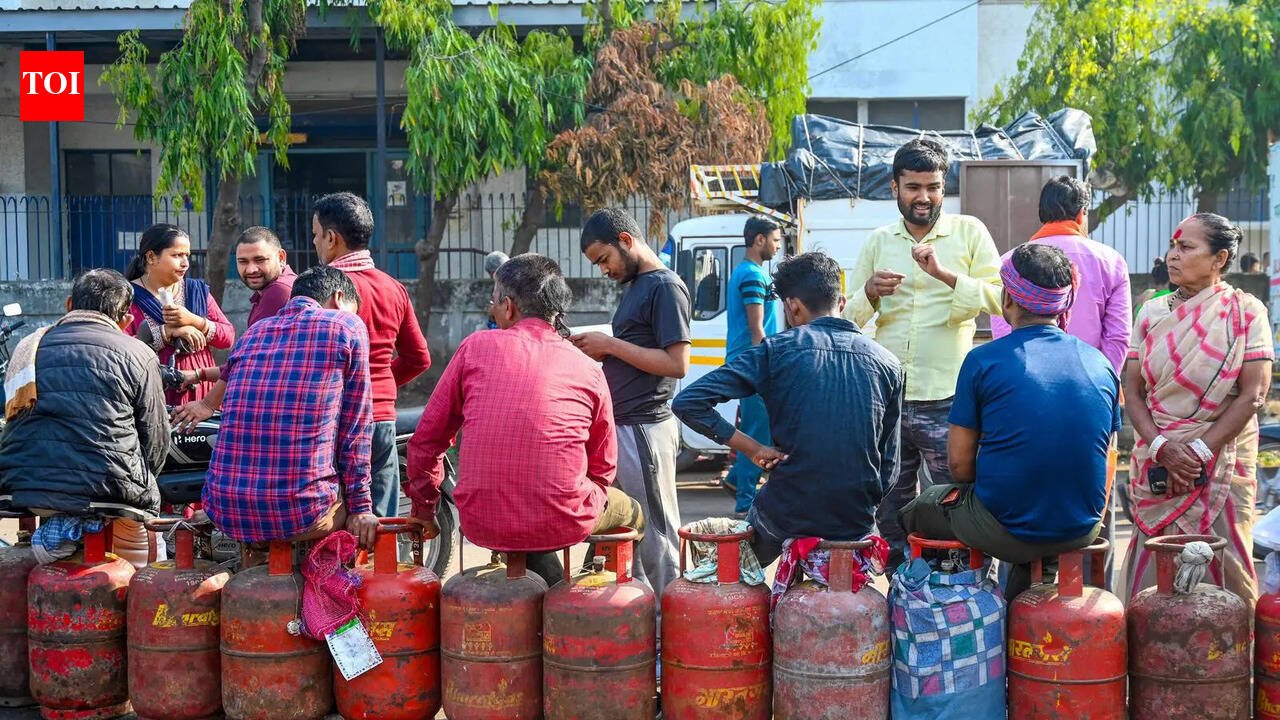
Noida: Long queues, frayed tempers and instances of cylinders being snatched from delivery vans continue to play out outside gas agencies in Noida and Ghaziabad, even as officials insist that supplies have nearly stabilised since the disruption triggered by the West Asia conflict earlier this month.According to officials, it is anxiety that is fuelling this “chaos”. “Consumers, unsure of timely deliveries, are rushing to agencies within a day of booking instead of waiting the standard 48 hours. Many in these queues already have confirmed bookings, but prefer not to risk delays. This is leading to crowding and disorder at distribution points,” an official said.The situation is worse for those without valid LPG connections — a group heavily reliant on the black market until now. With illegal supply chains drying up, many such users have begun approaching authorised agencies, often unsuccessfully. In some areas, this desperation has escalated into mobs intercepting delivery vehicles and forcibly taking cylinders away with them. As a result, this has disrupted supply for legitimate consumers.Officials said several such incidents had occurred in Harola (Sector 5), Gejha (Sector 93) and Sector 23, where crowds gathered as early as 7am and rushed to intercept delivery vans. Officials agreed it is difficult for agencies to safeguard stock under such conditions, creating a ripple effect where consumers who have booked cylinders are left waiting.The district magistrate has sought deployment of police teams at gas agencies to curb such incidents.Even where there is no law-and-order situation, operational bottlenecks have had an effect on deliveries. Intermittent server failures at some agencies and backlog from the recent festive period have added to delays.Data from both districts shows how sharply demand surged over the past couple of weeks — and why the panic lingered. In Ghaziabad, daily bookings jumped from 20,000-23,000 before March 4 to around 35,000 between March 10 and 15, while deliveries lagged at about 20,000, stretching waiting periods beyond three days. As supply caught up, deliveries briefly peaked at 40,000 a day around March 18-20.Noida saw a similar spike. Bookings rose from about 20,000-22,000 to 30,000 at the onset of the supply shortage, eventually touching 48,000 in mid-March, even as deliveries struggled initially at 15,000 a day. At its peak, deliveries rose to 36,000 a day.Officials said the numbers are now stabilising, but not evenly. In Ghaziabad, bookings have eased to around 30,000, with 20,000-25,000 cylinders delivered daily and a turnaround time of 48-50 hours. In Noida, supply has climbed to roughly 23,000 a day with delivery timelines of about 48 hours, though bookings remain elevated at around 48,000.“Many people in queues have booked cylinders just a day earlier, but don’t want to wait for delivery,” said Ghaziabad supply officer Amit Tiwari, adding that repeated announcements have been made assuring residents there is no shortage and that booked cylinders will reach homes.To address the needs of those without proper connections, particularly students and migrant workers, the govt has introduced a 5kg free trade LPG (FTL) cylinder. They can approach any agency with their Aadhaar cards or any valid govt ID and a declaration that they do not hold another gas connection. After verification, the 5kg cylinder can be issued.Tiwari said the 5kg cylinder costs Rs 1,523, including a refundable security deposit of Rs 968. He acknowledged that this is costlier than a 14.2kg domestic cylinder priced at Rs 913, which is one reason awareness and uptake has remained low.However, applications for new domestic LPG connections have been paused since March 14, further constraining options for first-time users. Agencies have been asked to keep at least 50 small cylinders in stock for such cases.Commercial supply, too, is being gradually restored to 70% of levels before the conflict, but only for entities transitioning to piped natural gas (PNG). Officials said this is part of a broader effort to streamline supply chains and reduce dependence on LPG.
