


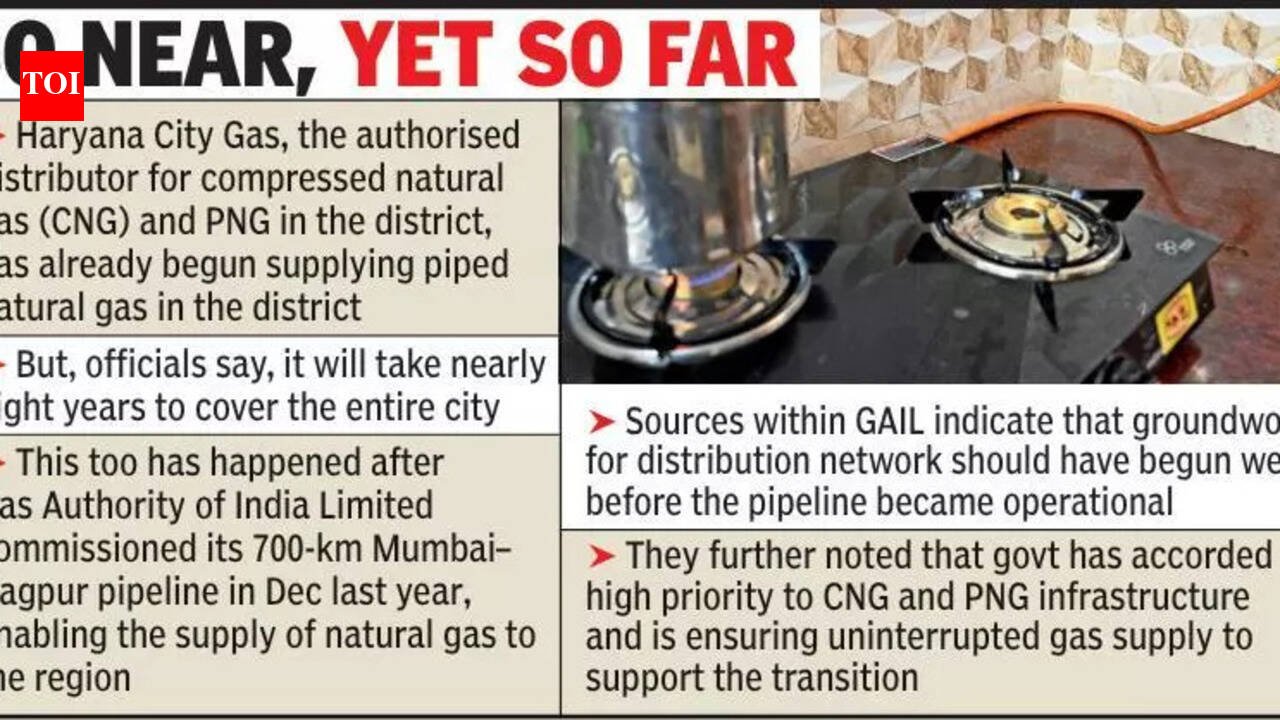
This too has happened after Gas Authority of India Limited (GAIL) commissioned its 700-km Mumbai–Nagpur pipeline in Dec last year, enabling the supply of natural gas to the region.“We are currently supplying CNG to some industries and residential units in Butibori while network laying work is being carried out in different areas, including in Hingna. Our pipeline has also reached up to Khapri. However, it will take eight years to completely cover Nagpur,” said a senior HCG official, adding that gas reached the city only recently.However, the pace of expansion has drawn criticism from industry experts. Sources within GAIL indicated that groundwork for the distribution network should have begun with full flow well before the pipeline became operational. “This way, HCG could have covered a bigger area as soon as the CNG reached Nagpur,” sources said.They further noted that the govt has accorded high priority to CNG and PNG infrastructure and is ensuring uninterrupted gas supply to support the transition.The issue also caught the attention of Union minister Nitin Gadkari, who earlier urged HCG to significantly expedite the rollout. Speaking at the inauguration of CNG distribution in Nagpur district in Dec, Gadkari had called for a two-year execution plan instead of the proposed eight-year timeline.“Eight years is too long. If we can build 10 national highways across the country in that time, why can’t this project be completed in two years?” Gadkari had said, assuring full support to fast-track approvals and remove bottlenecks.At the same event, he had strongly advocated for a shift towards a gas-based economy, highlighting India’s heavy reliance on energy imports. Gadkari had pointed out that country imports nearly 87% of its energy requirements, costing over Rs23 lakh crore annually, while also contributing to rising pollution levels.For Nagpur residents grappling with LPG shortages, however, PNG continues to remain a distant and “piped” dream.
