


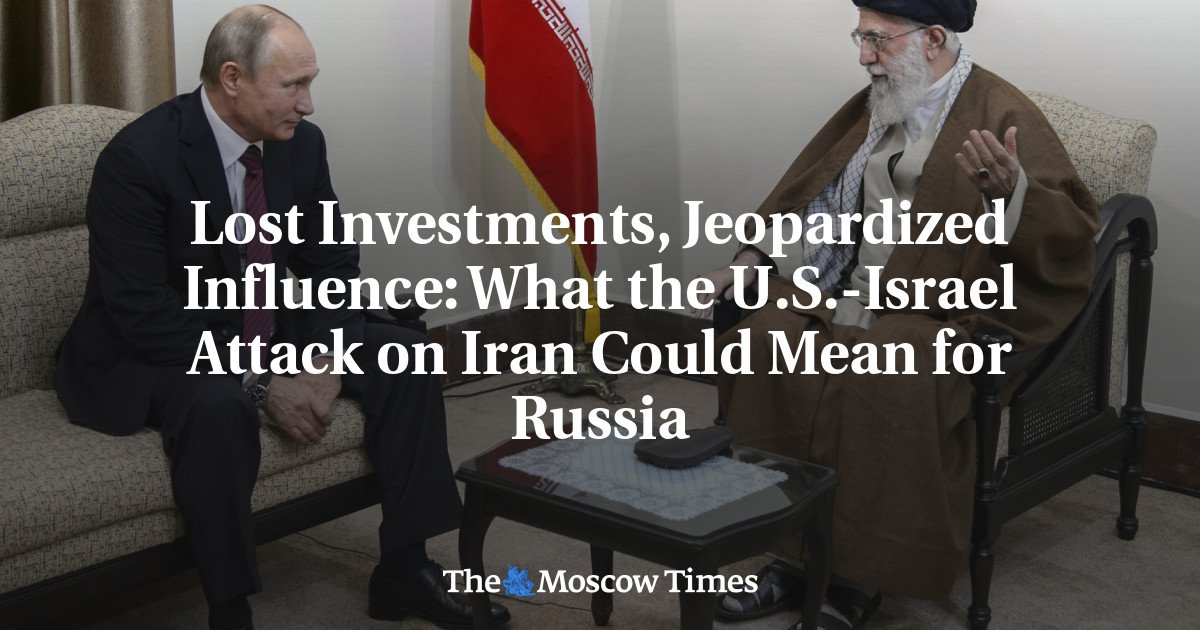
It was a question President Vladimir Putin did not want to answer: What if the U.S. or Israel assassinated Iran’s Supreme Leader Ayatollah Ali Khamenei?
Back then, in June of last year, the scenario was hypothetical. The two countries had just attacked Iran in an effort to destroy its nuclear program and kill top its leaders, and President Donald Trump said the U.S. knew Khamenei’s location. At the annual St. Petersburg Economic Forum, a reporter wanted to know how Russia would respond to what might happen next.
“If I may, I hope that this will be the most correct answer to your question,” Putin said. “I do not even want to discuss this possibility. I do not want to.”
On Saturday, the situation that was perhaps too troubling for Putin to contemplate became reality. In a massive show of force, the U.S. and Israel struck military sites and decimated Iran’s surviving leadership.
Whether Khamenei was among those killed was an open question until reports of his death began emerging late in the day — first from Israel, then from Trump, then from Iran itself.
Iran is one of Russia’s strongest allies on the international stage, and analysts say the attacks could have profound implications for their relationship.
With Khamenei dead and the future of the Islamic republic’s hardline anti-Western government in doubt, Russia now finds itself in a position to lose greatly. The only question is, how much?
When other allies have been ousted in recent years, Putin has not immediately commented.
But in a sign of the significance of this episode for Russia, he released a statement on Sunday — just one day after the attacks — condemning Khamenei’s death and calling it a “cynical violation of all norms of human morality and international law.”
“In our country, Ayatollah Khamenei will be remembered as an outstanding statesman who made a huge personal contribution to the development of friendly Russian-Iranian relations, raising them to the level of a comprehensive strategic partnership,” Putin said.
Russia’s Foreign Ministry also leveled a blistering condemnation, claiming the U.S. and Israel violated international law and were seeking to subjugate a state that didn’t bend to their will.
Statements are likely to be the extent of Russia’s short-term response, said Nikita Smagin, an expert on Russian-Iranian relations.
“There is no doubt that Putin takes it personally,” he told The Moscow Times on Sunday, likening the situation to the killings of other Russian allies like Libya’s Muammar Gaddafi in 2011 and Iraq’s Saddam Hussein in 2006.
But while the ousting of allied leaders hits close to home and prods at perennial anxieties about the Putin regime’s own downfall, Smagin said that the Kremlin’s bigger worry right now is its substantial investment portfolio.
That includes the North-South corridor, a multi-billion-dollar planned railway route between Russia and Iran through the South Caucasus, and a $25 billion deal to build four nuclear reactors in southern Iran. And just last month, Iran’s ambassador said he had received signals that Russia was planning to expand its presence in the country’s oil and gas industry.
“Russia has invested a lot of effort and money in Iran,” Smagin said. “Certainly, if we imagine regime change or if we imagine instability in Iran, all these projects are under threat.”
Beyond the risk of prolonged war and political chaos destabilizing the business environment, there is a simple reason for this: the next government in Iran may not be friendly to Russia.
In January, as Putin watched a different crisis befall an ally in Venezuela, George Washington University professor and Russia expert for the think tank CNA Julian Waller told The Moscow Times that the voices of Moscow-skeptical factions in Tehran might find greater purchase if Russia stands by while the regime is toppled.
“Russia failing to publicly back the regime might have significant consequences if the regime survives,” he said at the time.
Hanna Notte, director of the Eurasia Nonproliferation Program at the James Martin Center for Nonproliferation Studies, wrote on social media this weekend that such questions might come down to the country’s orientation toward the West.
“Russia’s interests in… Iran could suffer,” Notte wrote. “Especially if… whoever comes next seeks more pragmatic relations with the West.”
“This has been Russia’s longstanding fear,” she said.
There are some benefits for Russia from the weekend attacks, but these are likely short term and limited to oil exports.
As the damage was still being assessed across Iran on Saturday, ships navigating the Strait of Hormuz began reporting that they were being told by Iranian authorities to turn around.
Iran has not yet officially announced any action on the Strait, through which about 20% of global oil and gas export traffic passes, but its closure would send shockways through the markets and drive up the price of oil.
On Sunday, members of the OPEC+ oil cartel announced an increase in production quotas to take effect in April, but analysts said the increase wouldn’t be great enough to offset the expected price spike.
That would all be good news for Russia, whose economy is highly dependent on revenues from oil exports and tends to benefit from higher oil prices on the international market. What’s more, Iran is one of the biggest suppliers of oil to China, a market in which Russia is trying to surge ahead.
“Russia can even benefit short term,” Smagin said of the potential to leapfrog Iran in exports to China. “And maybe even these benefits can be really significant.”
One area that experts say is not likely to be shaken is Russia’s war effort in Ukraine. Moscow has relocated the production of destructive, Iran-designed Shahed drones to domestic facilities in recent years, and the importance of arms imports has decreased as domestic manufacturing for things like ammunition and first-person view drones has ramped up.
Taking the toll of the damage this weekend, Fyodor Lukyanov, a prominent Russian foreign policy analyst, chose not to assess the implications for Moscow, but instead how this moment could backfire for Washington and its Middle East policy.
“In any scenario, the region is entering a new phase of upheaval that will reverberate widely across neighboring areas,” Lukyanov wrote in an article for the magazine Russia in Global Affairs. “And that bodes ill for everyone.”
Smagin gave a similar assessment, but noted that Russia’s interests in the region are also seemingly being undermined by every new development — from the downfall of Bashar al-Assad’s government in Syria in 2024, to its faltering diplomatic mediation efforts, to now.
“Everything that is happening in the Middle East is threatening Russian interests,” he said. It’s the change of a norm, it’s the change of a pattern — how world powers act towards authoritarian countries. And certainly it’s not a good signal for Russia.”
