


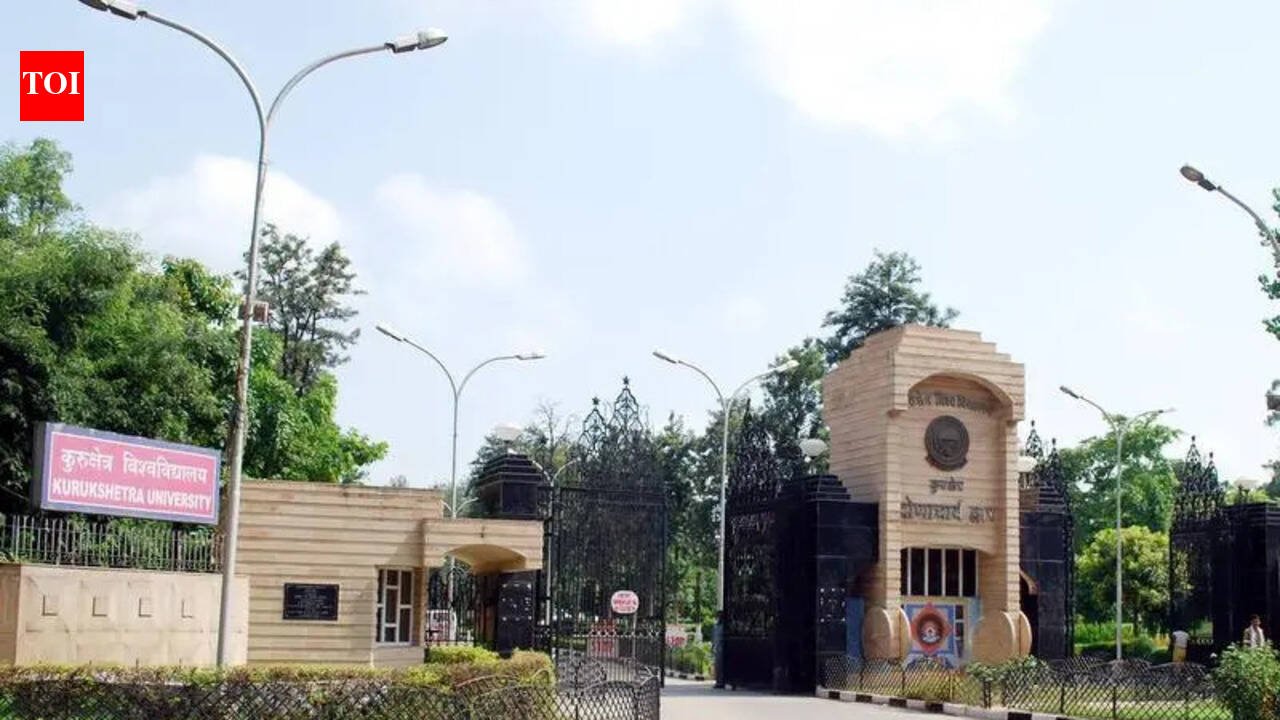
Kurukshetra: The three-day international conference on ‘Kurukshetra: Through the Ages’ concluded at Kurukshetra University on Saturday, (KU) with a strong call to project the region’s rich historical, cultural and spiritual heritage on the global stage.Addressing the valedictory session, Haryana animal husbandry and dairy minister Shyam Singh Rana described Kurukshetra as an ancient land of sages and knowledge. Referring to the teachings of the Bhagavad Gita, he said the message of duty, righteousness and peace delivered on this land continues to guide humanity. He also outlined various state initiatives for farmers, including infrastructure development and digital systems such as crop registration and direct payment mechanisms. Swami Gyananand emphasised the need to present Kurukshetra’s spiritual and cultural legacy globally, noting that its true essence can only be understood through deeper engagement and personal experience. Guest of honour Bharat Bhushan Bharti remarked that India has historically been a global centre of knowledge and can reclaim that position. He termed Kurukshetra the cultural capital of India and highlighted the university’s pivotal role in preserving this legacy. In his presidential address, economist Satish stressed the importance of rigorous historical research for the region’s holistic development. He observed that while many Western civilisations are relatively recent, Kurukshetra’s association with the Mahabharata makes it one of the world’s oldest civilisational centres, deserving recognition on par with cities like Rome and Mecca. A key highlight of the conference was the detailed historical analysis presented by Prof Amarjit Singh, pro-vice chancellor of Desh Bhagat University, on the armed resistance led by Baba Banda Singh Bahadur. He explained that, acting on the command of Guru Gobind Singh, Baba Banda Singh Bahadur launched a campaign in 1708 against oppressive Mughal rule to liberate the masses. Beginning his journey from Nanded in Oct 1708, Baba Banda Singh Bahadur entered the Haryana region in 1709 and set up his first military base at Sehroda near Samana. Prof Singh noted that Kurukshetra and Thanesar emerged as key strategic centres, with major operations coordinated from Thanesar. Citing historians including Khafi Khan, Mohammad Qambar Khan and William Irvine, he highlighted active local participation in the movement. Following victories at Samana, Kaithal and Thaska, Banda Singh Bahadur’s forces advanced across the region, capturing Shahabad, Mustafabad, Kunjpura, Sadhaura and Mukhlisgarh. After the decisive victory at Sirhind in May 1710, he established the first Sikh state, renaming Mukhlisgarh as Lohgarh and making it his capital. Prof Singh underscored that the newly established state was marked by two key features: the development of Sirhind and Thanesar as major administrative centres, and the elevation of individuals from marginalised communities to important positions, promoting social equity. He emphasised that Banda Singh Bahadur’s movement was not merely political but a broader moral and social struggle rooted in justice — values closely associated with Kurukshetra. Colonel Arun Vashisht described Kurukshetra as a land that continues to inspire spiritual thought. The conference reinforced KU’s role as a leading platform for historical research and academic discourse, while underlining the urgent need to position Kurukshetra prominently on the global cultural and intellectual map. MSID:: 130192631 413 |
