



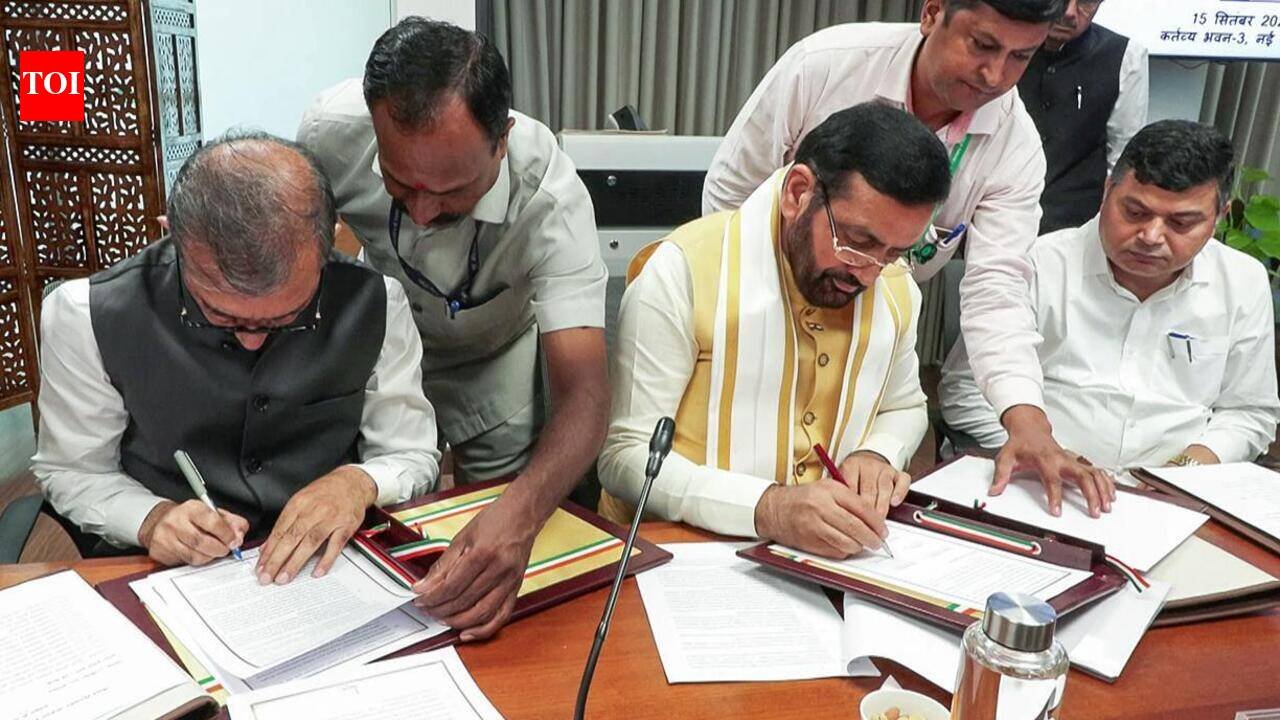
Shimla/Chandigarh: Haryana and five other northern states on Tuesday signed an MoU to pave the way for the long-pending 422-MW Kishau Multipurpose Project, with Haryana set to gain additional water and Himachal Pradesh succeeding in shifting an estimated Rs 2,000-crore liability for the project’s power component to beneficiary states.The Rs 15,624-crore project, proposed on the Tons river along the Himachal Pradesh-Uttarakhand border, has been stalled for years over cost-sharing, power and water allocation. The agreement involving Haryana, Himachal Pradesh, Uttarakhand, Uttar Pradesh, Delhi and Rajasthan was signed in New Delhi in the presence of Union home minister Amit Shah and Union jal shakti minister C R Patil.Haryana chief minister Nayab Singh Saini said the breakthrough would help secure the state’s present and future water needs. He said the three Upper Yamuna storage projects — Renuka Ji, Lakhwar and Kishau — would provide Haryana around 1,143 million cubic metres (MCM) of water, with its share of the combined additional availability estimated at 1,280 cusecs. Renuka Ji and Lakhwar are already under construction, he said.For Himachal, the key gain is the shifting of the power-component liability. Chief minister Sukhvinder Singh Sukhu said the Centre had agreed in principle that Delhi, Rajasthan and Haryana would bear the estimated Rs 2,000-crore cost on Himachal’s side. The issue had remained a major point of contention for eight years.Sukhu said his government had refused to accept the Rs 800-crore liability agreed to by the previous government, citing the state’s financial constraints. He said Himachal had also argued that since the Centre was providing a 90% grant for the water component, similar assistance should be extended for the power component.Himachal is expected to receive around 1,000 million units of electricity annually from the project, valued at more than Rs 1,000 crore. Sukhu said the state would also bear the social costs of displacement in the project-affected areas.Under the broader consensus, the Centre will bear 90% of Kishau’s water-component cost, with the remaining 10% shared by the six states. The project is aimed at conserving monsoon flows, regulating the Yamuna and augmenting water availability in the basin while generating hydropower.
