


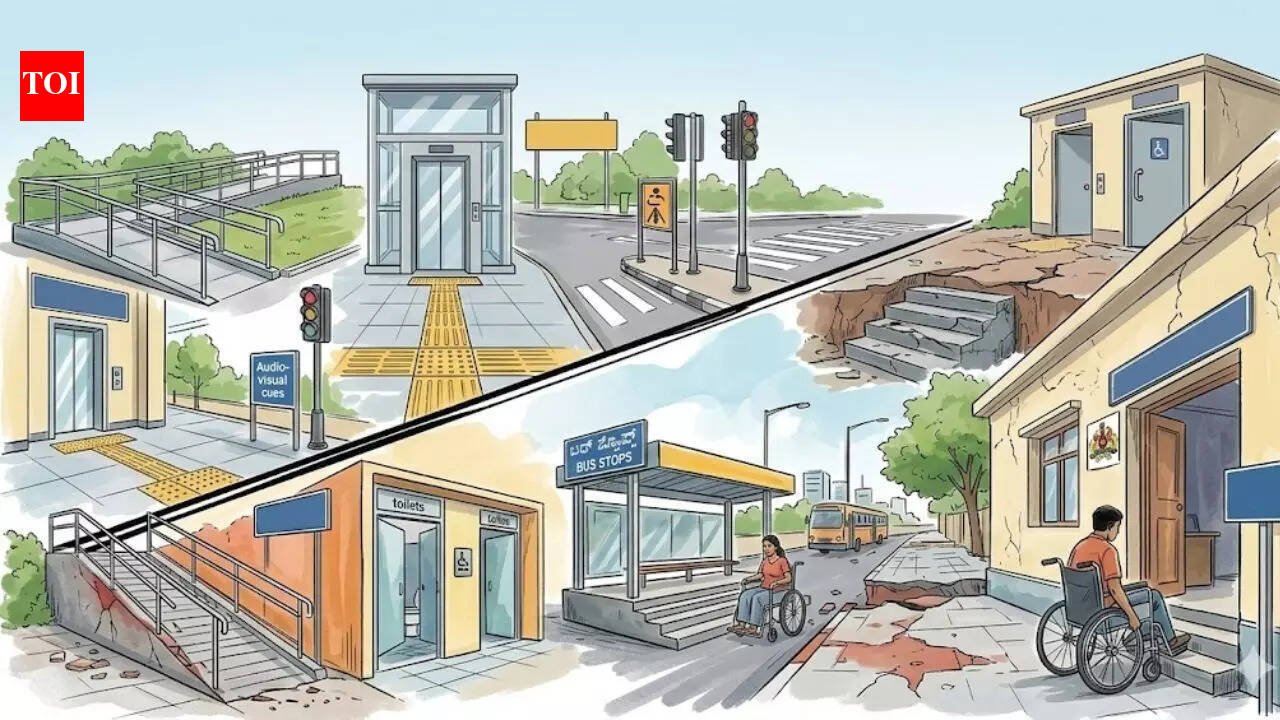
A statewide audit finds that ramps, toilets, parking, and tactile paths remain largely unusable, leaving persons with disabilities to navigate a state that still keeps them outOn most mornings, Devaraj KM leaves his home in Chintamani before sunrise, wooden stick in hand, left leg stiff from polio. He has lived with the condition since he was three.
Statewide audit finds public spaces largely inaccessible to PwDs in Karnataka
Now 43, Devaraj is an accountant with the Association for People with Disabilities (APD) in Bengaluru. And his biggest challenge is not his job, but getting there. “I rely on KSRTC to travel to and from Bengaluru. That’s a tough daily battle as most buses are high-floor ones,” he says. Some days, he doesn’t get a seat. “BMTC has reservations, but in KSRTC, there are many days when I stand throughout the 60km journey.People don’t listen when I ask them to move.” Conductors rarely step in.For Devaraj, broken pavements are as much a barrier as high bus steps. “Footpaths are barely accessible. Some don’t even have ramps. Several have misplaced slabs exposing drains,” he says. His experience mirrors the findings of a statewide accessibility audit, Sugamya Yatra, which covered over 1.8 lakh locations. It found that even where accessibility features exist, they’re often poorly designed or non-functional.Of nearly 1.2 lakh locations that were assessed for parking, 3,946 (3.3%) had accessible parking spaces. As many as 74,840 out of 89,564 locations had ramps. Only 8,164 of 59,025 locations had wheelchairs. Tactile pathways were present in just a fraction of internal routes. Of 32,507 toilets, 8,788 were Western-style ones.In Bengaluru Urban alone, accessibility gaps were flagged at 7,636 locations. Around 80% of Metro stations had signage for parking accessibility, better than other districts. Yet, the absence of tactile pathways and approach-route signage at most sites makes navigation difficult. Ashmira, 35, visually impaired since birth, says the cost of navigation goes beyond inconvenience. “When I was in Mumbai, I mostly used public transport. In Bengaluru, that’s almost impossible.” She depends largely on autos, which are expensive. Walking is no easier. “When you’re walking, vehicles come really close to you, and you don’t know what type they are. When I walk with someone, I have to walk exactly behind them,” she says.For Arbeena Kausar, 25, the barriers began at school. The first in her family to be diagnosed with dwarfism, she struggled to walk in her early years before medical intervention helped her gain mobility. When in class 6, she tried to board a BMTC bus and failed. “The floors are very high in most buses. Even with low-floor buses, access to ramps is limited. Climbing steps is difficult too. How can I think of stepping onto an escalator? We also need public toilets. Even where there are toilets exclusively for PwDs, they’re gender neutral. There should be separate toilets for men and women.”Manmeet Nanda, additional secretary, department of empowerment of persons with disabilities, said the audit was meant to capture these everyday obstacles. “…You don’t realise these small things,” she said. Based on the audit, the govt sought a budget to address gaps, and APD has projected Rs 396 crore.APD policy advocacy head Bhumika Modh said while accessibility gaps persist across states, Karnataka’s effort to quantify them stands out. The audit records some progress in entrances and toilets. But for PwDs, accessibility is measured not in percentages or crores, but in whether they can board a bus, find a toilet, or walk down a pavement without fear.
