


Public discourse in India often reveals how fragile the understanding of foundational concepts can be. A recent controversy surrounding remarks made by Kirti Azad, a Member of Parliament from the All India Trinamool Congress (TMC), offers a telling example.

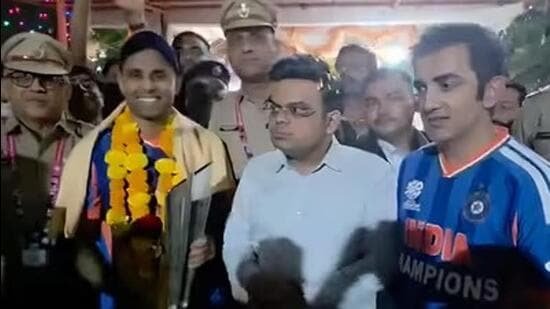
Azad reportedly criticised members of India national cricket team for visiting a Hanuman temple after their triumphant victory in the ICC Men’s T20 World Cup final on March 8. His comment suggested that such a visit was somehow inconsistent with the secular ethos that India claims to uphold.
Kirti Azad’s comment was impulsive, ill-thought-out, shallow and condemnatory in a manner that displayed an unfortunate lack of understanding of the meaning of secularism in India. In doing so, he trivialised secularism itself by applying it in circumstances where it is not threatened.
To my mind, the reaction of the victorious players was entirely human. Sport, particularly cricket in India, is not just a game; it is an emotional spectacle that binds millions across caste, creed and region. When the national team wins a momentous global tournament, expressing gratitude to the divine for many Indians is instinctive. It is a gesture rooted not in exclusion but in humility — a recognition that human effort, however remarkable, often seeks a larger moral or spiritual anchorage.
To interpret such a gesture as an affront to secularism is to misunderstand both the players and the idea itself.
The word ‘secularism’ has travelled a long intellectual journey before entering the vocabulary of modern India. In its European origins, secularism emerged from centuries of conflict between Church and State. The aim was to limit the political power of organised religion and create a state that remained neutral in matters of faith. In many Western countries, this neutrality evolved into a strict separation: religion was confined to the private sphere, while public institutions remained rigorously non-religious.
India’s historical experience was fundamentally different. Here, religion was never monopolised by a single church-like institution, nor was political authority uniformly defined by theology. Instead, India evolved a civilisational ethos in which multiple faiths coexisted, interacted and enriched each other. The Indian understanding of secularism therefore did not emerge from hostility to religion but from a deep respect for pluralism.
The phrase often used to describe this ethos — sarva dharma sambhava, or equal respect for all faiths — captures this distinction elegantly. The Indian state does not demand that citizens abandon their religious identities in public life. Rather, it requires that the state itself treat all religions with fairness and impartiality.
Seen in this light, the visit of the cricketers to a Hanuman temple cannot reasonably be construed as a violation of secular principles. These were private individuals, albeit famous ones, expressing gratitude according to their personal beliefs. They were not acting as representatives of a religious state, nor were they promoting one faith over another as a matter of policy.
In fact, Indian public life is replete with similar examples. Political leaders routinely visit temples, mosques, churches and gurdwaras. Festivals of different religions are celebrated with official recognition. The state observes holidays for diverse faith traditions. None of this has been considered inconsistent with secularism because the essential criterion is fairness, not abstinence.
Those who interpret secularism in a mechanistic manner — suggesting that any visible religious expression is automatically problematic — risk distorting the concept. Such rigidity may even produce the opposite of what it intends. When secularism begins to appear hostile to the everyday religious sentiments of ordinary citizens, it inadvertently strengthens the arguments of those who claim that the idea itself is alien to India.
The cricketers’ visit to the temple did not diminish the achievements of players belonging to other faiths. Nor did it imply that the victory belonged to any particular religious community. The triumph belonged to India — an India whose diversity is reflected in its team: players from different linguistic backgrounds, regions and religions united by a common goal.
Indeed, cricket in India has often served as a powerful metaphor for national integration. From the legendary contributions of Muslim players such as the Mansoor Ali Khan Pataudi, Mohammad Azharuddin and Zaheer Khan to the Sikh brilliance of Harbhajan Singh and the Christian heritage of Roger Binny and Sanju Samson, the Indian team has historically embodied pluralism in action. Their collective success has rarely been interpreted through the prism of religion.
A spontaneous act of thanksgiving at a nearby temple after a historic victory does not constitute communal assertion. It is simply an expression of faith — one among many possible forms that gratitude can take in a country as spiritually diverse as India.
India’s strength has always been its ability to accommodate complexity. A devout Hindu, a practising Muslim, a committed Christian, a dedicated Sikh or an agnostic citizen can all inhabit the same public space without denying each other’s legitimacy. That delicate equilibrium is the essence of Indian secularism.
Only when faith becomes a tool to divide communities or to assert cultural dominance must secularism indeed speak firmly. But to object to every religious gesture in public life is to confuse the symptom with the disease.
Secularism is a precious principle, but it must not be defended in ways that alienate the very society it seeks to harmonise. Liberals, who have historically championed secular values, must recognise this danger. If secularism is reduced to a reflexive suspicion of religious expression, it will gradually lose moral credibility. Worse still, it will hand rhetorical ammunition to those who wish to discard the concept altogether.
(Pavan K Varma is an author, diplomat, and former member of Parliament (Rajya Sabha). The views expressed are personal)
