


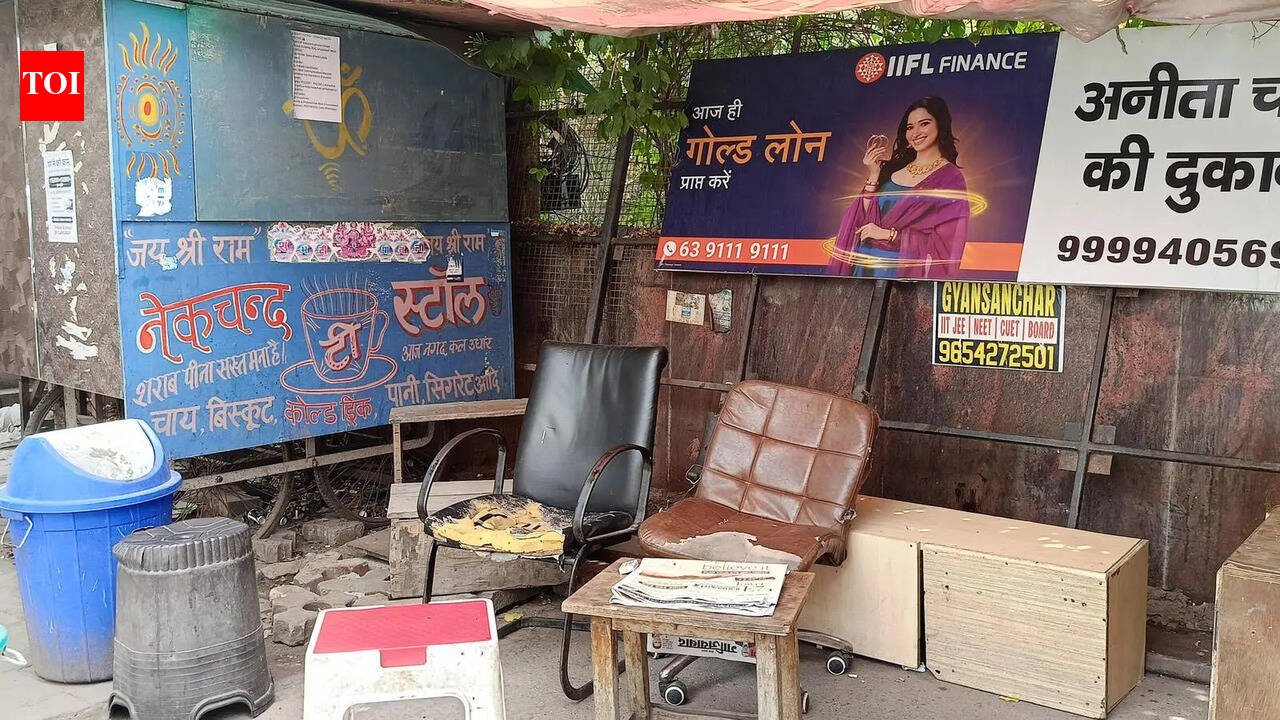
Noida/Ghaziabad: Soon after the US and Israel went to war with Iran, Nand Lal realised how shaky the lifeline of his business is. A tea and cigarette seller at Sector 57 in Noida, Nand Lal found half his business wiped out when his gas cylinder exhausted on March 15. His usual black market supplier pleaded helplessness. So Nand Lal got his domestic cylinder to his shop. It was a Hobson’s choice. Of what use is a cylinder if there’s no money in the house to buy ingredients? By March 20, that cylinder ran out too, and a replacement arrived only this month.“If I am not selling tea, consider my shop closed,” he said. “There is not much margin in cigarettes compared to tea. Only three days ago did I finally get a new domestic cylinder and bring it here. After so many days, I’ve started selling tea again,” he said.Rajkumar, who sells chhole bhature at Khoda Colony, did exactly the opposite. When commercial LPG supply was tightened in March, and people were alarmed about their domestic gas supply as well, he shut his shop for 15 days and took his cylinder home to ensure food could be cooked for the children. Street vendors feed many but remain among the most vulnerable to disruptions like this one, with thousands improvising whichever way they can to keep their businesses, and families, afloat.“When the crisis began, I had to choose between feeding my children at home or running the cart. I used up my savings in those 10 days. I’ve brought the cylinder here and plan to cook for both the stall and my home. At least during Covid our kitchens were running. This is worse than that,” he said.As LPG supply constraint drags on, several small food vendors have been forced to choose between closing down or absorbing costs that are rapidly eroding already thin margins. Many were forced to compromise by limiting LPG usage at home or work.A momo vendor in Sector 18 shuttered his stall for nearly 10 days before securing a refill through a domestic connection. “I finally managed to get a refill through my domestic connection and have restarted, but there’s no certainty about the next one,” he said.But necessity is the mother of invention, and sometimes adaptation.Some have shifted to coal-fired stoves and machine oil burners. Coal prices have climbed from Rs 15 to Rs 25 per kilogram. In a single shift, a vendor burns through roughly 20kg, vendors say.In Sector 57, RK Gupta of “Gupta Ji Ke Mashoor Parathe” stall, well known among the area’s factory workers, invested Rs 25,000 in a machine oil stove to keep serving lunch. Owner Hari Gupta said, “The stove runs on discarded machine oil. The flame is slower and lighter than gas, but for parathas this is the only workable option. We cannot shift to coal or wood.”Others have switched fuels entirely. In Sector 57, Raju Sahu has spent the past 20 days cooking on a coal kiln. “In 15 years of selling lunch here, I have never seen such a crisis,” he said. Without a formal commercial connection, he depended on informal supply chains that have now either dried up or become unaffordable. “Cylinder prices went up to Rs 4,000. We had no option but to move to coal.”In Film City in Sector 16A, a paratha seller left for his village nearly 20 days ago after struggling to sustain his work without gas. Pawan, who runs a tea stall next door, recalled the gradual decline. “Parathas can’t be made on wood or cow dung. He somehow managed for a week, then shut shop and went back to Samastipur in Bihar,” he said. The stall’s poster still hangs above.The month has forced many to rethink operations, even ones whose stalls are still running. Comparisons with the most recent event affecting livelihoods, Covid, are inevitable.
For some, the crisis has meant absorbing sharply rising fuel costs
“We have increased prices of our thaali,” said Adarsh, who runs a bhojanalaya cart in Sector 57. “This situation is worse than Covid. At least then work had stopped, but our kitchens were not under this kind of pressure.”When asked whether the 5kg cylinder can be taken in times of crisis, most of the vendors said Rs 1,581 is too expensive.For some, the crisis has meant absorbing sharply rising fuel costs. “Earlier, I used to get one or 2kg refilled at around Rs 50 per kg. Now I have to pay Rs 400 per kg,” said Shrikant, a poha seller in Sector 18.“I increased the price of a plate from Rs 20 to Rs 30, but it hardly covers my daily expense.” He has continued working through the month despite mounting costs as he operates on daily wages.In Ghaziabad’s RDC market, a tea stall that once held a steady crowd sits dark. A vendor nearby has replaced his gas burner with an electric coffee machine to stay afloat.Vendors said at least 20kg coal is required for a single shift, significantly raising daily operating costs while also altering cooking conditions.Few vendors with access to electricity have taken a different route. Ashok, a stall owner, replaced his gas stove with an electric coffee machine to keep his business afloat. “We had an electricity connection, so I switched. I couldn’t manage to get LPG. This is how I have survived the last two weeks,” he said. But such transitions remain limited, as most roadside vendors lack reliable access to power.TOI earlier reported that data from both districts shows how sharply demand surged over the past couple of weeks.Officials earlier said that the numbers are now stabilising, but not evenly. In Ghaziabad, bookings have eased to around 30,000, with 20,000-25,000 cylinders delivered daily and a turnaround time of 48-50 hours. In Noida, supply has climbed to roughly 23,000 a day with delivery timelines of about 48 hours, though bookings remain elevated at around 48,000.Applications for new domestic LPG connections have been paused since March 14, further constraining options for first-time users. Agencies have been asked to keep at least 50 small cylinders in stock for such cases.
