


Focus on growth, jobs & infrastructure
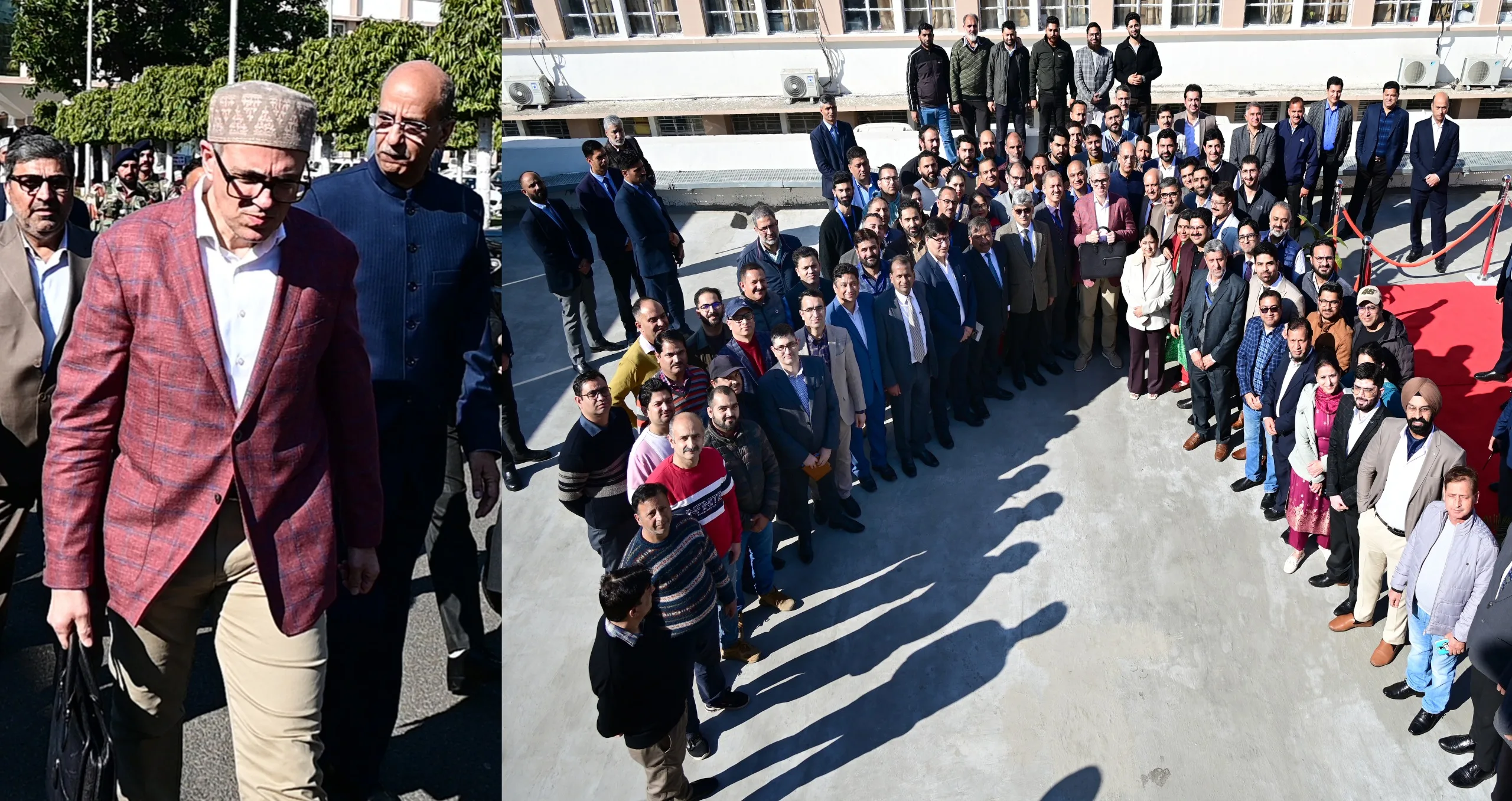
Jammu, Feb 6: Chief Minister and Finance Minister Omar Abdullah on Friday presented the Budget for 2026–27, describing it as a roadmap for resilience, reform and inclusive growth at a time of extraordinary economic and security challenges for Jammu and Kashmir.
Opening his address with a reflective note: “Safar taveel hai, bojh bhi bhaari hai. Par har surat, yeh safar jaari hai,” the Chief Minister said the Budget was not merely a statement of accounts, but a “fiscal compass” guiding the Union Territory towards sustainable prosperity, social harmony and long-term economic stability.
Presenting his second Budget as Finance Minister, he called upon all members of the House to work collectively to strengthen Jammu and Kashmir’s economic foundations.
The Budget projects Jammu and Kashmir’s GSDP to rise from ₹2.62 lakh crore in 2024–25 to ₹2.88 lakh crore in 2025–26, with an expected growth rate of 11 per cent, driven largely by the services sector contributing 62 per cent to GSVA. The government has earmarked ₹61,528 crore for road infrastructure, ₹3,456 crore for rural development, ₹1,878 crore for agriculture and allied sectors, and significant allocations for health, education, power, urban development, and tourism, signalling a strong focus on capital investment and infrastructure-led growth.
The Chief Minister acknowledged the twin shocks of the Pahalgam terror attack and devastating floods, which had affected tourism, agriculture, and employment. “This Budget provides an opportunity to respond with clarity and determination,” he said, underscoring inclusive growth and fiscal prudence.
The gross Budget for 2026–27 is pegged at ₹1,27,767 crore, with a net outlay of ₹1,13,767 crore. Own revenues meet just 25 per cent of expenditure, while committed obligations such as salaries, pensions, and debt servicing account for 60 per cent of outlays. The government plans to boost revenue through enhanced tax enforcement, e-governance tools like e-Abgari and e-Stamping, and rationalisation of subsidies, including a ₹2 per litre reduction in High-Speed Diesel rebate.
Supplementary grants of ₹3,077.04 crore have been proposed for 2025–26, covering departments such as General Administration, Home, Power, Education, Finance, Law, Tourism, Horticulture, and Cooperation. Key expenses include Darbar Move allowances, pension arrears, Mid-Day Meal Scheme, and Amarnath Ji Yatra infrastructure.
Under the Special Assistance to States for Capital Investment (SASCI) scheme, J&K secured interest-free loans of ₹4,293 crore for infrastructure, disaster mitigation, and reform-linked incentives, including mining and land governance. Digitisation of land records across 6,839 villages and cadastral mapping of 6,464 villages earned additional incentives of ₹65 crore. Initiatives like e-Office 2.0, State Data Centre upgrades, WhatsApp-based citizen services, and BHASHINI integration aim to strengthen digital governance.
Mission Karmayogi has onboarded 1.25 lakh employees, with over 53,000 undergoing training. In 2025, 7,650 candidates were appointed through merit-based recruitment, with 23,800 additional posts to be filled, including gazetted, non-gazetted, and Class IV positions. Daily-rated workers’ regularisation is being planned through a phased, legally sound roadmap.
Agriculture is expanding under the Holistic Agriculture Development Programme and IFAD-backed projects. Cultivated area has grown to 13.5 lakh hectares, fruit production reached 26.92 lakh metric tonnes, and milk output rose to 28.75 lakh metric tonnes. Seven milk processing plants costing ₹770 crore will increase processing from 4% to 25%, benefiting nearly 11 lakh farmers. Rural capital expenditure is pegged at ₹3,456 crore, with MGNREGA generating 250 lakh person-days and PMAY completing over 3.21 lakh houses.
Tourist arrivals exceeded 1.61 crore in 2025, despite floods and security challenges. Investments in adventure, winter sports, water sports, and cultural events aim to promote year-round tourism. Industrial growth includes over 2,200 units with ₹15,940 crore investment, generating 74,000 jobs. MSMEs and startups, including 490 women-led enterprises, are being supported through self-certification schemes, revival packages, and infrastructure expansion.
Health sector capital outlay is ₹1,866 crore, with new hospitals, cancer institutes, emergency facilities, and bulletproof ambulances planned. Education reforms include PM-SHRI schools, digital classrooms, and NEP-aligned initiatives, supported by ₹1,513 crore in capital allocation. Social welfare measures cover enhanced pensions, Ladli Beti Scheme benefits for 1.92 lakh girls, free public transport for women, six free LPG cylinders for AAY households, and ₹4,000/month support for 6,000 orphans.
Hydropower projects of over 3,000 MW are nearing commissioning. Renewable energy expansion continues under PM Surya Ghar. Smart metering has reduced power losses by 9% and increased revenue by 16%. The Power sector has been allocated ₹1,718 crore.
The completion of the Udhampur–Srinagar–Baramulla Rail Link and extensive road projects, including the Zojila Tunnel, 19 new National Highways, and rural connectivity works under PMGSY-IV, reflect a major thrust on physical infrastructure. Urban development projects under Smart City initiatives, PMAY-U, and Jal Jeevan Mission have received allocations of ₹2,809 crore and ₹2,558 crore respectively.
Over 510 lakh saplings have been planted, wetlands and zoological infrastructure upgraded, and CAMPA guidelines implemented. PACS reforms, cooperative food processing, and grain storage expansion received ₹27 crore in capital allocation.
Economic & Fiscal Highlights
Gross receipts: ₹1,27,767 crore
Net budget estimates: ₹1,13,767 crore
GSDP projected growth: 9.5% (₹3,15,822 crore)
Own revenues: ₹31,800 crore;
Central assistance: ₹42,752 crore; CSS inflows: ₹13,400 crore
Inclusion under SASCI scheme: 50-year interest-free loans for infrastructure projects
6 free LPG cylinders per year for AAY households
Fee waivers for AAY students in Classes 9–12 and UG colleges
Sponsorship for 6,000 orphans: ₹4,000/month via DBT
Marriage assistance increased to ₹75,000, eligibility relaxed
New Emergency & Trauma Hospitals at Uri and Poonch
Bullet-proof ambulances for border districts
Extension of Lal Ded Hospital, Srinagar (108 beds, NICU, IVF services)
Mother & Child Care Hospital, Anantnag (249 beds)
Expansion of Cardiology (Cath Labs) and PET scan facilities
Launch of Cancer Control Strategy with NITI Aayog & ICMR
Launch of JK e-Pathshala DTH Channel for Classes 1–12
Indoor games facilities in all government schools
Upgrade of 1,000 Anganwadi Centres; 127 new centres to be constructed
Scholarships for 3 lakh tribal students
Restructured Weather-Based Insurance for Apple, Saffron, Mango, Litchi (₹6,594.93 crore)
Expansion of Controlled Atmosphere storage; 40 new CA stores planned
Top-up subsidies for micro & sprinkle irrigation (₹116.86 crore)
Aromatic & Medicinal Plant Mission: ₹150 crore
Support for Van Dhan Vikas Kendras & tribal home stays
Unity Mall: ₹200 crore for permanent crafts bazaar
200+ works for Shri Amarnath Ji Yatra; further modernisation ₹180 crore
Digital financial governance: SPARSH system, Aadhaar-based DBT
Development of world-class tourist destinations
International Film Festival planned
Mission YUVA: 8,000 entrepreneurs trained, 16,000 applications sanctioned
Priority employment for local youth in industrial units
Incentives for employees in remote and hardship areas
Regularization of Daily Rated Workers to be implemented phase-wise
