


Persistent snow deficit triggers fears over water security
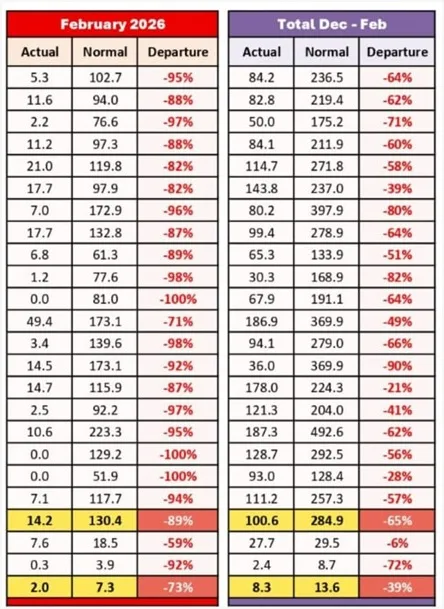
Srinagar, Mar 02: Jammu & Kashmir has closed the 2025–26 winter with a massive –65% rainfall deficit, marking the seventh consecutive deficient winter in the Union Territory and strengthening concerns over a sustained shift in seasonal precipitation patterns.
During December 2025 to February 2026, the region received only 100.6 mm of precipitation against a normal of 284.9 mm. “This is not a marginal shortfall — a 65% seasonal deficit is hydrologically significant,” said independent weather analyst Faizan Arif. “When you see seven back-to-back deficient winters, it strongly suggests a structural change in winter precipitation behaviour rather than random variability.”
The season began weakly. December 2025 recorded just 13.0 mm against 59.4 mm — a steep –78% departure. January 2026 saw some Western Disturbance activity and received 73.4 mm against 95.1 mm (–23%), offering temporary relief but failing to offset December’s losses.
February, however, collapsed dramatically. The month logged only 14.2 mm against a normal of 130.4 mm — an extraordinary –89% deficit, making it one of the driest Februarys in recent record.
“February’s –89% departure is the real turning point,” Faizan said. “Once the late-winter snow window fails, the entire seasonal snowpack generation suffers. That has cascading impacts on spring discharge and summer river flows.”
The long-term data shows a clear drying streak since 2019–20—2019–20 (–20%), 2020–21 (–37%), 2021–22 (–8%), 2022–23 (–34%), 2023–24 (–54%), 2024–25 (–45%) and 2025–26 (–65%)
“The consistency of deficits since 2019 indicates increasing variability in Western Disturbances — either weaker systems, shifting tracks, or rainfall getting concentrated in shorter spells,” Arif added.
Director Meteorological Centre Ladakh Sonam Lotus also noted that intra-seasonal distribution has become more erratic, with prolonged dry spells between active phases.
The deficit spanned almost all districts. In the Kashmir division, Shopian (–82%), Kulgam (–80%), Budgam (–71%), Kupwara (–64%), and Srinagar (–64%) reported severe shortfalls. Baramulla (–58%) and Bandipora (–60%) also remained significantly below normal.
In the Jammu division, Kishtwar recorded a staggering –90% deficit, while Kathua (–66%), Jammu (–64%), Ramban (–62%), Udhampur (–57%), and Reasi (–56%) saw major deficits. Only Poonch (–21%) and Samba (–28%) fared relatively better.
Climate experts at the Sher-e-Kashmir University of Agricultural Sciences and Technology (SKUAST-Kashmir) caution that repeated winter shortfalls weaken snow accumulation in higher reaches, reducing groundwater recharge and diminishing the meltwater buffer that sustains rivers such as the Jhelum and Chenab through summer. “With December nearly dry, January below normal and February collapsing almost 90%, the snowpack window has narrowed sharply,” Arif warned. “If this pattern persists, water stress during peak agricultural and summer demand periods could intensify.”
The 2025–26 winter now stands among the driest core seasons in recent memory — and the seventh consecutive reminder that J&K’s winter precipitation regime may be undergoing a lasting transformation.
