


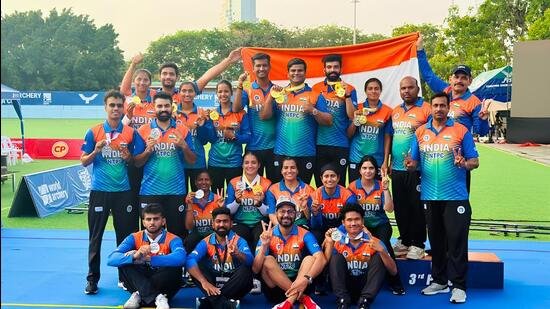
Mumbai: Compound archery’s inclusion in the 2028 Los Angeles Olympics last April came as a turning point for its global community. For Prathamesh Jawkar, it came as another detour for his career.
Part of the 2023 Asian Games gold-winning Indian men’s compound team, Jawkar had made an audacious move to recurve in late 2024. Eight months into his new start, the 22-year-old went back to compound. A clean slate once again, in a CV that comprised World Cup individual gold, World Cup Final silver and a highest world ranking of No. 4.
That slate got a fresh little tick last week, as Jawkar took the individual silver in the Asia Cup in Bangkok for his first medal after returning to compound and the national team.
“It took me a while to get back some rhythm,” he said.
The Michael Phelps-idolising archer’s switch to compound had the same basis as his switch to recurve – a shot at the Olympics. Recurve was his only chance at that, until LA tweaked things.
“Before shifting to recurve, that’s all I was wishing for: give me at least one spot, and I will try to make my way there,” Jawkar said.
It didn’t matter that LA features just the mixed team event in compound and probably one spot for an Indian male, as opposed to more events and slots in recurve.
“In recurve, I was just starting out. Although I was picking it up well because of my compound background, I have a solid base in compound. So I thought I should focus on what I do best,” Jawkar said.
And so, the day after the LA announcement, Jawkar ditched the recurve, and his eight months of training, and began shooting with the compound.
That day felt “very weird”, but also “easier”.
In recurve, the target is at a distance of 70m while in compound it’s at 50m. Compound equipment has pulleys, cables and a release switch while recurve tests physical strength as much as technique. Recurve archers shoot around 400 arrows a day in training while even half that number is termed an “intense day” in compound, as Jawkar put it.
“My recurve training initially helped me in compound, fitness wise,” he said. “My fingers would get blisters training for recurve. I had perpetual back pain which wouldn’t go away till I stopped recurve. In compound, at the end of the training day, I felt like I didn’t do a lot.”
Getting used to the compound equipment took no time and in three weeks, Jawkar felt back in shape. “The muscle memory was there.”
What wasn’t there was a competitive mindset. Jawkar did not compete at all while building his recurve blocks in those eight months. It chipped away at his “mental game”, which was nowhere close to its old self in the three tournaments that the ASI Pune trainee went to before the Asia Cup.
“I’m still not 100% there,” he said. “You get used to certain situations if you compete regularly. If there’s a long break, all those things which you’ve worked on over the years, it all feels new.”
The greater strength and shooting volume were the only aspects where recurve training helped his compound comeback.
“It’s not any easier to shoot compound if you train in recurve. In fact, it can affect you negatively too, because it’s a completely different technique.”
Which is why training for both never crossed his mind. And also why there were days, through the last 18 months in this compound-recurve-compound back and forth, that Jawkar would sit back and think: “if I hadn’t made the switch, I would’ve had a more consistent career”.
Yet, he wouldn’t take anything back. The phase made Jawkar meet new people, learn something different, and taught him a deeper lesson.
“Even after being out of competition for a long time and still making a comeback to the national team, it gave me the confidence that I shouldn’t be scared to experiment in life,” he said. “Even when I experimented, I could find my way back.”
He might be back in the national setup, but domestic competition in compound is higher now. Jawkar’s fellow 2023 Asian Games champions, Abhishek Verma and Ojas Deotale, made the cut for the upcoming World Cups along with two others from the February trials.
The challenge for Jawkar will be to join them up there again.
“It’s a really big challenge,” he said. “I did not come first in qualification in a single tournament. Everybody is shooting high scores now.”
Getting into the Indian team for this year’s Asian Games therefore feels harder for Jawkar than defending the gold in Japan. The Asian Games, though, remains “a big motivation for 2026” for this archer, who transitioned from compound to recurve and then back to compound.
