


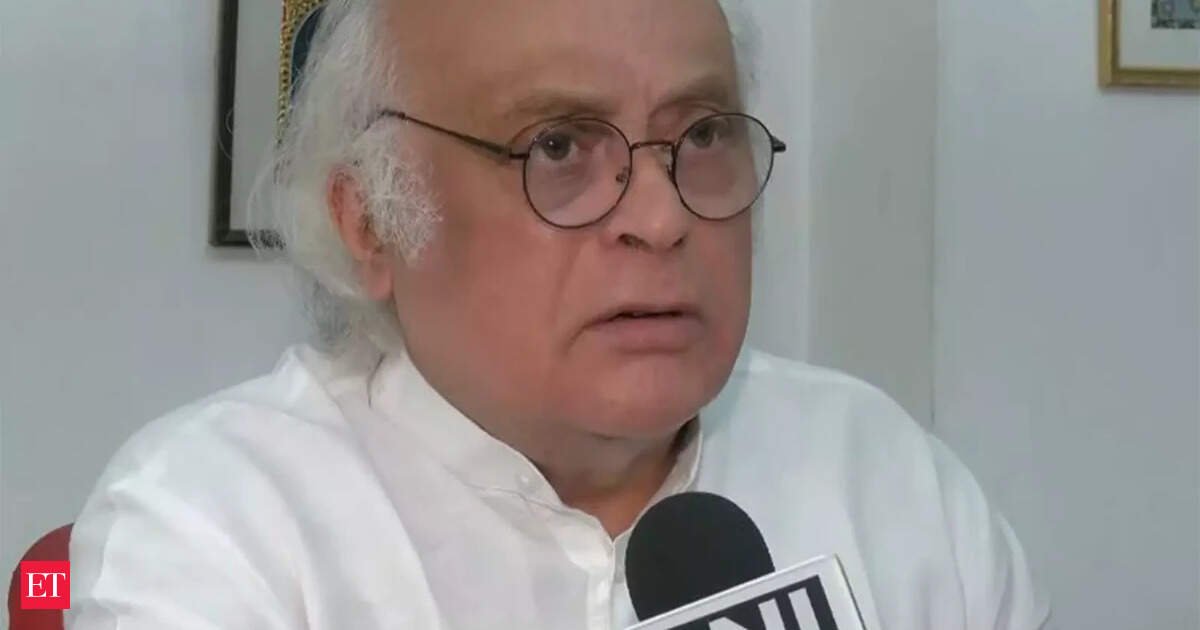
In an interview with PTI, the Rajya Sabha MP also alleged discrimination in the distribution of central funds, saying both representation and financial justice will be key issues raised to corner the BJP in the upcoming high-stakes polls in Kerala Tamil Nadu.
Asked whether the delimitation is going to be an campaign subject in Kerala and Tamil Nadu, the AICC general secretary (Communications) said it is a “very big issue” and as things stand right now, Kerala, Karnataka, Tamil Nadu, Telangana and Andhra Pradesh will see a reduction in their number of seats.
“It’s a concern. It’s not yet an issue, because the census is going to be done. By April next year, we will know the broad results of the census. And then, of course, a delimitation commission will be set up. But this is a big issue of federalism.”
“Shouldn’t be that states, particularly in the south Indian states, are penalised for being so responsible and responsive when it comes to family planning programmes,” he said.
Ramesh said Kerala was the first state in India to achieve the target of bringing the total fertility rate down to 2.1.
He explained that the objective of their policy had been to reduce the total fertility rate to 2.1, adding that at this level, the population would begin to stabilise after two generations.”That was about 40 years ago. Kerala reached a total fertility rate (TFR) of 2.1 in 1988, becoming the first state in India to do so. Tamil Nadu achieved it in 1993. Then undivided Andhra Pradesh reached it, followed by Karnataka. Later, some smaller states such as Himachal Pradesh and others also achieved it,” the former union minister said.
So it should not be the case that states which succeeded in family planning earlier are penalised in terms of their political representation, Ramesh said.
“There is an uncertainty in representation in Parliament, which is a big concern. There’s no clarity. There’s no discussion on that as yet,” he said.
His statement comes amid concerns raised by DMK leader and Tamil Nadu Chief Minister M K Stalin and Kerala CM Pinarayi Vijayan following the Centre’s move to conduct a census in the country.
Raising the alleged tussle between the Lok Bhavans and the non-BJP governments in the states, as well as discrepancies in fund distribution to states ruled by opposition parties, Ramesh charged that Prime Minister Narendra Modi speaks about cooperative federalism but practises “confrontational federalism”, centralising power and weakening the states.
“Look at the way Governors function. They are basically functioning as agents of the Centre, of the BJP. Look at the Governor of Kerala, the Governor of Tamil Nadu, the Governor of Karnataka. Wherever Opposition governments are in power, the way Bills passed by Assemblies are handled — they are sent for Presidential approval,” he said.
Ramesh said that MGNREGA, implemented during the Congress-led UPA rule, had been one of the most successful programmes and a good example of cooperative federalism, as it was implemented by the gram panchayats.
He alleged that the BJP government had bulldozed the law by introducing the Viksit Bharat-GRAM G Bill, under which allocations in every state would be determined by the central government, and it deciding on the distribution to the gram panchayats.
“This is extreme centralisation,” said Ramesh, who was in Kerala to address a gathering in the southern city of Kollam as part of the Congress’ statewide “Puthuyugam” rally led by Leader of the Opposition V D Satheesan ahead of the upcoming Assembly elections.
Ramesh said that in Kerala the contest was directly between the Congress-led UDF and the CPI(M)-led LDF, but there was also a third player, the BJP, which he claimed would ultimately work to the LDF’s advantage.
He alleged that the BJP’s objective in Kerala was not to come to power but to deny the Congress a victory, and that there was therefore a tacit understanding between the LDF and the BJP.
The senior leader argued that Kerala was ready for a change after 10 years of Left rule.
He said the response to the party’s yatra had been phenomenal, adding that the enthusiasm this time was far greater than in 2021.
Ramesh further alleged that in Kerala the objectives of the BJP and the LDF coincided, as both sought to prevent the Congress-led UDF from returning to power.
While acknowledging that the Left had taken a position against the BJP nationally, he claimed that in Kerala their interests converged, with the shared aim of keeping the Congress out of office.
