


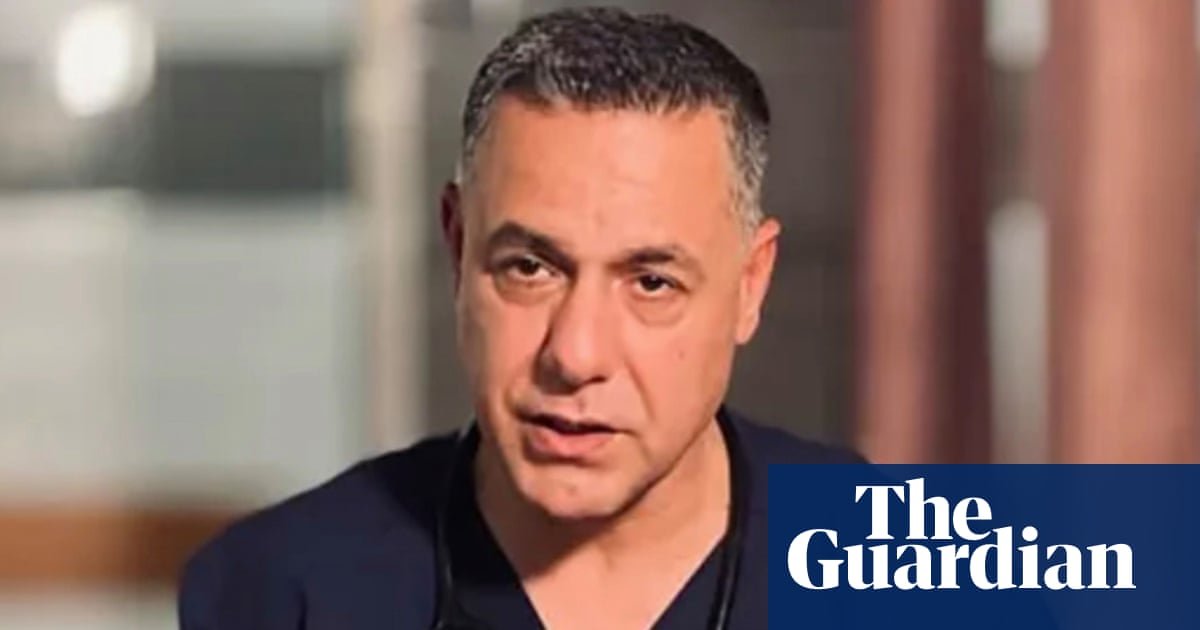
The son of a prominent Palestinian doctor detained by Israeli forces in Gaza in late 2024 and held for more than 500 days without formal charges has spoken of his deep concern for his father’s wellbeing after he was transferred without explanation to solitary confinement in a maximum-security prison.
Dr Hussam Abu Safiya, the director of Kamal Adwan hospital in northern Gaza, was detained at work on 27 December 2024. Physicians for Human Rights Israel said last week it had received information indicating that the 53-year-old had been transferred from Ketziot prison to Ramon prison, part of the Ganot prison complex, where he had been put in solitary confinement. PHRI said it had not been told the reasons for the transfer.
During a visit by a PHRI lawyer last month, Abu Safiya described harsh detention conditions, untreated medical problems and severe food shortages.
His son Elyas Abu Safiya, who is also a doctor, said his father required surgery to remove shrapnel that had become lodged in his left thigh when he was detained, and that he continued to suffer persistent pain and swelling at the site of the wound.
“What we know [about his time in detention] shows severe suffering,” Elyas said. “During the first months of his detention, he was not allowed to change his clothes, and he developed skin diseases without receiving proper treatment.
“We were told that he is [now being] held in an extremely small solitary cell, no larger than one metre by one metre, a space barely enough to move or sit properly,” he added.
According to Elyas, at the time of his detention his father was wearing a white medical coat that he had refused to wash since the death of his son Ibrahim, killed by a drone strike at the hospital entrance in October 2024.
Abu Safiya had kept the hospital running through more than 80 days of siege and attacks by Israeli forces amid an intensive military operation in the surrounding refugee camp.
More than 525 days after his arrest, Israeli authorities have yet to bring any formal charges against him. He was classified as an “unlawful combatant”, along with more than 375 medical workers – a designation Israel has frequently used to justify prolonged detention without trial. Since his arrest, the family has not been able to communicate with him directly.
“The only accusation is his refusal to obey the Israeli army’s orders to evacuate the hospital and leave the patients to their fate,” Elyas said.
PHRI learned of Abu Safiya’s solitary confinement during a visit on 4 June by a PHRI lawyer to see five other Palestinian doctors from Gaza in Ketziot prison. Four of the doctors reported that several days before the visit, security personnel had entered the wing where Abu Safiya was being held, handcuffed him and removed him without explanation.
PHRI later learned that he had reportedly been transferred to solitary confinement in Ganot prison.
Solitary confinement is widely regarded as one of the harshest forms of detention. Under the United Nations Mandela Rules, prolonged solitary confinement exceeding 14 days may amount to torture.
Abu Safiya’s lawyer, Nasser Odeh, said he had filed an appeal seeking his release on Thursday. “The Israeli officials replied saying the doctor is being held under the unlawful combatants law and that, under this law, all legal proceedings concerning the detainee are subject to a gag order and are held behind closed doors,” Odeh said.
In March, a group of UN experts said Israel must immediately release Abu Safiya and ensure that was granted access to medical examination and treatment.
He is one of 14 Palestinian doctors from Gaza currently held by Israel without charge. In April, PHRI filed a petition with the Israeli high court of justice seeking their release, and it is awaiting the court’s decision regarding the next stage of the proceedings.
The five doctors visited on 4 June, all of whom have been detained for more than two years without charge, reported a deterioration in detention conditions over the past two months. According to their accounts, prison guards forced them to sit or lie on metal beds or the floor for most of the day. One of the doctors reported frequent use of teargas, while two others said they had not appeared before a judge since December, when their detention was extended indefinitely.
The Israel Prison Service said that “due to privacy obligations, it does not provide information regarding the detention status of specific prisoners,” adding that “the allegations described do not reflect IPS practice”.
The IDF did not respond to a request for comment abut Abu Safiya’s detention without formal charges.
