



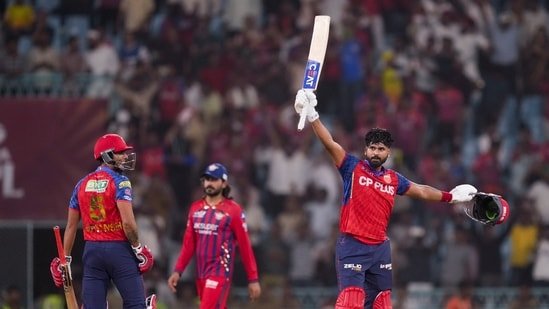
Punjab Kings did not only beat Lucknow Super Giants by seven wickets in Lucknow. They bought themselves another night in the playoff race through one innings that carried match value, captaincy value and season value in the same frame.
LSG put 196/6 on the board at the Ekana Stadium. It was not a chase that allowed comfort. Punjab had to go hard, but not brainlessly. They needed control after choosing to field first. They needed someone to absorb the scoreboard pressure, keep the rate from becoming a monster, and still close the game early enough to protect net run-rate pressure and playoff momentum.
Shreyas Iyer delivered that entire package. His 101 not out off 51 balls, with 11 fours and five sixes, was not a decorative hundred. It was a chase-winning asset. Punjab reached 200/3 in 18 overs, and Shreyas finished the game with a six when only three runs were needed. That last shot mattered symbolically, but the deeper worth came from the way he compressed the chase before that point.
Shreyas Iyer’s ₹8.36 crore night for Punjab Kings
Our monetary model values Shreyas Iyer’s total match worth at ₹8.36 crore. His cost for the match, based on his ₹26.75 crore season price and the active appearance/costing window, came to ₹2.06 crore. That leaves Punjab with a net profit of ₹6.31 crore from him alone.
That is the real ledger headline. This was not a case of a player simply scoring a century and clearing his fee. Shreyas produced more than four times his match cost. His recovery percentage stood at 406.4%, which means Punjab extracted a huge surplus on a night when the match and the season context demanded a premium return from their most expensive leadership asset.
His player-performance worth alone was ₹4.76 crore against a player-performance cost of ₹1.54 crore. That created ₹3.22 crore in batting-led profit. His captaincy layer added another ₹3.60 crore of worth against a captaincy cost of ₹0.51 crore, creating ₹3.09 crore more in captaincy profit.
That split is important because Shreyas was not only Punjab’s run-maker. He was also the control centre of the chase. A captain batting through a 197-run chase has a different economic meaning from a floating impact knock in a dead passage. He controls risk. He controls tempo. He controls dressing-room panic. He decides when the chase must be dragged, when it must be broken open, and when the opponent must be denied a comeback window.
In this match, those decisions had scoreboard consequences. Punjab were not chasing 145. They were chasing 197 away from home, with playoff survival attached to the result. Shreyas’ innings converted that target from a threat into a manageable equation.
Why the innings became premium value
The raw cricket impact was obvious. Shreyas made 101 of Punjab’s 200 runs. He faced 51 balls, which means he occupied 42.5% of the legal deliveries Punjab used in the chase. He still scored at a strike rate of 198.03. That combination is rare because volume and destruction often fight each other in T20 cricket. A batter either eats balls and protects the chase, or attacks and takes volatility with him. Shreyas did both.
His boundary count tells the story more sharply. Eleven fours and five sixes mean 74 of his 101 runs came in boundaries. That reduced the pressure on the non-striker, protected Punjab from dot-ball build-up, and allowed the chase to keep breathing even when wickets fell.
The model gave him a batting impact raw value of 150.14 and a batting score of 95.00. His final total impact score, after manual performance and captaincy treatment, rose to 455.26. That put him in the historic/freak impact band for the match. He finished No. 1 by rating-adjusted worth and No. 1 by rating-adjusted profit.
That ranking is not cosmetic. In a match where 397 runs were scored and several players had space to build statistical value, Shreyas still separated himself from the field because his output carried the match result directly. The chase did not merely contain his century. The chase became possible because of it.
The captaincy premium changes the whole reading
The most interesting part of Shreyas’ ledger is the captaincy component. His captaincy rating was 10, and the model attached ₹3.60 crore of worth to that layer. That is almost as large as his batting profit. It makes the match a leadership-performance event, not just a batting-performance event.
Punjab had chosen to field after winning the toss. LSG still reached 196/6. At that point, the decision could have looked expensive unless the chase was executed with authority. Shreyas made sure it was. A captain who wins the toss, makes the call, then personally delivers the chase carries responsibility on both sides of the match.
That is why the actual worth is stronger than a plain century valuation. The hundred gave Punjab the runs. The unbeaten finish gave Punjab certainty. The captaincy layer recognised the tactical and emotional value of holding the chase together.
This is where his ₹26.75 crore price also becomes relevant. Expensive players are not bought only for normal nights. They are bought for leverage nights. They are bought for matches where the season can bend. On a standard evening, Shreyas’ match cost of ₹2.06 crore is a heavy burden. On this night, that burden turned into a profit engine.
Punjab got ₹8.36 crore of total match value from a ₹2.06 crore match cost. That is a ₹6.31 crore surplus from one player in one game. For a retained star captain, that is exactly the kind of return that justifies the price tag.
What this means for Punjab’s season ledger
This innings keeps Punjab’s season alive in cricket terms, but it also repairs the economic logic of their investment. Shreyas entered the match with a huge annual cost attached to him. A player at that price cannot merely be decent. He has to produce match-defining spikes.
This was one of those spikes. The profit did not come through cheap efficiency. It came through premium domination. There is a difference. A low-cost player can generate profit with a good cameo. A ₹26.75 crore captain needs to alter the match. Shreyas altered it.
His century did not need a charitable reading from the ledger. The actual model value gives him ₹8.36 crore for the match, and the profit number lands at ₹6.31 crore. That is the cleanest interpretation: Punjab paid superstar money for a superstar-control game, and on this night, the account closed heavily in their favour.
The knock also avoided the classic high-price trap. In many matches, a player with an enormous season fee can produce visible contribution but still lose money because the cost base is too heavy. Shreyas cleared that line comfortably. He did not merely recover cost. He turned the match into a big-profit entry.
For Punjab, that is the night’s deeper value. The win kept them alive. The hundred gave them a hero. The ledger showed why the innings was worth far more than the scorecard number.
Method note and disclaimer
The monetary valuation exclusively designed by the author converts match impact into rupee worth using the player’s season price, expected appearance/costing window, batting-fielding impact, manual performance rating and captaincy layer where applicable. The numbers are analytical estimates designed to measure match value and profit/loss within this model, not official IPL payments, prize money or franchise accounting. The method is built to capture context-heavy T20 value, but it should be read as an editorial performance model rather than a financial statement.


