
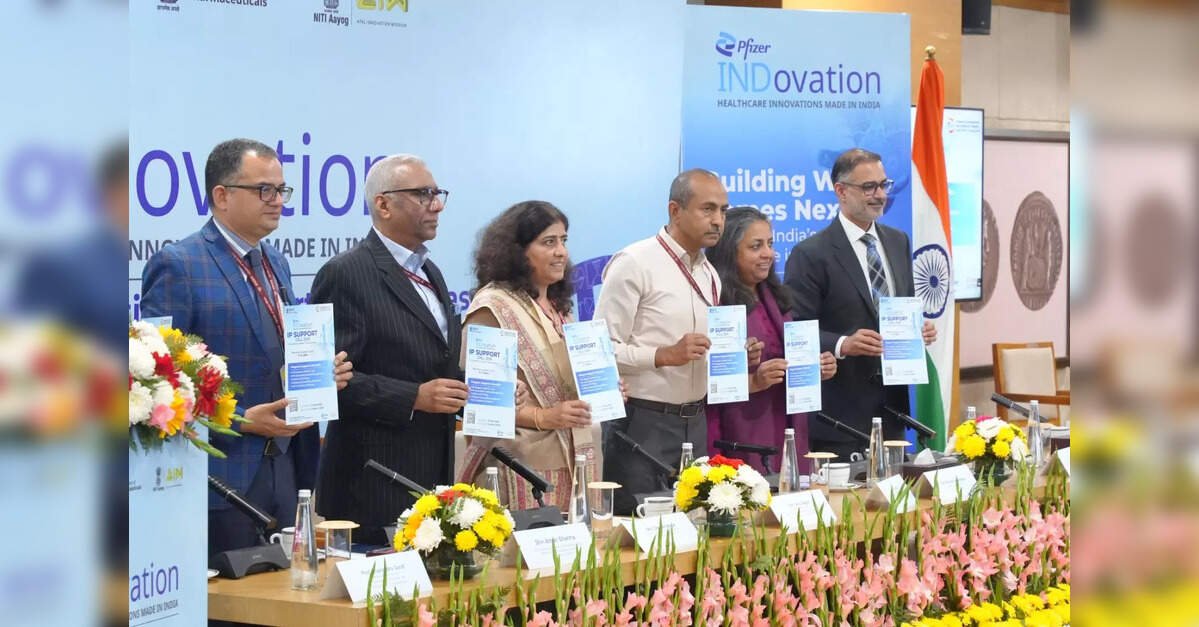
New Delhi: While India’s medtech startups are steadily gaining ground, with rising numbers, growing funding, and stronger policy support, experts lament that many innovators are sticking to low-hanging fruit instead of pursuing the riskier bets that could drive real disruption and unlock real value.
Speaking at the Pfizer INDovation Program, Dr Shailendra Saraf, Director, NIPER-Ahmedabad, said that medtech startups in India are showing promising innovations and capabilities. Yet many remain focused on “low-hanging fruit,” such as low-risk IVD kits, instead of pursuing higher-end, transformative technologies.
“Moreover, on the broader scale, 90 per cent of all pharma and medtech firms in India are purely production units with no R&D-driven operations. To unlock real value, the industry must embrace bolder, innovation-led research,” he added.
Most startups target only low-risk Class A and B devices, which keeps them exposed to competition from global giants. Part of the challenge is the stiff competition from China, where scaling at this level is difficult, Dr Saraf told ETHealthWorld at the sidelines of the summit.
“Venturing into deeper, high-tech domains could unlock untapped opportunities, yet few startups are taking that leap. The best way to do this is by striking the right balance between industry and academia, where both are interdependent on each other, he added.
Leading countries like the UK and Ireland have built robust networks with US universities—particularly Stanford—that help startups strengthen product pipelines and access top talent. In these ecosystems, students are also required to register startups as a mandatory condition for earning a PhD, Aman Sharma, Joint Secretary Department of Pharmaceuticals, sahred.
At the event, Sanjiv Singh, Joint Secretary at the Department for Promotion of Industry and Internal Trade, pointed to limited corporate investment in R&D as a key reason why deep-tech innovation remains limited.
A senior government official at the event, speaking on condition of anonymity, said that the business of high-end medtech is highly complex. Today, global giants hold as many as 400 patents for their novel products, with up to 35 patents for each component.
“Meanwhile, existing startups in India, are largely focusing on the traditional diagnostic playbook, and importing reagents from China. As a result, they lack the scope for truly frugal innovation tag that a potential investor will look to support the their commercial stages,” it added.
Under the Biopharma SHAKTI scheme announced in the recent Budget to support biopharmaceuticals, Sharma told ETHealthWorld that of the Rs 10,000 crore corpus, Rs 1,000 crore is now set aside for injectable devices.
“Such drugs require a particular dosing mechanism, and companies will be supported to build manufacturing capacities for these products,” he said.
According to government officials, as of 2025, India’s medical device imports stand at $9 billion—almost double the $4 billion worth goods exported by the domestic industry.
Besides this, India’s export basket largely features low-risk consumables such as bandages and rubber gloves, while imports include high-end critical care technologies like surgical robots, MRI scanners, and CT scanners.
Speaking at the event, Piyush Goyhal, Minister of Commerce and Industry noted that over the last three years the government has signed nine free trade agreements (FTA) that has unlocked duty free access to around 70 per cent of the global GDP and medtech startups must look to explore this opportunity.
Outlining a trend of equity dilution Goyal remarked that, by the time startups start delivering results, their founders are often left with very “low levels of equity” and are unable to reap the rewards of their own assets.
Looking at these concerns, the Pfizer INDovation Program has selected 14 medtech startups—eight for supporting ideation and six for development.
Under its CSR initiative, Pfizer has committed Rs 60 lakh to each startup, to support clinical validation, IP filing and other related aspects.
Startups selected in the development category currently hold a Technology Readiness Level (TRL) of 6 and aim to reach TRL 9 by the end of the program, with all of them deployed in real-world settings.
One of these projects includes an AI-assisted early gastric cancer detection Software as a Medical Device (SaMD) solution developed by RNT Health Insights.
Notably, the device has recently received US FDA Breakthrough Device designation, opening the fast-track approval pathway for the lucrative device market.
Ria Khurana, the startup co-founder, shared that the device works on a deep learning algorithm to detect cancer at an early stage and has outperformed gold-standard endoscopy tests in terms of efficacy.
In a trial of 250 people at PGI Chandigarh, the device demonstrated 96 per cent efficacy compared to endoscopy. The trial results are yet to be published in any peer-reviewed journal.
The other startups selected by the US giant for mentorship included Cervicheck, Utopic Tech, AiSteth and 10 others.
Pfizer also announced the launch of an IP protection program, committing Rs 2 lakh each for 20 selected startups to help cover IP filing fees and other expenses, for securing and safeguarding their innovations.
