


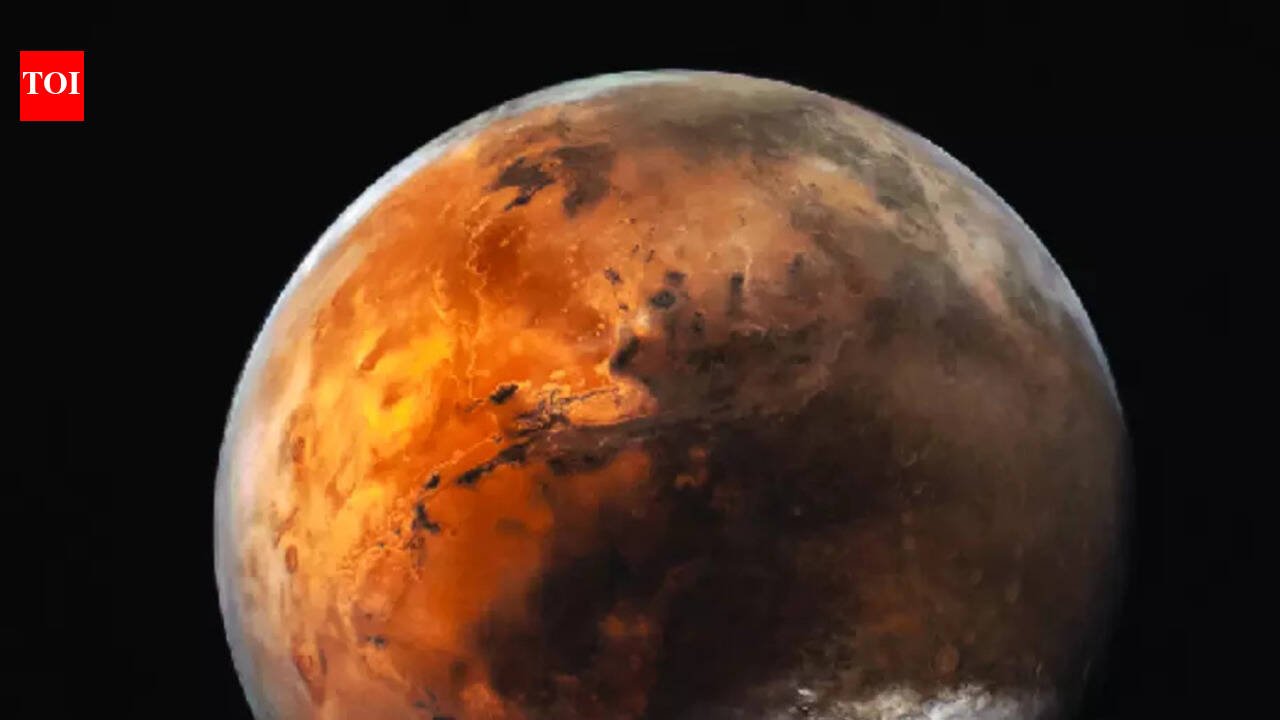
Panaji: As part of the agreement between India and the UAE, scientists have been trying to gain insights into Martian geology by studying Antarctica’s coldest and most inhospitable regions.Mohamed Ramy El-Maarry and Omar Abdulrahman Aldhanhani from Khalifa University joined the 45th Indian scientific expedition at India’s Maitri station to investigate the Schirmacher Oasis to improve scientific understanding of Mars. The collaboration is part of the MoU between India’s National Centre for Polar and Ocean Research (NCPOR) and the UAE Emirati Polar Programme, focused on exploring how Antarctic terrains act as a model or parallel for Mars.“Antarctica is the closest analog we have for Mars on Earth. It is cold, mostly dry, and is not significantly affected by biological activity or by the limited life forms that live and thrive there. Therefore, it allows us to study many landforms and processes that we know from our continuous observations of Mars are relevant to our understanding of its geological evolution and active seasonal processes,” El-Maarry told TOI.Mars, which has 24.6 hours in a day, exhibits Earth-like seasons. Research indicates that the mean equatorial surface temperature is about -60ᴼC on Mars, with the higher latitudes being even colder.El-Maarry has been involved with numerous space missions since 2006 for ESA, NASA, and recently the UAE Space Agency. These missions include the European Rosetta mission to comet 67P/Churyumov-Gerasimenko, NASA’s new horizons mission that explores the Kuiper belt, and the Emirates lunar exploration programme.El-Maarry is also on the teams for the upcoming UAE mission to explore the asteroid belt (EMA), and the ESA missions comet interceptor, the ExoMars rover, and the planetary defence mission, Hera.“Our most recent fieldwork has indeed offered new insights into how terrains on Mars change with time, particularly in areas that may have been covered by ice in the past and are now ‘ice-free’, similar to the Schirmacher Oasis terrains,” said El-Maarry.Antarctic zones, particularly the cold, hyper-arid McMurdo dry valleys, serve as premier Earth-based models or parallels for Mars, allowing scientists to study geological processes, test equipment, and search for microorganisms that thrive in extreme conditions similar to the red planet.“As the strategic partnership between India and UAE has reached a new level, India, with long-term expertise in Antarctica, will also support and collaborate with the UAE to enhance scientific exploration of polar regions,” said NCPOR director Thamban Meloth.This collaboration reflects India’s commitment to supporting Asian and global south partners in advancing polar and planetary science, as NCPOR plays host to scientists from the Emirates polar programme as part of international scientific cooperation
