


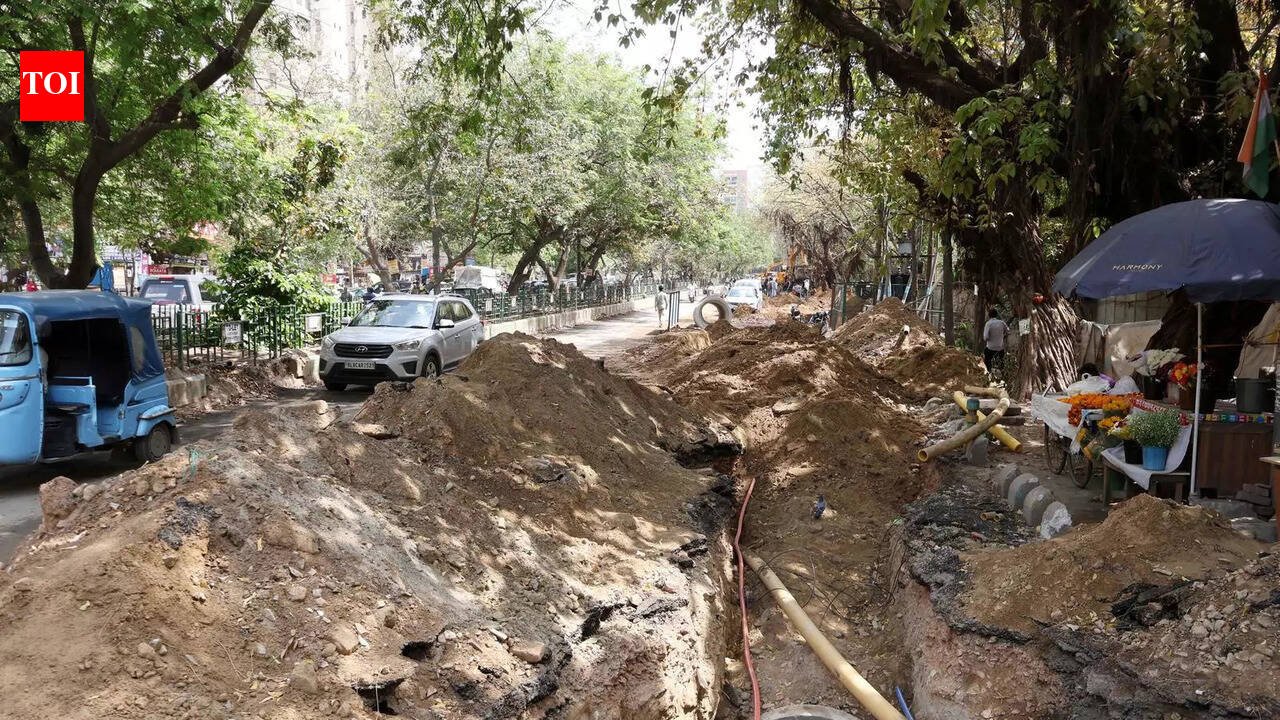
Ghaziabad: For years, Indirapuram has existed in a civic limbo. Managed by the Ghaziabad Development Authority until two years agao, the densely populated neighbourhood saw little visible civic infrastructure revamp. Roads deteriorated, drainage lines aged, and complaints piled up.Now, residents say the pendulum has swung too far the other way.Since the township was handed over to the Ghaziabad Municipal Corporation on Oct 3, 2024, much of Indirapuram has turned into a patchwork of excavation sites. Roadsides are dug up to lay pipelines, repair drainage lines, or install utility poles. In many places, pits remain open for weeks or months. And more often without barricades or warning signs. Some have protruding iron rods, creating hazards for pedestrians and motorists alike.Across the township, the combination of broken roads, mounds of earth and overflowing drains has begun to reshape everyday life.“The whole stretch between Sai temple and Amrapali Village sometimes looks like a hill station, except the ‘hills’ here are mounds of excavated soil dumped along the roadside,” said Jitender, a resident of nearby Supertech Icon.One side of the 2-km stretch has been closed for repairs for days now, forcing vehicles to squeeze through a narrow lane riddled with potholes. The result is constant traffic snarls and frequent overflow of sewer water onto the road, he said.“It feels like the authorities dug up the entire stretch and then forgot about it,” said Sanjeev Sinha, who lives in Patrakar Vihar, about 500 metres away.For shopkeepers along the corridor, the construction has also meant dwindling customers. Near the entrance of Amrapali Village along National Highway 9, Chanchal runs a small kiosk that once relied heavily on passing commuters.“For the last two months, the road outside my shop has been dug up,” he said. “Customers who used to stop on the way no longer come because of the dust and sewer water. Only some regular customers visit now. Business has dropped sharply.” Residents claimed the situation is no better on CISF Road. One of Indirapuram’s main arteries linking NH-9 with Vasundhara, the stretch has been repeatedly excavated in recent years for sewer projects. At one point, residents said, the road remained dug up for nearly nine months. Now it has been excavated again.“They dug it up earlier to lay a sewer pipeline, and now it is dug up again,” said Ratnesh Singhal, who owns a shop near Shanti Gopal Hospital. “Iron rods are sticking out in places. It is dangerous for both pedestrians and vehicles.”Commuters claimed the road conditions have become so poor that drivers of ride-hailing taxis often refuse to enter bylanes of the township.Swati Choudhary, who lives in Amrapali Village, said drivers frequently stop short of their destination. “Many of them drop us nearly a kilometre away,” he said. “One driver told me his car was new and he wouldn’t risk damaging it on these roads.”According to civic officials, work was underway on at least 13km of roads and sewer lines in Indirapuram, with additional stretches covered under the CM Green Road Infrastructure Development Scheme (Urban Phase-I).GMC’s chief engineer NK Choudhary told TOI that delays and disruptions were inherent to such projects. “Concrete slabbing requires time to settle, and there is a fixed process—survey, tendering, work orders and execution, which cannot be rushed,” he said.Key stretches under repair include the Bala Ji Mandir-NH-9 corridor via Kaveri Marg and the NH 9-Balaji Mandir stretch via Kala Patthar (about 4km), Kala Patthar to Shaheed Capt Mangal Pandey Marg via Sushila Naiyar Marg (2km) and via Kasturba Gandhi Marg (1.8km), and Sushila Naiyar Marg to Kala Patthar via Shipra Mall (1km). Several additional stretches are being upgraded under the state govt’s CM Green Road Infrastructure Development Scheme. Indirapuram has about 40 kilometres of roads and nearly 135 kilometres of drainage lines, and many of these are old and need a complete overhaul.According to Choudhary, the township’s drainage network has long struggled with undersized pipelines that cannot handle the volume of wastewater generated by its dense population. “The diameter of several pipelines is too small, which causes wastewater to overflow onto roads. We are replacing damaged pipelines and laying new ones where necessary.”The area’s topography also complicates matters. The township slopes eastward towards the Hindon, creating uneven gradients that can cause wastewater to accumulate in certain pockets.Because drainage lines often run parallel to roads, excavating them inevitably damages the road surface, the official said.“After the handover of the township, GMC started major revamp work. The municipal corporation has allocated about Rs 17 crore for the overhaul and estimates that work will take at least four more months to complete,” Choudhary added.
