


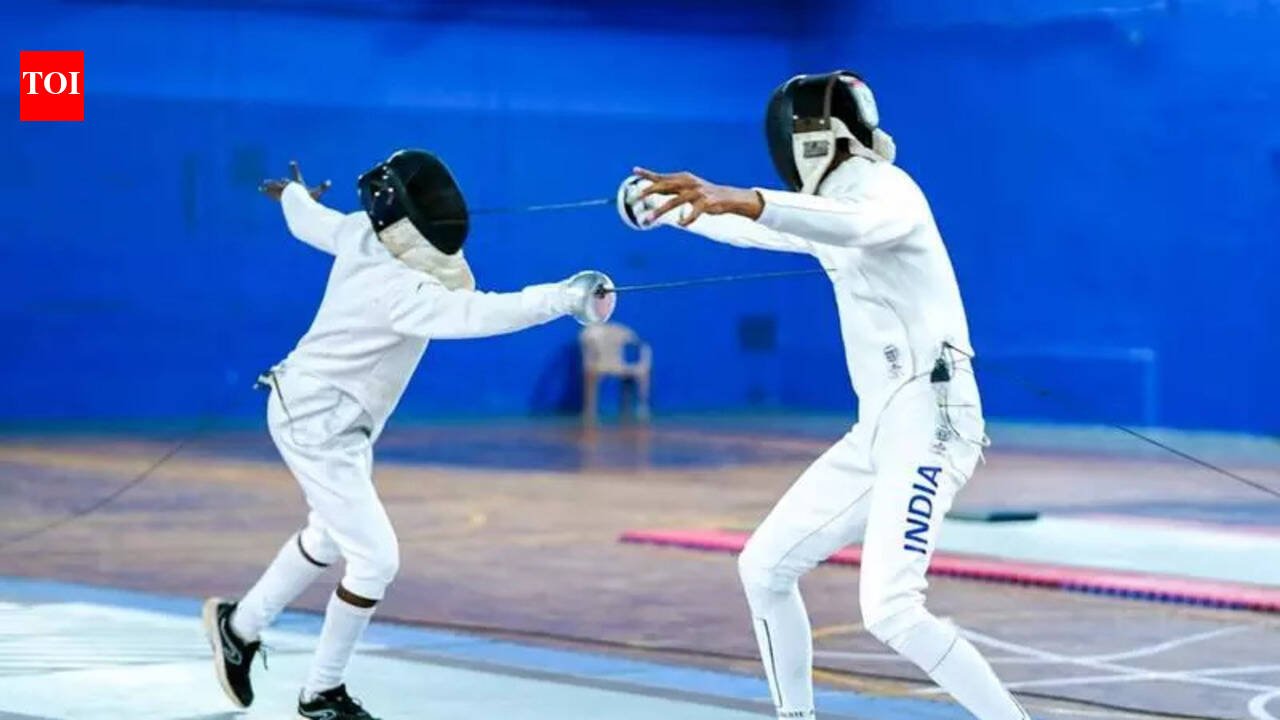
Chandigarh: Inside the newly operational Sports Authority of India’s (SAI’s) High Performance Centre at the Nataji Subhas National Institute of Sports (NSNIS) in Patiala, the metallic clang of blades echoes across the hall as India’s top sabre fencers push through intense training sessions. With the Senior Asian Fencing Championships set to be held in India for the first time this June, the national camp has taken on added urgency.The camp, organised by the Sports Authority of India (SAI), brought together the country’s best senior and junior sabre fencers as part of preparations for upcoming World Cups, the Asian Championships, and ultimately the Asian Games qualification cycle.As the current training cohort concludes its intensive sessions at the centre, the momentum is set to carry forward with the next national camp scheduled to return to NSNIS Patiala this April.“We currently have 12 senior boys and 12 senior girls training in sabre. Alongside them, the top four each cadet and junior boys and girls are also part of the camp,” said SAI’s senior fencing coach and national chief coach Sagar Lagu adding that, “…the idea is to create an environment where younger fencers can observe and learn from the seniors while preparing for the Junior Asian Championships.”According to Lagu, the focus is particularly on team events as India looks to strengthen its position in continental rankings. “In sabre, our women’s team is currently ranked seventh in Asia and the men’s team sixth. Being in the top eight puts us in a competitive bracket, but our aim is to improve those rankings through the upcoming competitions,” he says.The immediate targets include World Cups, followed by the Asian Championships scheduled in New Delhi from June 18 to 26. In total, four World Cup events for men’s and women’s sabre will contribute crucial ranking points toward Asian Games qualification.Lagu also pointed to trailblazers like Olympian Bhavani Devi, who won an individual bronze medal at the 2023 Asian Championship, as inspiration for the younger athletes. “Performances like hers show the next generation what is possible,” Lagu asserted.From chance beginnings to professional precision Among those at the camp is Tamil Nadu’s KP Gisho Nidhi, a soldier in the Indian Army who has emerged as one of the country’s most experienced sabre fencers. A four-time National Games gold medallist and two-time national champion, Nidhi also claimed an individual bronze at the 2022 Commonwealth Championship in London and has competed at the Asian Games.“My journey began quite by chance,” he recalls. “In school, fencing was introduced around 2004. I used to play kabaddi, but my teacher encouraged me to try fencing. I played my first nationals in 2006 and the following year I met a Major who selected me for the Army Sports Institute.”The move proved pivotal. “At the Army Sports Institute we had access to foreign coaches and structured training. That helped build a strong foundation,” said Nidhi, who went on to win India’s first international junior Commonwealth medal in 2012.His competition calendar is packed: “We have events in Italy and Budapest in March, then World Cups, the Asian Championships in Delhi in June and then event in Hong Kong in July. These tournaments will determine our ranking for Asian Games qualification. The top eight teams will make it.”For Vishal Thapar, who hails from Jammu and Kashmir and has been training at NSNIS Patiala since 2019, fencing began as a summer curiosity.“During a summer vacation, I went to the local stadium with friends and saw people fencing,” he said. “It looked unique and exciting, so I spoke to the coaches and started learning. What began as fun gradually turned into my profession.”Thapar has since won gold at the Commonwealth Championship and represented India at Asian and World Championships.Forging a sharper strikeThapar believes the new infrastructure at the High Performance Centre is a major step forward for Indian fencing. “Earlier, facilities like gym access, physiotherapy and specialised coaching were mostly available during camps. Now athletes have all of that integrated into their regular training,” he says.Punjab’s Sanya, another sabre fencer in the camp, traces her journey back to a school experiment. The Sangrur native first picked up a blade at age 12 when the sport was introduced at her school.“I wanted to try something different. What started as fun soon became serious when I got selected for the nationals,” she says.Sanya won her first mini national medal in 2012 and was selected for a SAI training programme at just 15. A student of Guru Nanak Foundation School, she credits early guidance from coaches Mohit and Krishan for shaping her career.“I was the first in my family to pursue sports professionally. My mother always encouraged me to excel not only in academics but also in other fields,” Sanya says. Today, even her younger sister has taken to sport, competing in shooting.Reflecting on the sport’s growth, the young fencer said that the ecosystem has improved dramatically over the past decade. “Back in 2015 we didn’t have so many facilities. Now athletes have support in nutrition, sports psychology, recovery and hydrotherapy. It makes a big difference,” she added.With the Asian Championships coming to India for the first time and Asian Games qualification on the horizon, the trio — like many others in the Patiala camp — are sharpening their blades with a shared goal.“Our focus is simple,” says Thapar, “Stay consistent, keep improving, and make sure India qualifies strongly for the Asian Games.”
