


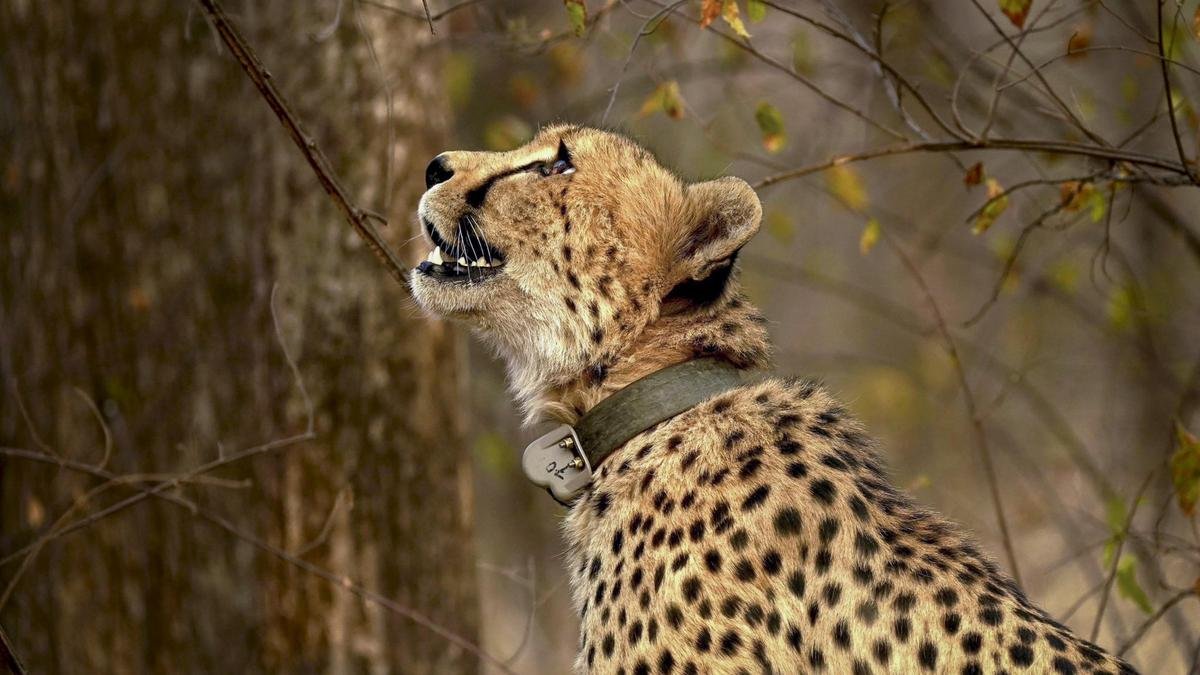
Last week, nine wild African cheetahs were tranquilised in Botswana’s savannah, quarantined for a few weeks in the country, and then taken on a 10-hour flight over the Indian Ocean by the Indian Air Force to Gwalior. From here, the big cats were flown in helicopters to large quarantine enclosures in Kuno National Park in Madhya Pradesh.
This was part of the controversial multi-crore Project Cheetah, flagged off in 2022 by Prime Minister Narendra Modi (on his birthday, September 17). The aim was to introduce African cheetahs to India — Asiatic cheetahs were hunted to extinction in the country in 1952 — to help with the “global conservation” of the big cat and re-establish the cheetah within its “historical range”.
“Here, the cheetah will serve as a flagship to save not only its prey-base, but also other endangered species [such as the great Indian bustard and the Indian wolf] of the grassland and semi-arid ecosystems,” the National Tiger Conservation Authority had said.
The scheme also hopes to improve livelihood options for local communities through ecotourism.
Ready for next phase
With this new batch, India now has 53 cheetahs, 33 of which are cubs born here and 20 are adults brought from Namibia in 2022, and South Africa in 2023, and, now, nine from Botswana. Jwala gave birth to five cubs on March 9, her third litter in three years.
Last week, Gamini, a cheetah from South Africa, gave birth to four cubs in Kuno National Park to much applause.
“India is on track to establishing a self-sustaining metapopulation of 60-70 cheetahs across 17,000 sq. km by 2032, with Gandhi Sagar Wildlife Sanctuary ready for the next phase,” a government press note said last December.
According to the Madhya Pradesh forest department, 14 cheetahs have now been released from their larger enclosures and are free-ranging in Kuno.
Rising numbers
But scientists said the project should immediately stop further imports of wild African cheetahs because of the abysmal lack of habitat and prey and other socio-economic reasons.
Wildlife biologist and CEO of Metastring Foundation Ravi Chellam said the cheetah introduction project has focused too much on captive breeding of cheetahs, which he said the Cheetah Action Plan doesn’t even mention.
It is “farcical,” said Dr. Chellam, that the birth of what are essentially captive-bred cheetahs is being hailed as a sign of the project’s success. The carrying capacity of the 748.76 sq. km Kuno National Park is also at best only about 10 adult cheetahs, he added. But with every captive-bred litter the numbers are only set to rise.
“India currently doesn’t have an adequate extent of habitats … suitable to host a population of wild and free-ranging cheetahs in terms of habitat quality, primarily availability of prey animals and connectivity to other suitable habitats,” according to Dr. Chellam.
Importing wild cheetahs from African countries to primarily keep them in some form of prolonged captivity in India does not make any sense, he added, “especially from countries like Botswana, which has a declining population of wild cheetahs”.
Not rosy
Nitin Rai, a fellow at the Ashoka Trust for Research in Ecology and the Environment, concurred: it is time for Project Cheetah to end, he told The Hindu. “It is destined to fail because there is no habitat for an expanding population.” Hegoes further to say the project is a “green grab”, or a land grab in the name of conservation.
“The cheetah, like the tiger, is being used as a proxy for territorial control of land and to move out forest dwellers,” he said. “Just as land is controlled in tiger reserves in the name of the tiger, forests that do not have tigers are now sought to be controlled in the name of the cheetah.”
Will cheetahs help conserve grasslands as is hoped? That would be putting the cart before the horse, says Dr. Rai. “We first need to recreate massive areas as grassland before we consider reintroductions of cheetahs and associated prey. Cheetahs are not going to be able to create their own habitats!”
The fate of the African cheetahs in India has not been rosy: nine of the imported big cats and 12 cubs born in India have died so far at Kuno. Uday died of acute heart failure. Daksha was mauled by a male cheetah in a large enclosure while the managers were trying to get them to mate. Tejas most likely died in conflict with another cheetah. Suraj and Dharti died of dermatitis, followed by myiasis and septicaemia. Pavan either drowned to death or was poisoned. Nabha died from fractures possibly sustained while hunting within the large enclosures.
Cheetahs instead of lions
But Y.V. Jhala, former dean of the Wildlife Institute of India and designer of the cheetah project, says he is optimistic about seeing cheetahs breed and have their numbers increase. “It is also good that cheetahs have been brought in from Botswana and not Kenya as these are of the same subspecies; so we have not compromised on our global contribution to conservation of the species,” he told The Hindu.
“What we now need is to secure and restore habitats in other protected areas in the State by incentivised voluntary relocation of habitation and judicious fencing of some boundaries of these parks.”
The Chief Wildlife Warden of Madhya Pradesh Subharanjan Sen said it is standard management practice at several low prey density spaces in protected areas, where big cats roam in Madhya Pradesh, to supplement chital (spotted deer) from high density areas. He added that Kuno also has two chital breeding enclosures to help supplement the prey in the cheetah territory: “In relocated village areas we are striving to maintain the old agricultural fields as grasslands.”
From the very beginning, the idea of cheetah introduction has been pushed by a conservation elite, such as former princes turned either bureaucrats or conservationists. “They are the people who have run roughshod over local opinions, understanding and histories of landscape change,” Dr. Rai said, adding: “When the lions were not released from Gujarat, the government decided to bring cheetahs instead.”
divya.gandhi@thehindu.co.in
Published – March 10, 2026 08:00 am IST
