


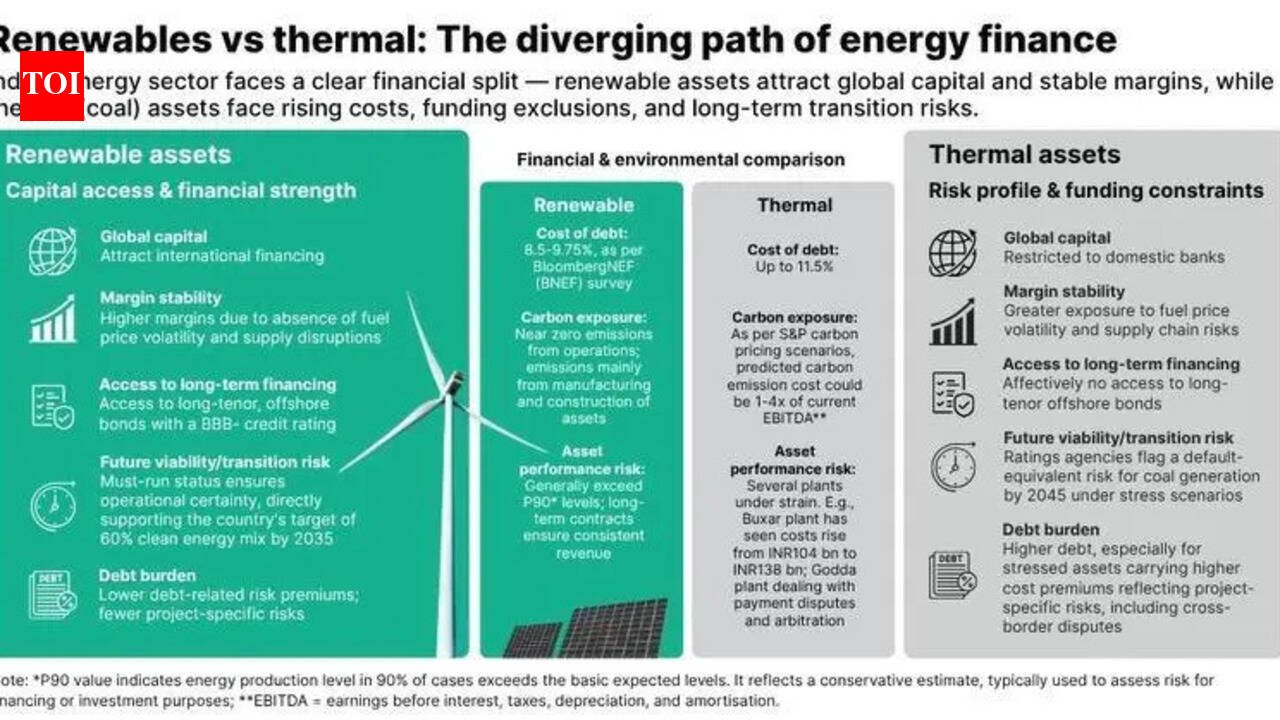
Chennai: India is scaling up clean power rapidly. The country aims to reach 500 GW of renewable energy capacity by 2030 and source 60% of its total energy mix from non-fossil fuels by 2035. However, mobilising the required scale of financing is emerging as the biggest challenge to achieving these goals, according to a study by the Institute for Energy Economics and Financial Analysis (IEEFA).Annual investments in renewables, storage and transmission could more than double to about $145 billion by 2035, up from an estimated $68 billion by 2032. The report underlines that the success of India’s energy transition will depend not just on technology or policy support, but increasingly on the availability, cost and structure of debt financing.India’s power sector is entering a critical phase, where the pace and trajectory of the transition will be shaped by its ability to secure long-tenor, affordable financing for capital-intensive renewable projects such as solar and wind. Meeting the government’s target of 500 GW of renewable capacity by 2030 will require a sustained surge in capital expenditure, with debt markets expected to play a central role.The report highlights that credit markets are already drawing a clear distinction between clean and thermal energy assets. Renewable energy platforms are benefiting from stronger margins, lower operating costs and better access to capital, while continued investment in thermal power risks constraining balance sheets and limiting funding availability for green projects.“Transition planning is fundamentally a question of debt market planning. The availability, tenor and cost of debt will decide how fast capacity can be added—and who gets left behind,” said Kevin Leung, Sustainable Finance Analyst, Debt Markets, IEEFA – Europe.India’s corporate bond market, despite annual issuances exceeding $500 billion in 2025, remains relatively underdeveloped and dominated by public sector borrowers. The report notes that utilities still rely heavily on bank loans, which account for nearly 80% of their debt, pointing to significant untapped potential for bond market financing.The study points out NTPC as a key player in enabling the transition. With a planned capital expenditure of ₹7 trillion (about $80 billion) through FY2032 and a credit profile aligned with sovereign ratings, NTPC is seen as well-positioned to anchor large-scale, low-cost financing for the sector.“It is uniquely positioned to catalyse broader capital flows if it can demonstrate a credible shift towards clean energy,” said Saurabh Trivedi, Lead Specialist, Sustainable Finance & Carbon Markets, IEEFA – South Asia.It also cautions that reliance on volatile international capital flows could expose India’s energy transition to external shocks, making the development of a deeper domestic bond market and greater participation from long-term institutional investors critical for financial resilience.With multidisciplinary reforms that integrate the entire energy and finance ecosystems, debt finance is not just an enabler of India’s energy transition; it represents a strategic opportunity to strengthen the country’s financial markets while supporting sustainable economic growth, the report added.
