


Eight days ago in Ahmedabad, when Suryakumar Yadav was asked about the visible correlation between Abhishek Sharma and Tilak Varma’s struggles during the group stage, and whether Sanju Samson could be considered as a solution, the India captain laughed it off at the press conference.
Abhishek, India’s designated aggressor at the top, had failed to get off the mark in his first three innings. Tilak, batting at No. 3, had managed 106 runs in four outings at a strike rate of 120. The concerns were real, even if India were unbeaten.
“You mean, I should make him (Samson) play for Tilak? Or Abhishek?” Surya had quipped.
At that moment, neither Surya nor the management were entirely wrong. He acknowledged the concerns but was unwilling to disrupt a winning combination at the start of the Super 8. Having endured an 18-month rough patch himself, during which the team backed him unwaveringly, Surya was keen to extend the same faith to Abhishek and Tilak.
ALSO READ: Send Sanju Samson all the love you have, but don’t forget India’s hero who silenced West Indies
But 24 hours later, after India’s frailties were brutally exposed in a 76-run defeat to South Africa, the management returned to the drawing board. This time, Samson was no longer a hypothetical question, he was a genuine solution.
India were widely tipped to defend their T20 World Cup crown because of their explosive batting over the past year. At its core was Abhishek’s dominance against the new ball, which allowed the middle order, Tilak included, to flourish.
However, the decision to pair Ishan Kishan with Abhishek meant India fielded five left-handers in their top seven. Opponents responded predictably, introducing off-spin early. Abhishek struggled, and Tilak, forced in earlier than intended, looked indecisive.
The vulnerability against off-spin had been debated in pre-match discussions, but India persisted. South Africa exploited it ruthlessly, handing India their heaviest defeat in T20 World Cup history and pushing them to the brink.
Suddenly, it was unfamiliar territory, a must-win scenario so early in an ICC tournament, something India hadn’t faced since the disappointing 2021 campaign.
Enter Samson
Four days later in Chennai against Zimbabwe, Samson opened and took strike in the first over, a tactical move that likely discouraged Zimbabwe from starting with off-spin. He struck a brisk 25 off 15 and set the tone. India’s top order followed suit, all six of the top batters scoring at over 150. Abhishek made 55 off 30. Ishan, promoted to No. 3, scored 38 off 24. Tilak, now at No. 6, smashed an unbeaten 44 off 16. The recalibration had worked.
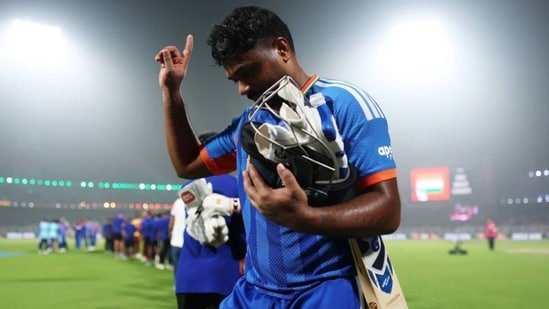
Then came Eden Gardens. On Sunday, before a packed Kolkata crowd, it was a long-awaited Samson spectacle. Opening the innings, he struck 97 off 50 balls, 12 fours and four sixes, carrying his bat for the first time in his T20 career as an opener.
He did not face a ball in the first two overs. But once on strike, he dismantled Akeal Hosein, smashing two sixes and a four in his first four deliveries. By the end of the powerplay, India were 53 for 2, with Samson contributing nearly half, 24 off 13.
With two early wickets down in a stiff chase, Suryakumar looked tense. The dugout did too. Samson, however, remained composed. There was no visible rush, no exaggerated muscle, just clean, classical shot-making and measured acceleration.
That calm impressed head coach Gautam Gambhir the most.
“I actually felt that he never accelerated the innings,” Gambhir said. “It was just normal cricketing shots. I never saw him muscling the ball. That is the kind of talent he has.
“He had a tough series against New Zealand. Sometimes you need to give a player a break to get him out of that pressure situation. But we always knew that when we needed him in a World Cup game, he would deliver.”
Samson’s knock featured two key partnerships, including one with Tilak, who once again flourished in a freer role with a 15-ball 27.
‘Victory belongs to the most tenacious’
Those into tennis will surely know these words, which are engraved at Stade Roland Garros in Paris. And few narratives in this tournament embody them better than Samson’s.
The past year has been an emotional rollercoaster. After three centuries in late 2024, Samson became India’s first-choice T20 opener. Then came the dip. By mid-2025, India brought back Shubman Gill to the XI, pushing Samson down the order and eventually out of the side.
A last-minute shift in World Cup planning reinstated him as opener. A lean New Zealand series saw him dropped again.
In the 2024 T20 World Cup, he was the only squad member not to feature in a single game. There were moments when he must have felt surplus to requirements.
Yet he never sulked. Even during difficult phases, he was often seen smiling quietly in the dugout, waiting. And when the opportunity arrived, he produced what might be the most valuable innings of his career, greater in impact than any of his three international centuries.
Perhaps it was circumstance. Perhaps inevitability. But as India approach the business end of the tournament, Samson’s return, and the tactical adjustments around him, have reshaped their batting blueprint at precisely the right time.
