


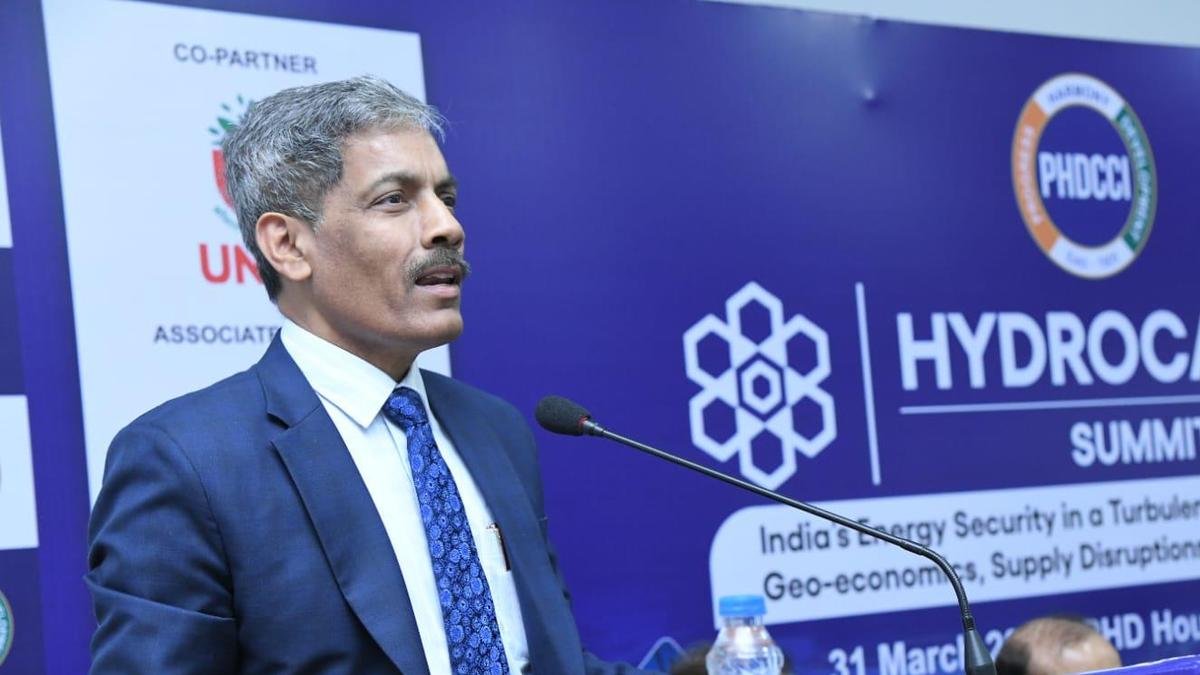
“Even if you scale up to say 2 crore, or 5 crore, we are totally sufficient with respect to our domestic consumption,” Anjan Kumar Mishra, Secretary at the Petroleum and Natural Gas Regulatory Board (PNGRB), said. Photo: Special Arrangement
India can comfortably cater to the demand of as many as 30 crore domestic piped natural gas (PNG) connections even if it were to solely rely on its domestic production of liquefied natural gas (LNG), according to Anjan Kumar Mishra, Secretary at the Petroleum and Natural Gas Regulatory Board (PNGRB).
Speaking to The Hindu on the sidelines of industry body PHDCCI’s Hydrocarbon Summit, Mr. Mishra said India currently had approximately 1.1-1.2 crore active domestic PNG connections. These connections consumed 3 million metric standard cubic meters per day (MMSCMD) of the natural gas.
India’s current production of natural gas was about 90 MMSCMD. Therefore, India could comfortably cater to about 30 crore connections solely with its domestic production of natural gas itself, Mr. Mishra said.
“Even if we are just reserving the [domestic natural gas] production for domestic PNG, we should be able to make provisions for 30 crore connections,” Mr. Mishra said. “So, even if you scale up to say 2 crore, or 5 crore, we are totally sufficient with respect to our domestic consumption.”
LPG pressure
With escalating tensions in West Asia, the government has sought to institute mechanisms for an accelerated and incentivised transition to piped gas. The objective is to ease some pressure off the liquefied petroleum gas (LPG), supplies of which have been affected.
Mr. Mishra said the government and the PNGRB were trying to significantly scale up the number of connections added every day. This was inclusive of new connections and re-activating dormant ones.
“We are trying to achieve 20,000 connections every day,” he said. “At present, we are hovering around 8,000-9,000 connections per day; we are definitely trying to scale the level,” Mr. Mishra said.
He further noted that, with permissions being accorded on a “war footing” by the government, municipal corporations, among other entities concerned, had played an active role in the attempt to reach the target.
The Ministry of Petroleum and Natural Gas, in a gazette notification dated March 24, had introduced norms to help accelerate the uptake of and transition to PNG. The norms sought to address structural delays in approvals and access to land and accorded provisions for deemed approvals, among other things.
‘Capex not an issue’
Addressing concerns about the requirement of additional capital expenditure amid the expedited push for PNG and pipeline expansion, Mr. Mishra said the accelerated push would provide the city gas distributors (CGDs) an opportunity to infuse their available capital more rapidly.
“They [CGD companies] were having the capex ready with them but they were not able to expand and infuse the capital because of varied permissions,” he stated. “We are expediting the permissions and they would be able to infuse the capital. Moreover, the economics also works because when they have more connections, more revenue would come and they would be able to spend more.”
Published – March 31, 2026 09:55 pm IST
