


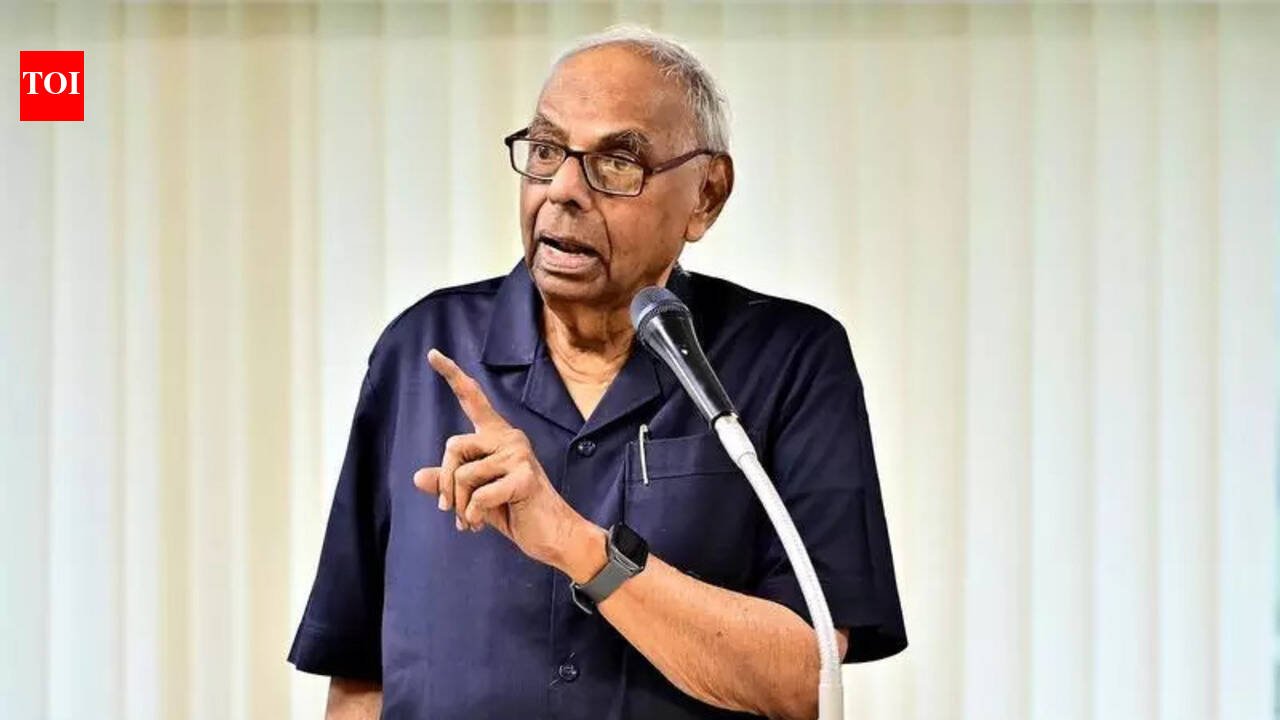
Chennai: Reserve Bank of India former governor and economist C Rangarajan on Tuesday criticised the 16th finance commission report for recommending a “grand bargain” between the Centre and states to increase the divisible tax pool, saying it was inappropriate for the commission to suggest this. Speaking in Chennai at a conference on the report of the 16th finance commission, jointly organised by Madras Institute of Development Studies and Madras School of Economics, Rangarajan said, “The commission said states would agree to a smaller share, resulting in a larger divisible pool with no loss of revenue to either side, provided the Centre agrees to merge a larger part of cesses and surcharges into the regular taxes. This is surprising. The finance commission was appointed to decide the shares of the Centre and states.”Rangarajan said the finance commission repeatedly stated that fiscal space was shrinking. “The finance commission repeats in many places that the fiscal space is shrinking. The Central govt reacted to it in many ways, including levying cess and surcharges rather than duty or taxes, because these two items, cess and surcharges, are not part of the divisible pool,” Rangarajan said, adding that the share of the Centre also went down in the centrally sponsored schemes.He said the finance commission should have taken a stronger position on the issue. “In my view, the finance commission should have made a strong point that it is inappropriate for the Centre to resort to these measures to reduce the share of the states,” he said. He also said the finance commission retained that 41% of the divisible tax pool would go to the states. He also criticised the removal of certain grants. S Narayanan, former economic adviser to the PM, said, “Simply looking at this as a Centre vs State issue misses a lot of disparities that are happening within the country from a social, economic and anthropological point of view.”
