


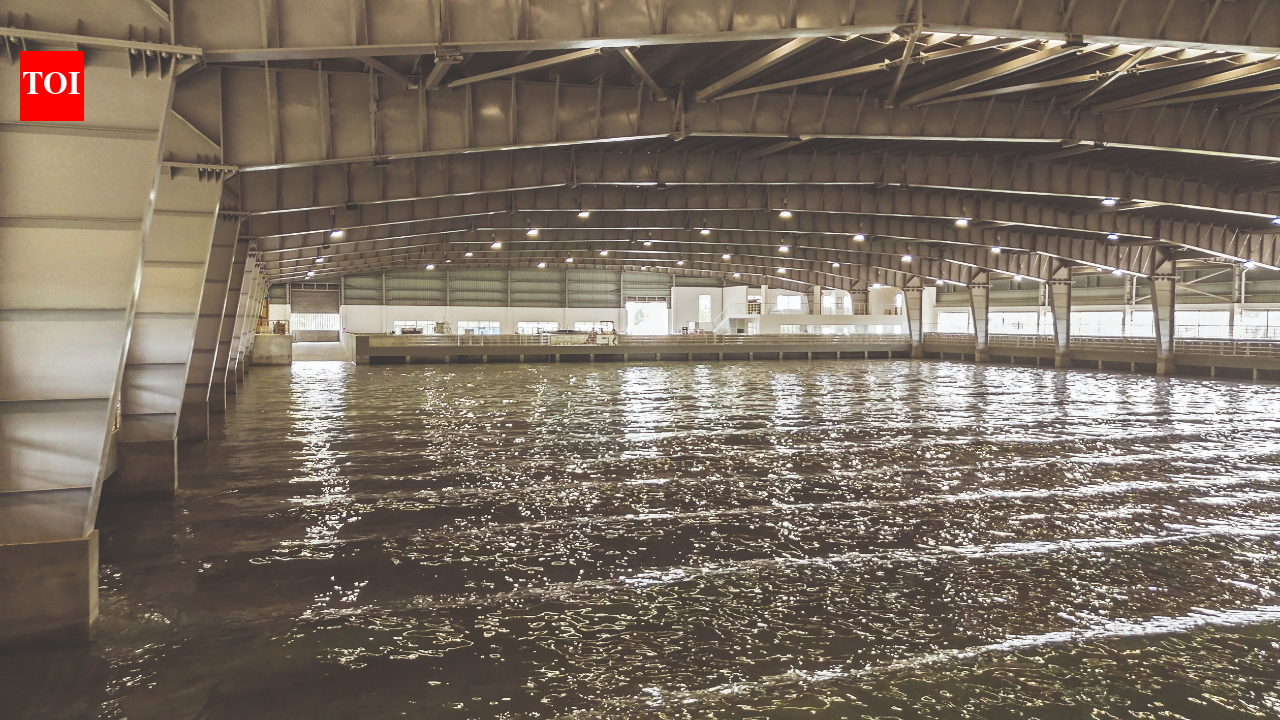
Fifty years ago, on the ground floor of the Centre of Ocean Engineering at IIT Madras, researchers sat in a 2m-deep basin, pedalling for hours to simulate sea waves. The basin, among the earliest facilities at the department, was used to test ship designs and structural stability under varying conditions. In the 1980s, the unique facility was used by the Indian Space Research Organisation (Isro) to test a re-entry vehicle.The facility became a full-fledged department in 1982, and has since grown into one of the country’s leading academic centres for research, development and education in ocean engineering, naval architecture and offshore technology. From 10 students in the UG programme in 1977, the department enrols 70 students in the BTech programme and 600 students in total in all its streams (MTech, MS and PhD).The facility was set up with support from Germany, with a German professor stationed at IIT-M for a year to oversee its development.Now, in its golden jubilee year, the department houses Asia’s largest shallow water basin, 60m wide and 95m long.“The BTech in ocean engineering programme was launched to create a workforce in shipbuilding. Only IIT Kharagpur offers an undergraduate programme in ocean engineering,” says Abdus Samad, head of the department of ocean engineering at IIT-M. “Companies would come to check their designs. We also test offshore structures.”“The department has developed several indigenous platforms for different stakeholders in the maritime area, reducing the dependence on foreign countries,” said IIT-M director V Kamakoti at the golden jubilee celebrations on Tuesday. The celebrations will include year-long academic events, international conferences, industry interactions and alumni engagement programmes. Over the past five decades, the department has helped address real-world challenges in coastal protection, marine infrastructure, and ocean technology, with researchers contributing to several national projects, including port development studies, dredging assessments, and marine hydrodynamics research along India’s coastline. The department’s contributions include scientific and engineering support for the restoration of Vaan Island in the Gulf of Mannar, Lake Chilika in Odisha and an artificial reef system in Puducherry to mitigate coastal erosion.
