



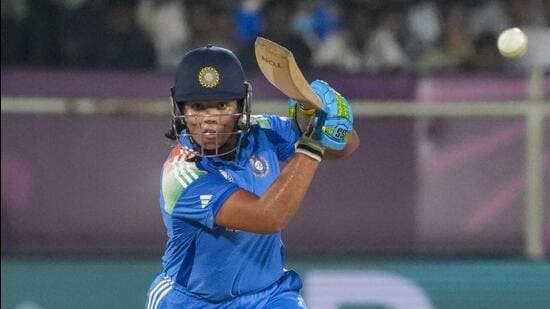
Kolkata: Siliguri is to table tennis what Bhiwani is to boxing and Chennai to chess. So, Richa Ghosh’s route seemed almost predetermined. But one afternoon she made a choice that would land her in the midst of the rapid rise of Indian women’s cricket.
“There was a cricket match at Baghajatin Club in Siliguri,” Richa, 22, recalls in an interview. “Both table tennis and cricket were played there. I said, ‘I want to watch the cricket match.’ I was maybe four-and-a-half. My father got me admitted to the cricket coaching centre.”
Not every stellar career is fuelled by a childhood dream. Sometimes, a little girl getting curious about an unfamiliar game can be a trigger too. With Richa established as one of India’s most destructive wicketkeeper-batters and among the defining players of a fearless new generation aiming to win the T20 World Cup and complete a double (India won the ODI World Cup last November), the story feels almost improbably simple. It was anything easy though.
Opportunities were scarce, infrastructure for aspiring female cricketers was limited, equipment was expensive, and Kolkata – cricket’s nerve centre in Bengal – was nearly 600 km away. This was around the time Wriddhiman Saha – Siliguri’s first international cricketer – was breaking into the India team. The horizons were broadening, but catching up with Kolkata was some time away. Richa wanted to take the plunge anyway.
She couldn’t have done it without her family’s support though, especially father Manabendra, a club-level cricketer who became a part-time umpire. “If I wanted a bat or cricket kit, my father never said no,” Richa says. “Even when it was difficult financially, my family never let me feel it.”
Sometimes they would hear about trials only a day before it is held. Somehow a ticket for travel would be arranged because every opportunity mattered. Years later, after international caps and franchise contracts, Richa still traces her story back to those moments when showing up mattered the most. “If my father hadn’t been with me, I wouldn’t be sitting here giving an interview,” she says.
Richa though had the game to justify the confidence of her backers. It was gained mainly through competing against older players. Be it at the academy, for Bengal or for India, she often found she was the youngest player in the dressing room. For Richa, it was an education. The age gap forced her to mature fast. She observed, listened and learned.
Among those who made the transition easy was Jhulan Goswami, starting with the Bengal team. “Jhulan di took care of me like a child,” Richa says. Harmanpreet Kaur and Smriti Mandhana took that place when Richa started to play regularly for India. “When I first came to the India team, I didn’t know what to do,” Richa says. “Harry di and Smriti helped me understand how to stay in the team and face every challenge.”
Those lessons went beyond technique, preparing her for a professional career, understanding what separates talented cricketers from lasting international careers.
If the India team accelerated her development, franchise cricket – including stints in Australia and England – gave more perspective. Then came the Women’s Premier League (WPL), giving a chance to interact with elite overseas talent daily. At Royal Challengers Bengaluru, Richa watched Ellyse Perry and Sophie Devine from close, giving her insight no coaching manual can. “I learned how Sophie builds an innings despite being a power-hitter,” she said. “I learned from Ellyse how to construct an innings when wickets fall and how to finish games.”
With time, every match and season became part of a growing catalogue of knowledge. To internalise everything wasn’t easy, especially with Richa keeping wicket as well. So, to prepare, she recreates pressure situations during training. “I create scenarios in practice. I tell myself I need a certain number of runs in a certain number of balls. I create that pressure mentally.”
Every practice session has a purpose, every challenge is rehearsed before match day. Her development as a finisher is a work in progress, but she embraces it wholeheartedly, even if it means travelling with a city-based academy team to far-flung places. Add to that the tenacity to face bowlers from every age category since she was a junior.
MS Dhoni is an inspiration too. “It takes a lot of preparation, but instinct helps. If I feel I should hit the ball, it’s better to hit it.” It’s this instinct, backed by a lot of training, that Richa hopes will help scale newer heights in the T20 World Cup.
Memory of the 24-ball 34 in the 2025 ODI World Cup final should be enough to validate Richa’s mettle. But scores of 12 and 1 in the defeats to New Zealand and Australia that knocked India out at the 2024 T20 World Cup means Richa has unfinished business in England. In seeking that high, she builds a story that will inspire more girls to dream big.
Catch all the action from ICC Women’s T20 World Cup 2026, June 12-July 5, LIVE on JioHotstar and Star Sports Network


