


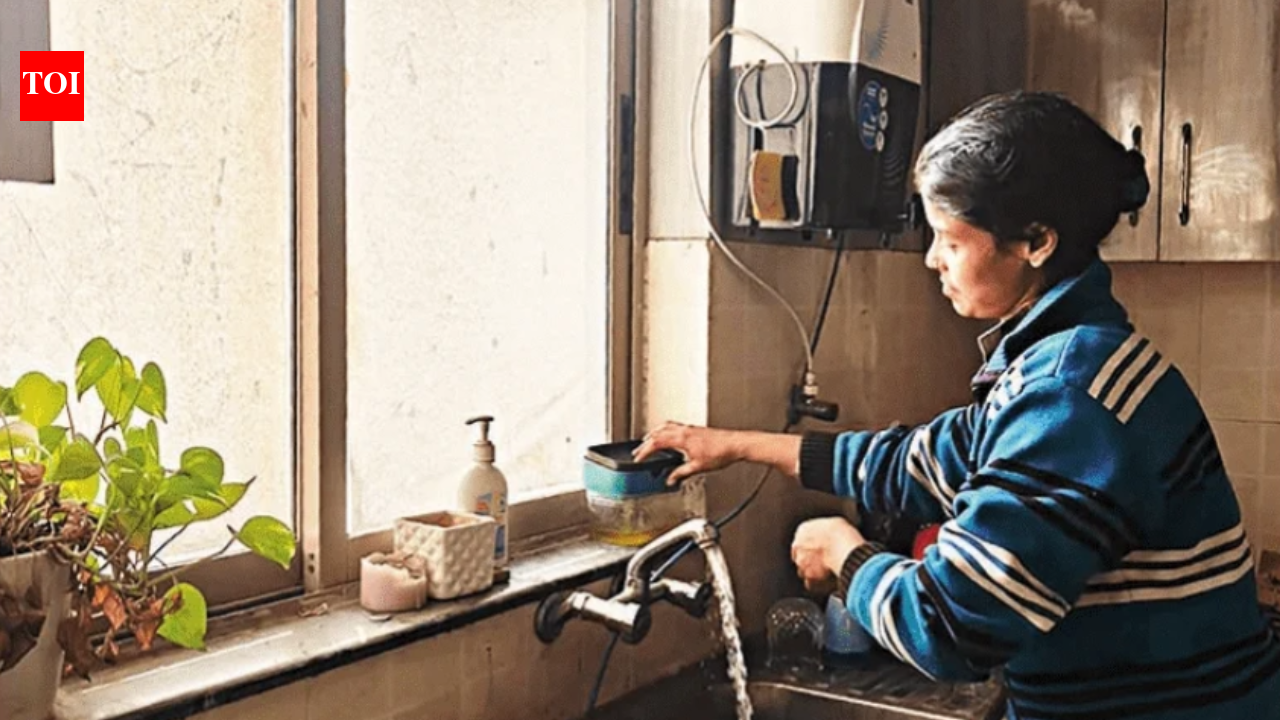
The dreaded text that heralds the arrival of manic Monday two hours early was sitting there before the morning alarm went off. It was from Swapna’s domestic helper of several years: “Didi main aj nahin aungi (Didi, I won’t be coming today)”This would, normally, mean panic stations in the house – rush to the kitchen, rush to catch the schoolbus, rush back to make breakfast, rush out again to catch the office shuttle, and finally, slump into the office chair as if it were Friday afternoon. “Two months ago, this would have ruined my day,” says Swapna, an education consultant living in a housing society in Noida’s 7x. “But I’ve discovered the 10-minute help,” she adds.For Swapna, instant maid services – where one can get a helper for anything from doing the dishes to laundry and cutting vegetables and fruits as quickly as a grocery order – have changed how she views the crisis of her regular helper taking an unannounced day off. “Even if my regular worker doesn’t turn up, my routine doesn’t collapse. Although she knows the nitty-gritty of my household, the apps help get the work done,” she says.Across NCR and India’s major metros, the gig economy’s latest 10-minute business model – comprising nearly an all-women workforce – is fast altering the oldest of urban work models: the house help.The services, offered by aggregators like Snabbit, Pronto, both based in Bengaluru, and Insta Help by Gurgaon-based startup Urban Company, are swiftly gaining traction, most evident in groups of women in pink or green uniforms standing, phones in hand, in market common areas, inside parks, next to auto stands, under flyovers and near housing society gates, all serving as pop-up office.How this gig works“This is my office,” says Kajal, who has been reporting to work at a bus stop in Noida Sector 70 at 7am for the last two months, since she enrolled with Snabbit. “I log in and reach the bus stop. Bookings come from nearby societies. But sometimes, they can be from a place 2km away, and then I need to run,” says Kajal. In her late 20s, the Noida resident who sold fruits till last year says she has found the work to be physically demanding but the income is much more than she ever had. Kajal says she has been earning around Rs 27,000 a month since she became an ‘instant help’.In Gurgaon, 20-year-old Nandini Paswan says she is happy about “upgrading” from daily wage work to a “job” that she goes to daily. Nadini underwent five days of training at a Snabbit hub in Nathupur before starting work in Sector 57. “After finishing one job, I return to my designated spot and wait for the next booking,” she says. This spot has a rider service that drops off Nandini and others at societies the bookings come from.Compared to Nandini, Vishnu Priya (31) is a veteran, having worked for years as a domestic helper in Gurgaon. “But I never earned more than Rs 10,000-12,000 a month and couldn’t send much back to my family in West Bengal.” The remittance has jumped up since she enrolled with an app. “I don’t want to work that traditional way anymore. I’m earning around Rs 25,000 a month and have completely shifted to app-based work now. And I get respect because I wear a uniform,” she says.Nasreen Khatoon (23), who moved from Sitamarhi in Bihar to Gurgaon a year ago with her husband and daughter, now 2, has hopped platforms to grow her income. “I am not educated but I am working to ensure that my daughter can get an education,” she says. “I joined Pronto and earned Rs 10,000 a month. Then I left and joined Urban Company as they were giving me Rs 25,000 for a month,” she says. Sujata Giri (20) learnt about app-based house work from a friend. The Class XII passout lives on rent in Tigra. “I work from 9am-3pm every day. I am earning around Rs 25,000,” she says. “If I don’t earn, then I’ll have to get married and work at someone’s place with no salary. Then I won’t be able to help my family either.” Why there is demandIt’s still early days in this gig model but there is no dearth of work for those taking the plunge as app-based labour platforms tap into evolving lifestyles — longer work hours, smaller families, rising number of people living alone, and varying domestic work needs. For students and young professionals, especially, app-based house helps bring something that traditional domestic work often cannot: on-demand access without long-term commitment. “I leave early and return late. I generally eat lunch and dinner at the university. Paying Rs 2,000 a month for a regular help doesn’t make sense to me,” says Subhranil Mukherjee, a PhD scholar from Jamshedpur currently doing fieldwork in Delhi-NCR. Mukherjee, who has rented a flat, says household chores tend to get postponed indefinitely due to his hectic schedule. “Sometimes, my unwashed utensils sit in the sink for days. With these apps, I call someone 2 or 3 times a week. It costs me around Rs 100 per visit, which is around Rs 800 a month.”When Ritu Sharma (35) shifted from Indore to Gurgaon with her husband and two children last year, her biggest worry wasn’t the relocation but finding a reliable house help. The solution came from an unlikely avenue – an app. “I saw an advertisement in Sector 57, where we live, to try the app. It worked. Now, when I book, I ask for the same person each time. Both of us are now familiar with each other and I don’t have to repeat instructions. I am finally trying to make Gurgaon my home,” she says. Through standardised pricing, a rating system and early incentives, the apps have been able to enrol thousands of women into their workforce, focusing on dense urban clusters such as Delhi-NCR, Mumbai and Bengaluru, where demand for instant services is high and so is availability of labour because of migration.A Snabbit local coordinator explains that the pop-up offices, which they call ‘hubs’, are temporary and set up based on demand, accessibility and safety. “If bookings increase in an area, we create more hubs. Sometimes, we shift hubs to other places,” he says.Snabbit’s on-ground operations are structured around area team leaders, who act as supervisors for house helpers. “My job is to check their location and uniform, and I also log reports of any incidents,” says Atul Agarwal, a team leader posted in Noida. Agarwal says his job is to also ensure the safety of workers. “There was once an incident when a family was abusive to one of our staff. We reported it to the police and later the family apologised,” he says.What’s pulling in workersWhat has helped draw the workforce is the promise of a decent income. In the early months, reality appears to have lived up to the promise. The payment system varies across platforms and contracts, ranging from a fixed monthly salary to daily earnings and incentives.“If I log in early, I get Rs 20 extra,” explains Ujala, a Snabbit worker. “If I refer someone, I can earn Rs 3,000-Rs 4,000 per referral. Weekends pay more. On weekdays, I typically earn around Rs 800 a day. On weekends, this can go up to Rs 1,020. I can also choose the shifts — 6, 8, 10 or 12 hours. If I work a longer shift, I earn more.” Diviya Singh, who works with Pronto, earns a fixed monthly salary of Rs 24,000, besides variables from jobs she completes each day. A resident of Sangam Vihar in south Delhi, her work areas are the neighbourhood of Greater Kailash, Chittaranjan Park and Kalkaji, allowing her to manage her commute easily. “The best part is that even if I don’t get a single booking in a day, I receive my monthly salary,” she says. According to Urban Company, joining a formal platform opens access to benefits that informal domestic work does not offer. “Life accidental cover would be about Rs 10 lakh, while health insurance would be in the range of Rs 50,000 to Rs 1 lakh with OPD consultations bundled in,” says a company representative, adding that workers can also apply for personal loans through NBFC partnerships, reducing dependence on private money lenders.Where the discomfort isOn the flipside are the model’s gruelling demands, sometimes punishing physical strain, penalties, and the perpetually unfamiliar work setting, which brings with it safety concerns unlike the comfort zone of a fixed employer’s house in the traditional model. “Crossing roads is risky when I’m in a hurry. I’m always running to meet the 10-minute deadline. Even if the distance is longer, I cannot refuse a booking,” says Pooja. Refusing a booking can result in pay deductions.“Most customers are nice. But there are risks too. During training, I was instructed to keep my phone with me at all times. The app has an SOS button (answered by the coordinator or supervisor) and emergency helpline. If I feel unsafe, I’ve been told to leave immediately,” says Priyanka, a Pronto worker in Noida.Pronto founder and CEO Anjali Sardana says the work model has brought a sense of agency. “In the offline world, domestic workers often have no protection. If they stand up for themselves, they lose their income. The app has multiple safety layers—SOS systems, emergency helplines, and local response teams for on-ground intervention. There are no consequences for reporting incidents,” Sardana told TOI. “We launched the app in Gurgaon in April last year. In Sept, we launched in Noida, and in Nov, in Delhi. So far, there are over 2 lakh users from these three cities. In NCR, there are around 50 hubs, including 10 in Noida, 18 in Delhi and 15 in Gurgaon. We plan to expand.”Urban Company says it has a 24×7 partner helpline, chat support and ‘feet-on-ground’ teams if assistance is required, and that it does not operate late-night jobs. A Snabbit representative says the platform gets around 20,000 bookings in a single day across all metro cities presently. “A majority of the bookings are made from Delhi NCR, followed by Mumbai and Bengaluru.” The company, according to the representative, operates on a “nano-market” strategy instead of pin codes. “Our ecosystem is as granular as two dense apartment clusters near each other. Workers don’t congregate at a single spot. They log in from home, and the first job is assigned based on their location. Between two jobs, the distance is usually 100 to 300 metres.”
