



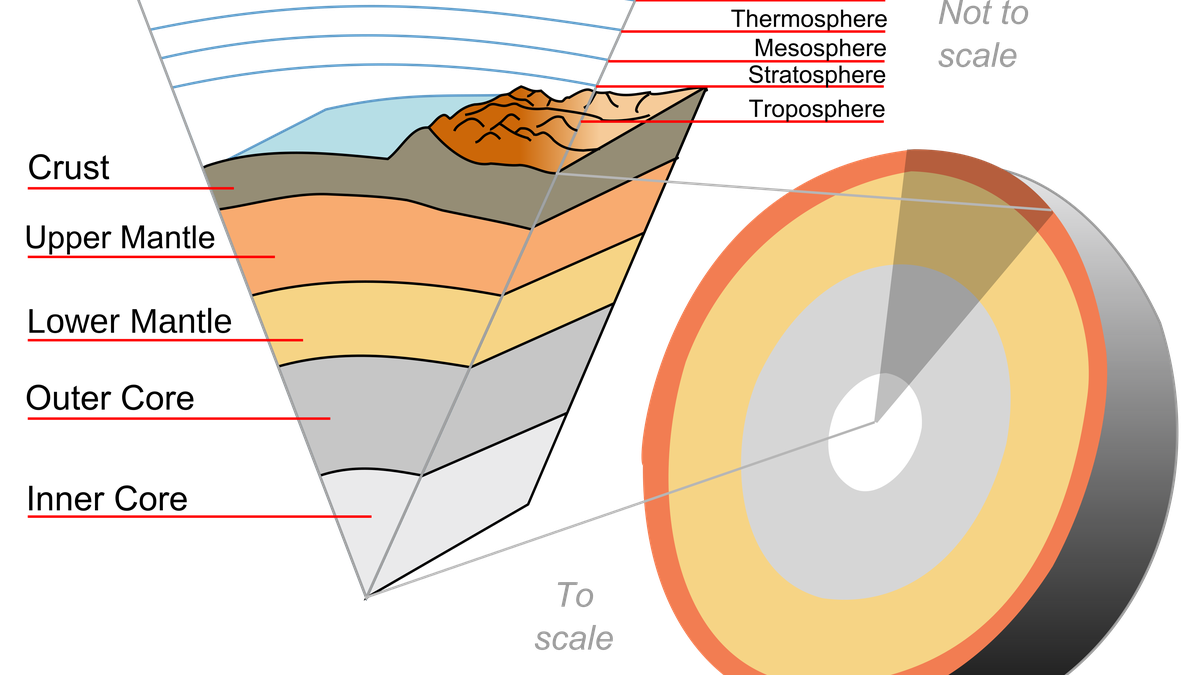
An infographic depicting the earth’s geophysical layers.
| Photo Credit: Surachit (CC BY-SA)
A: The earth’s outer core is a voluminous liquid layer that lies around 2,800 km beneath the surface. This hot, churning sea is filled with molten iron and nickel.
As the outer core moves constantly, it acts like a large generator, creating the planet’s magnetic field, which shields the earth from harmful solar radiation.
Researchers from the University of Edinburgh and the British Geological Survey have reported that around 2010, the liquid iron in the outer core below the equatorial Pacific Ocean changed direction from a slow westward crawl to a more rapid eastward surge.
They found this after mapping 27 years of iron movement in the outer core using data from ground stations and four European satellites.
When they analysed the data, the team identified two important patterns in the flow. The main pattern accounted for 95% of the movement: it consisted of a steady flow westwards — which also explains why the earth’s magnetic field has historically drifted west.
The second pattern revealed the dramatic shift in 2010. The researchers also found that this shift began to weaken around 2020.
The researchers were able to link the 2010 reversal to seismic and geodetic shifts in the earth’s solid inner core. According to their model, the flow is also roughly 10% lopsided between the northern and the southern hemispheres.
These details could explain sudden ‘jerks’ in magnetic field readings and suggest that deep-earth liquids can change direction much faster than the traditional theory predicts.
Published – May 24, 2026 11:08 am IST


