


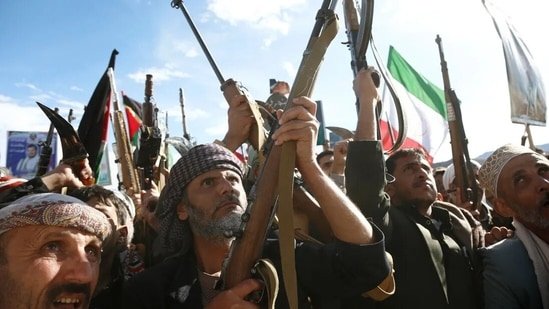
The Houthis of Yemen are often described as a Shia militia or an Iranian proxy. Such labels capture only a fraction of a far more complex reality. The movement is rooted in Yemen’s distinctive Zaydi tradition, shaped by historical grievances, theological contestation, social hierarchy, and state failure — and today sits at the intersection of regional geopolitics and global trade disruption.

Their rise reflects a continuum of struggles within Islam and Yemen — over legitimacy, leadership, and resistance. The origins lie in the earliest dispute after the Prophet’s death: Whether leadership should be based on community consensus (non-hereditary) or hereditary lineage. The advocates of consensus prevailed, and their followers came to be known as Sunnis, while those who supported Ali ibn Talib — the Prophet’s nephew and son-in-law — based on lineage later became known as Shias. The subsequent heroic martyrdom of Husayn, the second son of Ali, at Karbala, presently in Iraq, transformed this political dispute into a moral narrative of injustice, resistance, and sacrifice.
Subsequent disputes among his descendants further fractured Shia Islam. Zaydism, one such branch of Shiism to which the Houthis belong, followed Zayd ibn Ali, the great-grandson of Ali and the grandson of Hussayn and developed a distinctly activist doctrine: The Imam was not merely hereditary but one who must rise against unjust rulers. Resistance thus became a source of legitimacy. The Houthis’ emphasis on struggle is therefore not an aberration but an inheritance of Zaydi political thought, like the Twelver Shi’as of Iran.
For over a millennium, Zaydi imams exercised intermittent rule in northern Yemen, particularly in the Sa’dah region, with the sada (plural of Sayyid) — a hereditary elite claiming descent from the Prophet — at its core. The 1962 republican revolution abolished the imamate and sought to build a modern, non-sectarian State, but failed to ensure inclusive governance. Power shifted to tribal elites and military networks, marginalising traditional Zaydi regions. At the same time, Saudi-backed Wahhabi-Salafi influence challenged Zaydi identity and hardened what had been a relatively fluid sectarian landscape.
Zaydism itself had never been monolithic. The legal teachings of Yahya ibn al-Husayn served as the basis for the Zaydi Hadawi school of law. Owing to its doctrinal proximity to Sunni jurisprudence, it is sometimes described as a “fifth school” alongside the four Sunni schools of jurisprudence (madhhabs). From the 18th century, scholars such as Muhammad al-Shawkani sought to reconcile Zaydi and Sunni doctrines, diluting core principles such as the obligation to revolt against unjust rulers and the centrality of the sada. This Sunni-isation blurred sectarian boundaries but weakened the distinctiveness of classical Zaydi thought and the traditional dominance of the sada.
The Houthis (Ansar al Allah) emerged partly in response to this erosion. They framed themselves as defenders of ‘authentic’ Zaydism, linking it to contemporary grievances — inequality, state neglect, and external intervention. Yet this revival carries a paradox. Classical Zaydism emphasised religious pluralism and interpretive flexibility. Still, the Houthi movement has centralised authority and elevated the teachings of its founder, Husayn al-Houthi, known as Malāzim, as a core ideological canon. Critics, including many traditional Zaydis, argue that this represents a departure from Zaydi tradition rather than its restoration.
A key turning point came with the second Palestinian intifada in 2000. An incident in which a child was killed in his father’s arms became a powerful symbol, invoked by Husayn al-Houthi to frame a narrative of resistance. This was encapsulated in the slogan (Shi’ar): “God is great, death to America, death to Israel, curse on the Jews, victory to Islam.” The slogan transformed local discontent into a global ideological frame and aligned the movement with a broader anti-western and anti-Israeli discourse.
The ‘war on terror’ following September 11, the invasion of Afghanistan, Yemen’s alignment with the West, and State repression together transformed this revivalist movement into a formidable insurgency force. In 2004, President Ali Abdullah Saleh’s attempt to arrest Husayn al-Houthi triggered a conflict that led to his death and six Sa’dah wars (2004–2010). Under Abdulmalik al-Houthi, the movement survived and evolved into a disciplined insurgent force. These wars eroded traditional tribal mechanisms of conflict resolution, intensifying violence and giving it a more ideological character.
The collapse of authority during the Arab Spring provided an opportunity for expansion. Previously divergent Zaydi factions found temporary convergence against political marginalisation and external influence, broadening the Houthis’ base. By 2014, they had seized Sana’a, the capital of Yemen, transforming themselves from a regional movement into a national power centre.
Subsequent developments demonstrated their resilience. The Saudi-led intervention (2015–2022), backed by the US and its allies, failed to dislodge them despite prolonged military operations. External intervention, rather than weakening them, reinforced their narrative of resistance, eventually forcing Saudi Arabia to seek disengagement. This underscores a critical reality: Militarily superior forces often struggle to defeat movements deeply embedded in local society and sustained by ideology.
Although Houthi Shias differ ideologically from Iran’s Twelver Shi‘as, shared narratives of grievance, resistance, and opposition to the West and Israel — alongside support for the Palestinian cause — have aligned them with Iran, a convergence reinforced by Saudi Arabia’s campaign against them. Like Hezbollah, their support for Palestine broadens their appeal beyond sectarian lines, challenging Sunni–Shia binaries and exposing Arab regimes seen as accommodating western and Israeli interests. Their threats to act in support of Iran further underscore this fusion of local and regional dynamics.
Geography amplifies their significance. The Houthis control territory overlooking the Bab al-Mandeb Strait, a critical maritime chokepoint connecting the Red Sea to the Indian Ocean, through which roughly 10–15% of global trade passes. Their ability to disrupt this route elevates them from a domestic actor to a global concern. Their earlier attacks on commercial shipping have forced vessels to reroute around the Cape of Good Hope, increasing costs, delaying supply chains, and contributing to inflationary pressures worldwide. Any further escalation in the ongoing conflict could disrupt the Bab al-Mandeb, deepening strains on an already fragile global economy and carrying particularly serious implications for India.
Their rise reflects a pattern: When political systems fail to accommodate diversity and external pressures deepen fractures, theology fused with resistance breeds resilient movements. By controlling territory overlooking a vital maritime route, the Houthis have moved from Yemen’s margins to the centre of global strategic concern.
This article is authored by B Bala Bhaskar, former ambassador and specialist in West Asia.
