


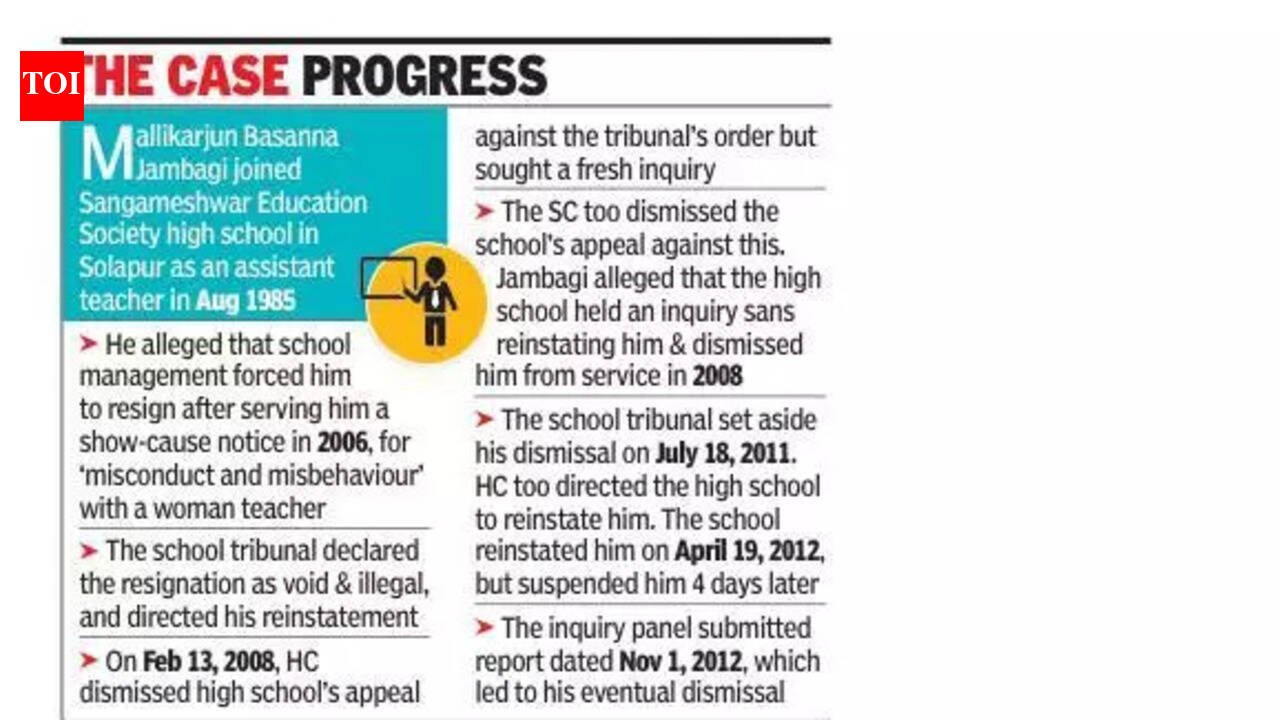
Pune: The Bombay high court’s Kolhapur bench has quashed and set aside Solapur School Tribunal’s order of Nov 25, 2013, that rejected a teacher’s appeal against his dismissal from service on Nov 2, 2012, by a high school in Solapur for ‘misconduct and misbehaviour’ with a woman teacher. The bench of Justice Vrushali V Joshi cited multiple flaws in the inquiry proceedings and violation of rules while directing that the teacher, now retired, was “entitled to continuity of service and to receive back wages, along with all pensionary and other retiral benefits, as admissible under law, treating the service of the petitioner as continuous for all purposes.” On a request by the advocate representing the high school, the bench directed a stay on its order for four weeks to enable the educational institution to approach the Supreme Court against the HC’s latest order. “In the latest round, the inquiry committee did not make any order or recommendation of specific action to be taken. As such, there was non-compliance with the Maharashtra Employees of Private Schools (Conditions of Service) (MEPS) Rules, 1981,” advocate Abhijeet A Desai, who represented petitioner Mallikarjun Basanna Jambagi, told TOI. Jambagi joined Sangameshwar Education Society high school in Solapur as an assistant teacher in Aug 1985. His case is that the high school management forced him to resign and accepted his resignation after serving him a show-cause notice on April 1, 2006, for ‘misconduct and misbehaviour’ with a woman teacher. The school tribunal declared the acceptance of his resignation as void and illegal and directed his reinstatement. On Feb 13, 2008, the HC dismissed the high school’s appeal against the tribunal’s order but asked the management to conduct a fresh inquiry. The SC too dismissed the school’s appeal against this. Jambagi alleged that the high school then conducted a purported inquiry without reinstating him and dismissed him from service on March 30, 2008. Once again, the school tribunal set aside his dismissal on July 18, 2011, citing that an inquiry committee was not constituted as per the MEPS Act and Rules. The HC too directed the high school to reinstate him and proceed in accordance with law. The high school reinstated Jambagi on April 19, 2012, but suspended him four days later and initiated an inquiry with undue haste and violation of MEPS Rules. Jambagi contended that affidavits from the previous inquiries were mechanically relied upon without affording any opportunity for examination-in-chief. He was denied the right of cross-examination, and the inquiry committee submitted its report dated Nov 1, 2012, which led to his eventual dismissal. Justice Joshi observed that the inquiry proceedings were conducted in a manner that was “neither fair nor transparent” as no proper notice, effective hearing, or reasoned and speaking order was passed. “The very object and purpose of the MEPS Rules, which is intended to provide procedural safeguards and ensure fairness in disciplinary proceedings, stands defeated,” the bench said. “The failure to comply with the mandatory provisions of Rule 37(6), Rule 37(2)(d), and other relevant Rules, has vitiated the entire inquiry, rendering it non est in the eyes of law,” the bench said. The high school management sought to justify Jambagi’s dismissal on the grounds that he had been convicted in a parallel criminal proceeding before a magisterial court with regards to the misbehaviour incident. The petitioner, however, said his appeal against this conviction was pending final decision before the sessions court. Justice Joshi cited SC rulings and said “The criminal proceedings before the sessions court and the departmental inquiry are distinct, independent proceedings, governed by different procedures, standards of proof, and statutory requirements. The subsequent conviction in the criminal case can neither retrospectively validate the termination order passed earlier, nor can it absolve the management from complying with the mandatory procedural safeguards enshrined in the MEPS Rules, particularly Rule 37(6).“
