



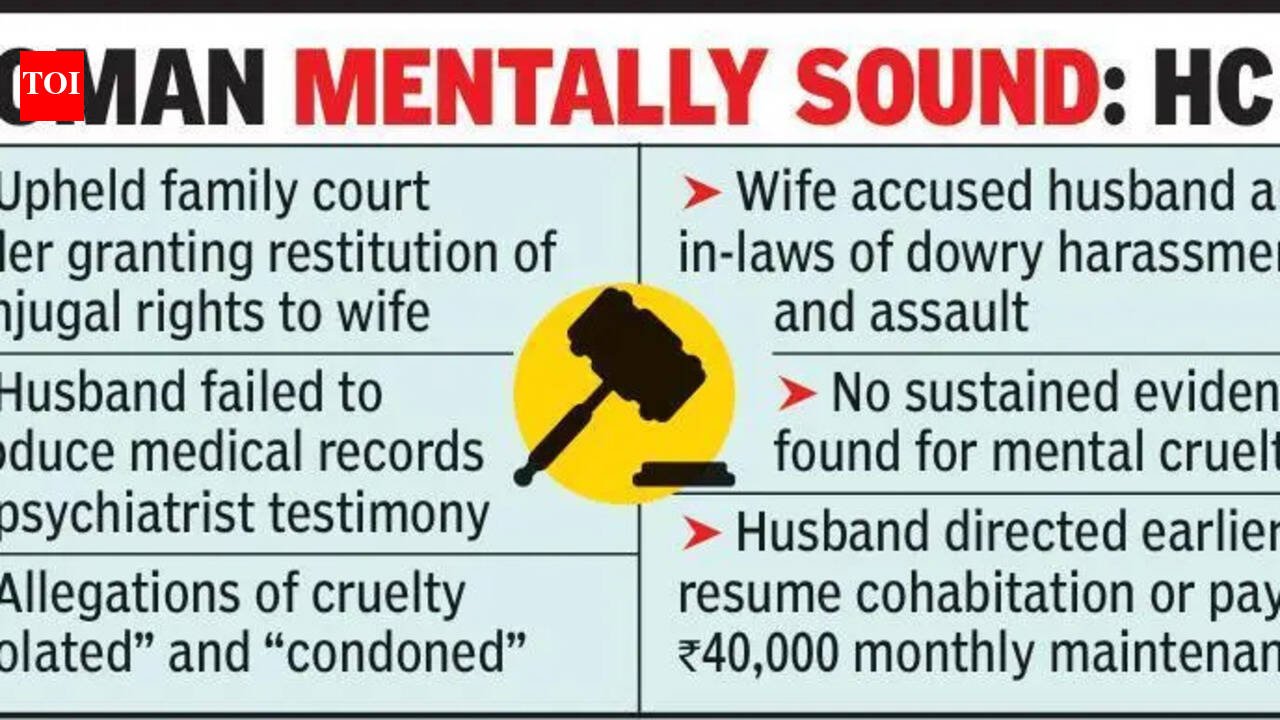
Nagpur: A wife completing a postgraduate degree in medicine after separation is “a clear indication” she is not mentally unsound, the Nagpur bench of the Bombay High Court observed recently as it rejected an IPS officer’s plea for divorce on grounds of mental cruelty and alleged mental disability.A division bench comprising Justices Mukulika Jawalkar and Nandesh Deshpande dismissed the appeal challenging a family court order that refused the IPS officer divorce and instead granted restitution of conjugal rights in favour of his wife, who is a teacher in Amravati.The applicant alleged that his wife displayed erratic behaviour, attempted suicide, damaged household articles, assaulted him during his posting in Delhi and later in Mizoram, and suffered from psychiatric illness. He also cited the wife’s criminal complaint under Section 498A of IPC, which was later withdrawn after a compromise, as an act of mental cruelty.The wife refuted all allegations and accused the husband and his family of dowry harassment, physical assault and emotional abuse. She alleged that she was pressured for money soon after marriage, assaulted during pregnancy, and deliberately admitted to a psychiatric ward in Mizoram to falsely portray her as mentally unstable. The family court in Jan 2023 dismissed the husband’s divorce petition and allowed the wife’s plea for restitution of conjugal rights. It directed the husband to resume cohabitation within a month, failing which he would have to pay Rs40,000 per month as maintenance from March 1, 2023, which he challenged in HC. The HC judges noted several admissions made by the IPS officer during cross-examination. The bench observed that he admitted there was no documentary evidence showing psychiatric treatment of his wife. “There is no material on record to show that the wife has undergone psychiatric counselling as alleged,” they said.The court further held that many allegations cited by the husband were either “stale or isolated” incidents and stood condoned because the couple continued cohabiting afterwards, including the birth of two children after several of the alleged incidents.“The consistent course of conduct by the erring spouse should be of such a nature that the other one should not be reasonably expected to live with him/her,” the bench said, adding that no such sustained conduct was proved. The judges also observed that the husband made no effort to seek custody of the children or attend their school meetings since 2013, when the couple began living separately. Concluding that the family court’s findings were based on “cogent reasoning” and proper appreciation of evidence, the bench confirmed the lower court’s decree.


