


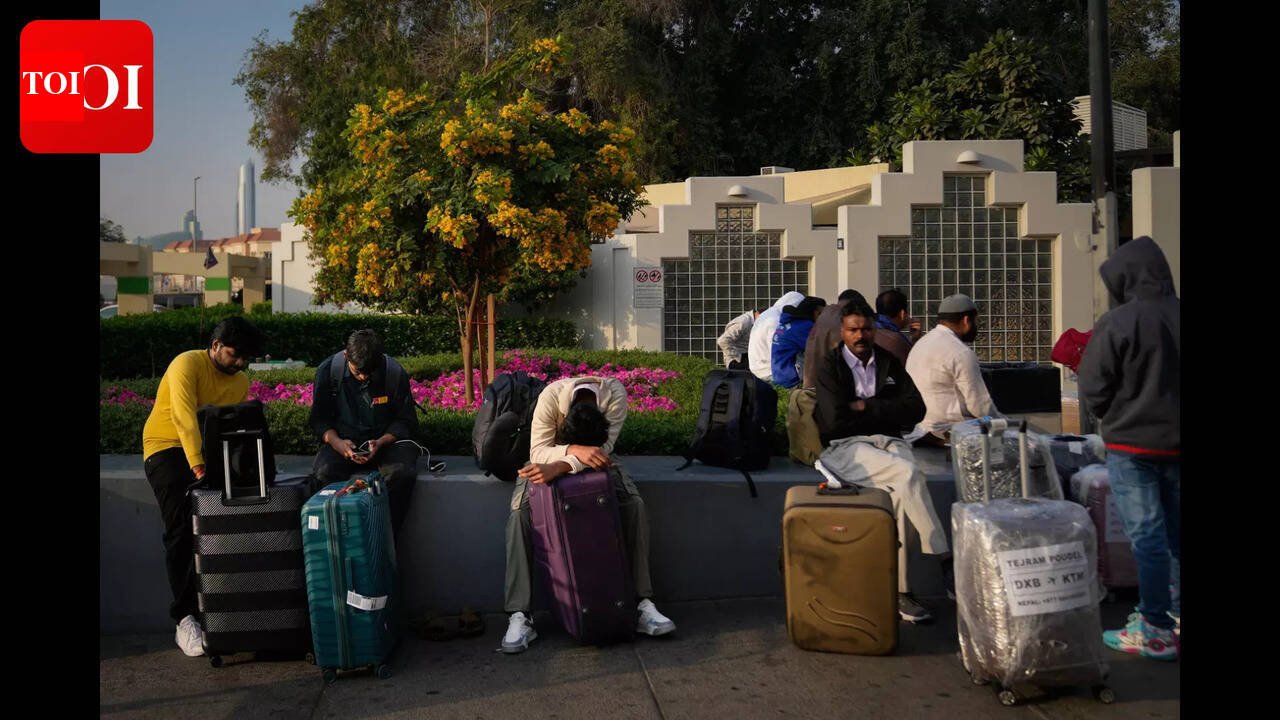
Panaji: The joint Israeli-US military strikes on Iran and the retaliatory Iranian bombing of US bases across the Gulf threw Goa’s substantial expatriate community into a state of shock. Goans in Dubai, Sharjah, Abu Dhabi, Kuwait, Qatar and Israel watched drones and missiles shoot across the sky, airport closures, and debris from intercepted missiles falling near residential areas.While most Goans remained safe, some found themselves trapped at airports and in hotels, desperate to find a way home to safety. The crisis stranded travellers, forced residents indoors, shut workplaces and left those on pilgrimage unable to return.
Among the most dramatic near-misses was that of 60-year-old John Desa, who was already on the aerobridge at Goa International Airport at Dabolim, five passengers away from boarding an Air India flight to Mumbai for a connecting flight to Qatar, when he received a call informing him that Qatari airspace was closed.“I informed the airline staff, they cross-checked and offloaded me, or I would have got stuck in Mumbai,” Desa said. His baggage had to be retrieved, delaying the flight by 15 minutes.In Dubai, Abida Fernandes, who works in marketing and advertising, described watching missiles fly over her neighbourhood. “I saw it flying over as well and it is getting a bit worrying. Almost all the missiles have been intercepted, but there is debris falling from the explosions,” she said.A group of Goan friends travelling back to Goa on Saturday were forced to turn around and return to Sharjah after Dubai International Airport was struck. Fernandes said a friend from Morjim was very close to the first interception point, as a US base was located directly behind her office. “Palm Jumeirah and Burj Khalifa are not near the US base, which means the drones have gone beyond their targets,” she added.Ida Braganza, also based in Dubai, said staff were asked to work from home until Wednesday. “It is mostly the iconic structures that are being targeted. So far, all the missiles have been intercepted, causing negligible damage and mostly only debris,” she said.In Abu Dhabi, Tony Gomes, who lives with his wife and infant children near the Abu Dhabi airport and a US military base, said Saturday was frightening but Sunday turned quieter. “We get alerts from UAE govt when there is a missile interception,” he said, adding that the impact among Gulf Cooperation Council countries was felt most severely in Doha and Bahrain.In Kuwait, Martino, a resident of Azzosim, reported a direct strike on the facility. “All are safe here but the conditions are not really good because the airport is close to us,” he said.In Israel, Goan musician Seby described a tense existence of repeated runs to the shelter. “It’s worrying what’s happening around us. We have to go all the time into the shelter room whenever there is a siren,” he said.Perhaps the most precarious situation belongs to Fr Ceynon Fernandes, a priest on a pilgrimage through Egypt, Jordan and Israel, whose return flight is booked out of Tel Aviv — an airport that remains closed amid the conflict. Currently in Sinai and due to enter Jordan, he said he was hoping the situation would improve before he needed to fly home.Indian govt and Goa’s NRI commissioner Narendra Sawaikar are in touch with Indian nationals and Goans in the affected region. “I got calls from many people, Goans who are there. They are all safe. The situation does not warrant panic. If there is an issue, they can connect with the NRI commission office or the embassy, particularly if someone is stranded,” said Sawaikar.
